Small kitchen appliances — blenders, kettles, air fryers, coffee makers — are some of the most popular categories importers source from China, but they’re also among the most heavily regulated. A single missing certification can get your shipment held at customs or your listing pulled from a marketplace.
This guide walks through the certifications that actually matter, how factories handle them, and what to check before you place a deposit.
Which Certifications Do You Actually Need?
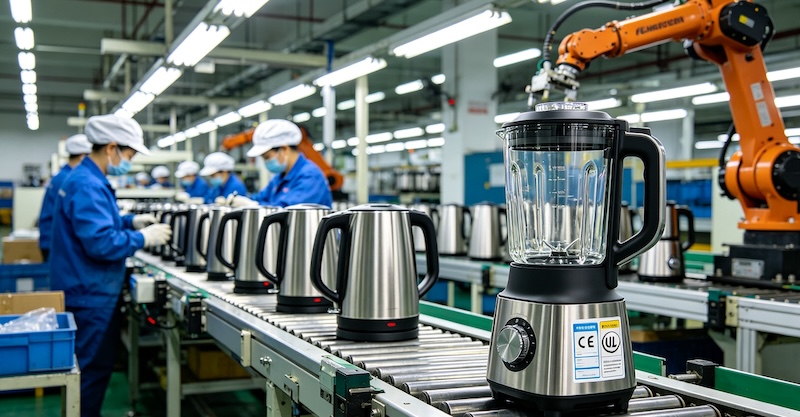
The certification you need depends entirely on your target market. Selling in the US generally requires UL or ETL listing for anything with a heating element or motor, plus FCC certification if the product has any wireless or electronic control components. The EU requires the CE mark, which for appliances typically bundles the Low Voltage Directive (LVD), EMC Directive, and RoHS compliance.
Germany and a few other EU countries also expect the GS mark (Geprüfte Sicherheit), which is a voluntary but widely trusted safety certification that goes beyond the baseline CE requirements. If you’re selling on Amazon Germany specifically, GS certification can meaningfully improve buyer trust.
- UL/ETL — required for US electrical appliances
- FCC — required for anything with wireless or digital controls
- CE (LVD + EMC + RoHS) — required for the EU market
- GS mark — recommended for Germany and DACH region sales
- CB Scheme certificate — useful if you plan to certify in multiple countries at once
Working with Factories That Already Hold Certifications
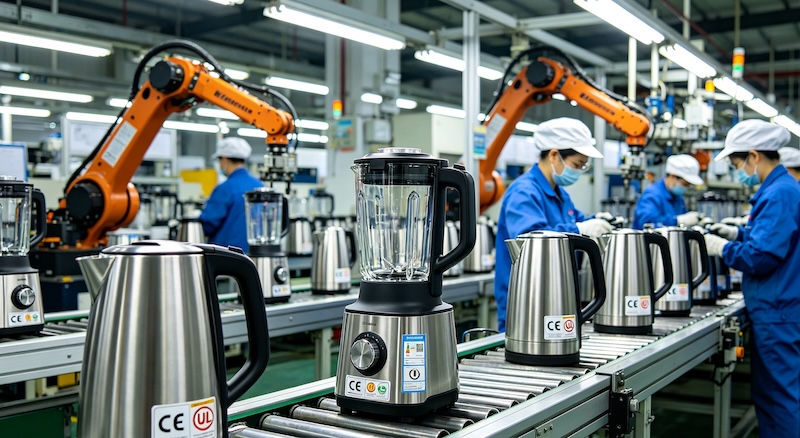
The fastest and cheapest path is finding a factory that already manufactures a similar product under an existing UL or CE certificate. Ask directly: “Do you have an existing UL file number for this product category?” If yes, adding your private label to that file is usually far cheaper than certifying from scratch.
If the factory has never exported to your target market, budget for a full test cycle. Expect 4-8 weeks and several thousand dollars for a first-time UL listing, depending on the appliance’s complexity.
Heating Element and Motor Safety Testing
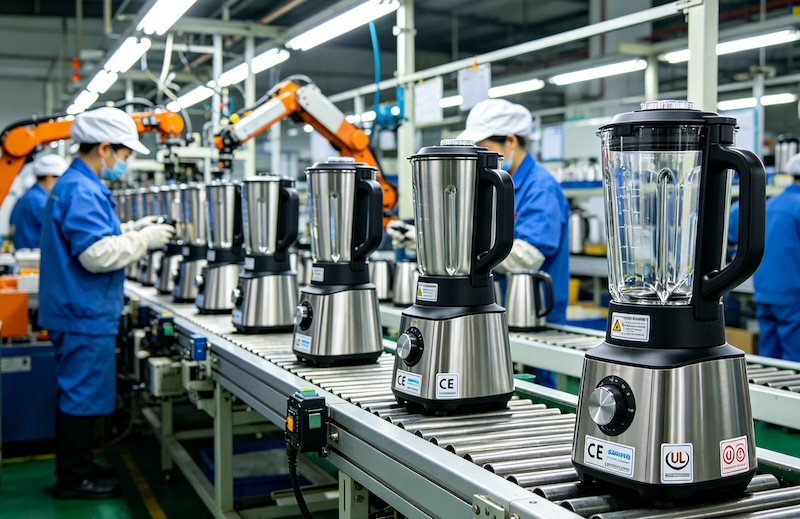
Appliances with heating elements (kettles, rice cookers, air fryers) undergo additional scrutiny for thermal cutoff performance, insulation resistance, and leakage current. Motorized appliances (blenders, mixers) are tested for overload protection and blade guard safety.
Ask your factory or a third-party lab for the test report on thermal cutoff switches specifically — this is one of the most common failure points in kitchen appliance recalls.
Packaging and Labeling Requirements
Beyond the product itself, your packaging needs the correct safety warnings, voltage/wattage ratings, and certification marks printed clearly. US-bound appliances need a UL mark that matches your actual file number — printing a UL logo without a valid listing is a serious compliance violation, not just a labeling mistake.
Frequently Asked Questions
Can I use a generic UL mark without my own certification file?
No. Every UL mark must correspond to a specific file number tied to a tested product. Using the mark without an active listing is illegal and can result in the product being seized at customs.
How long does CE certification typically take for a kitchen appliance?
For a factory with prior CE experience on similar products, 2-4 weeks. For a completely new design, plan for 6-8 weeks including lab testing and documentation.
Do countertop appliances need FCC certification if they have no wireless features?
If the appliance only has a simple mechanical or basic digital control with no Bluetooth/Wi-Fi, FCC Part 15 unintentional radiator testing may still apply, but the process is simpler than for wireless-enabled devices. Confirm with your compliance consultant based on the specific control board.
Is GS certification mandatory for selling in the EU?
No, GS is voluntary. CE is the legal requirement. GS is an additional trust mark that some retailers and marketplaces in Germany prefer, but it does not replace CE.