Choosing between LCL and FCL shipping is mostly a volume question, but the trade-offs go beyond simple cost per unit — transit time, handling risk, and flexibility all differ meaningfully between the two options.
FCL: Full Container Load
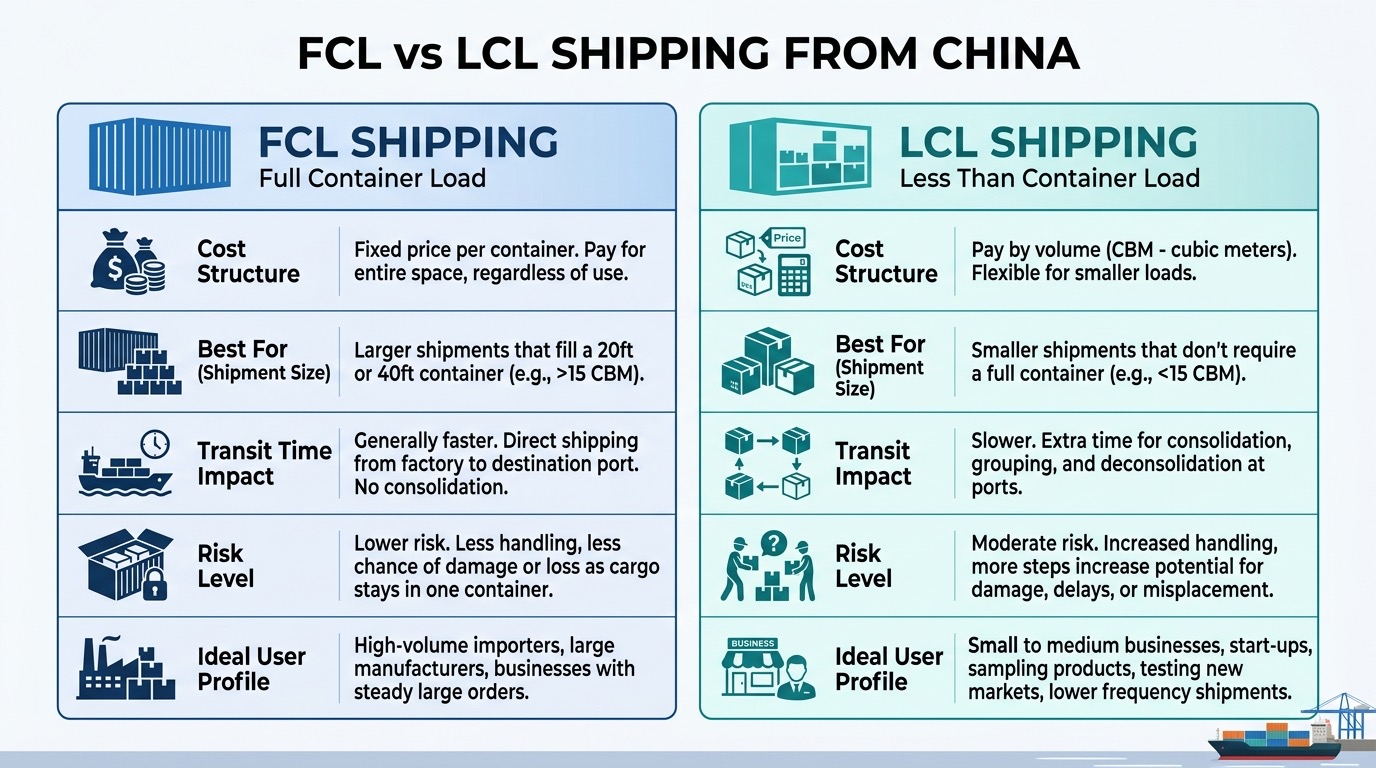
You book an entire container (typically 20ft or 40ft) exclusively for your goods. This is more cost-efficient per unit once your order volume fills a meaningful portion of the container, and it minimizes handling — your goods are loaded once at origin and unloaded once at destination, reducing damage risk from repeated handling.
LCL: Less than Container Load
Your goods share container space with other shippers’ cargo, consolidated and later deconsolidated at destination. This makes sense for smaller orders that don’t justify a full container, but adds transit time (waiting for the container to consolidate, then deconsolidate) and slightly higher handling risk since your goods are loaded and unloaded alongside unrelated shipments multiple times.
Rough Cost Crossover Point
As a general guideline, once your shipment volume approaches roughly 12-15 cubic meters, FCL in a 20ft container often becomes cost-competitive with LCL on a per-unit basis, even if you’re not fully utilizing the container’s total capacity — the fixed handling and documentation costs of LCL start to outweigh the unused container space cost of FCL.
Frequently Asked Questions
At what shipment size does FCL become more cost-effective than LCL?
Roughly around 12-15 cubic meters is a common rough threshold, though the exact crossover depends on current freight rates and your specific route.
Does LCL take significantly longer than FCL?
Yes, typically — LCL adds time for consolidation at origin and deconsolidation at destination, which can add several days to a week or more compared to a direct FCL shipment.
Is damage risk higher with LCL shipping?
Generally yes, since LCL cargo is handled more times (loaded, consolidated, deconsolidated, unloaded) and shares space with other shippers’ goods, increasing the chance of contact damage.