One of the most common reasons for manufacturing failures, delays, and quality disputes when sourcing from overseas is a poorly drafted product specification sheet. When dealing with a product spec sheet for a China factory, you are not just defining your product; you are bridging a massive gap in language, culture, and manufacturing expectations.
A specification sheet (or spec sheet) is the blueprint of your product. If a detail is missing from this document, you cannot expect the factory to magically figure it out. In fact, if something is left ambiguous, the factory will almost always choose the cheapest and easiest interpretation.
Here is how to write a product specification sheet that Chinese factories will actually understand and follow.
1. Eliminate Ambiguity: Be Extremely Specific
The golden rule of working with Chinese manufacturers is: Assume nothing.
Never use subjective terms like “good quality,” “sturdy,” “soft,” or “industry standard.” These terms mean completely different things to a factory owner looking to cut costs than they do to a premium brand owner.
Instead of saying “use strong plastic,” specify exactly what you need:
* Material: ABS Plastic (injection molded).
* Thickness: 2.5mm ± 0.1mm.
* Finish: Matte finish (provide a specific Pantone color code or a physical golden sample reference).
2. Overcome the Language Barrier with Visuals
While your factory contact likely speaks English, the engineers and line workers actually building your product probably do not. Your spec sheet will likely be translated into Mandarin, and technical nuances are often lost in translation.
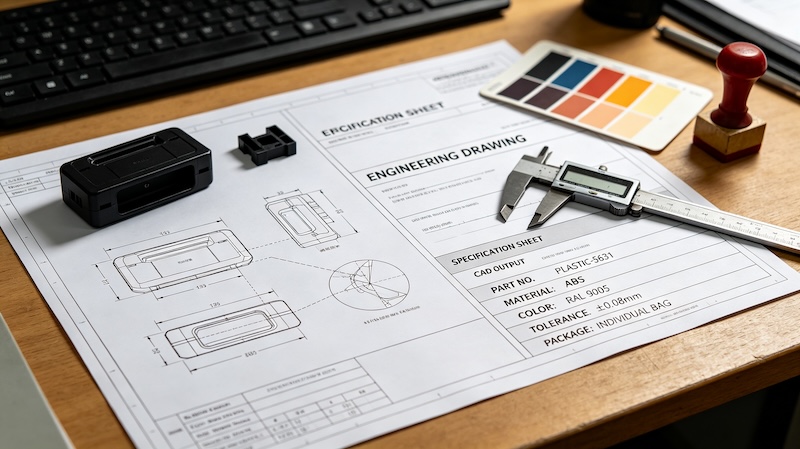
Visuals are a universal language. Your spec sheet should be heavily visual.
* Use 2D and 3D CAD Drawings: Provide precise technical drawings with all dimensions clearly marked.
* Exploded Views: Show how all the different components fit together.
* Annotated Photographs: If you are improving an existing product, include high-resolution photos of the prototype with arrows pointing to specific areas and explaining the requirements.
* Red “Do Not” Examples: Show examples of defects or incorrect manufacturing methods explicitly stating what is unacceptable.
3. Define Tolerances for Everything

In manufacturing, nothing is exactly perfect. There is always a tiny variation in size, weight, and color. If you do not define the acceptable range of variation (the tolerance), the factory will define it for you—often resulting in unsellable goods.
For every dimension, weight, and critical feature, provide a +/- tolerance.
* Example: Product length is 150mm (Tolerance: ± 1.5mm).
* Example: Fabric weight is 200 GSM (Tolerance: ± 5%).
4. Specify Packaging Requirements
Many buyers spend weeks perfecting the product specs but completely forget about the packaging until the last minute. Packaging is critical for both branding and protecting your goods during a rough journey across the ocean.
Your spec sheet must include:
* Inner Packaging: Polybags (specify thickness and warning labels), bubble wrap, or custom retail boxes.
* Retail Packaging: Dimensions, materials (e.g., 350g corrugated cardboard), color printing specifications, and barcode placement.
* Outer Master Cartons: Dimensions, burst strength (e.g., 5-ply double wall corrugated cardboard), maximum weight per carton, and shipping mark designs.
5. Include Testing and Quality Control Standards
How will you know if the factory met your specifications? By outlining the exact tests the product must pass before it is shipped.
Integrate your Quality Control (QC) requirements directly into the spec sheet so the factory knows exactly what they will be judged against.
* Compliance: List required certifications (e.g., CE, RoHS, FCC, FDA compliance).
* Performance Tests: E.g., “The hinge must withstand 10,000 opening/closing cycles without degrading.”
* Drop Tests: E.g., “The packaged product must pass a standard ISTA 1A drop test from 1 meter.”
* AQL Levels: State your Acceptable Quality Limit (AQL) standards for major, minor, and critical defects.
6. Version Control and Sign-Off

Product designs evolve. It is common to go through several revisions of a spec sheet during the prototyping phase.
Always include a version number and a date at the top of your document (e.g., “Version 3.1 – October 15, 2026”). When a finalized version is ready for mass production, have the factory manager sign and stamp every page of the physical document with their official company chop. This ensures everyone is legally and practically on the same page.
Conclusion
Writing a comprehensive product spec sheet for a China factory takes time and meticulous attention to detail. However, it is the single best investment you can make to prevent disastrous quality fade, costly rework, and delayed shipments. Treat your spec sheet as a living, breathing contract, and your manufacturing journey will be significantly smoother.
Frequently Asked Questions
Why do I need a product specification sheet when sourcing from China?
A specification sheet is crucial for bridging language and cultural gaps. It provides a precise blueprint of your requirements, preventing the factory from making assumptions that could lead to quality issues or incorrect materials.
Should I include packaging details in my product spec sheet?
Yes, always include details for inner, retail, and outer master cartons. Packaging is vital for protecting your product during international shipping and ensuring it arrives in sellable condition.
How can I overcome the language barrier in a specification document?
Rely heavily on visual aids. Use 2D/3D CAD drawings, exploded views, and annotated photographs to show exactly what you mean, reducing the risk of translation errors.