When sourcing products from overseas, your first point of formal contact with a potential supplier is usually the Request for Quotation (RFQ). A poorly written RFQ will result in ignored emails, wild price variations, or—worst of all—hidden costs later in the process. Conversely, a professional, detailed RFQ to a Chinese factory signals that you are a serious buyer, prompting them to prioritize your request and provide accurate, competitive pricing.
Here is a comprehensive guide on how to structure an RFQ that gets results, cuts down on back-and-forth communication, and sets the stage for a successful manufacturing partnership.
What is an RFQ?
An RFQ (Request for Quotation) is a standard business process whose purpose is to invite suppliers into a bidding process to bid on specific products or services. In international sourcing, it’s the document you send to a factory detailing exactly what you want them to make and asking how much it will cost.
Why Vague RFQs Fail
Chinese factory sales representatives receive dozens, sometimes hundreds, of inquiries daily. If an inquiry says, “Hi, I want to buy 500 yoga mats, what is your price?”, the rep has to guess the size, material, thickness, packaging, and shipping terms. They will either:
1. Ignore it entirely because it looks like spam from a beginner.
2. Quote the absolute cheapest, lowest-quality option to hook you.
3. Waste days asking clarifying questions.
To get an accurate quote fast, you must eliminate the guesswork.
Essential Elements of a Winning RFQ
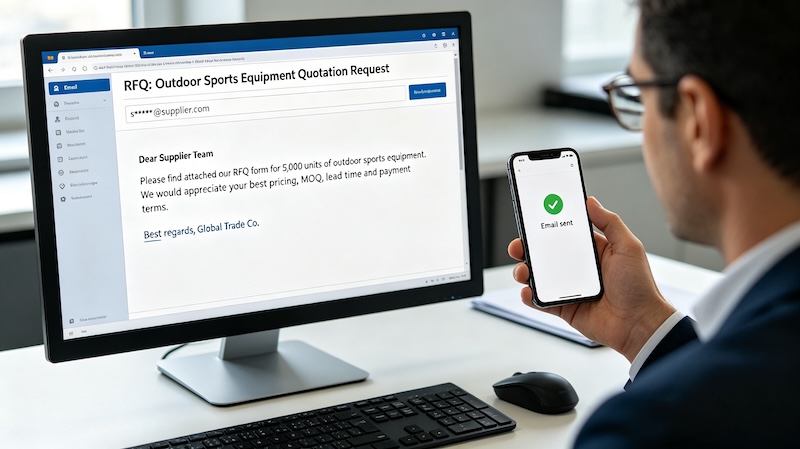
A structured RFQ should be clear, concise, and ideally formatted in a PDF or an organized Excel sheet. Here is what you must include:
1. Company Introduction (Keep it Brief)
Briefly introduce yourself to establish credibility. Mention your company name, location, and your target market.
* Example: “We are [Company Name], an e-commerce brand based in the US specializing in premium fitness gear.”
2. Product Specifications (The Core)
This is the most critical part. The more detail, the better.
* Product Name: Be specific (e.g., “TPE Yoga Mat with Alignment Lines” not just “Yoga Mat”).
* Dimensions & Weight: Provide exact measurements in metric units (cm, mm, kg).
* Materials: Specify the exact material grade (e.g., “100% 304 Stainless Steel,” not just “Metal”).
* Color: Use Pantone color codes. Do not just say “Blue.”
* Certifications Required: State upfront if the product needs CE, FDA, RoHS, or specific ASTM standards.
3. Order Quantity (MOQ)
Provide your target order volume. It’s smart to ask for tiered pricing to see how volume affects the cost.
* Example: “Please provide quotes for 500 pcs, 1,000 pcs, and 5,000 pcs.”
4. Customization and Branding (OEM/ODM)
If you are doing private label, be explicit.
* Logo: Where will it go? How will it be applied (laser engraved, silk screen, embossed)? Include the logo file if possible.
* Packaging: Do you want standard OPP bags, a custom color box, or a corrugated mailer? Packaging significantly affects price and shipping volume.
5. Shipping and Trade Terms (Incoterms)
How do you want the goods priced regarding logistics?
* EXW (Ex Works): The factory just manufactures the goods. You arrange all pickup and shipping. (Usually the lowest quoted price).
* FOB (Free on Board): The factory handles manufacturing and local transport to a designated Chinese port (e.g., FOB Shenzhen). This is the most common and recommended term for sea freight.
* DDP (Delivered Duty Paid): The factory handles everything to your door, including customs and taxes.
6. Target Lead Time
Ask for the estimated production time after the deposit is paid and the sample is approved.
Pro-Tips for Communication
- Number Your Questions: When asking questions in an email, use a numbered list (1, 2, 3). It makes it much easier for the supplier to answer point-by-point, reducing the chance they skip a question.
- Use Simple English: Avoid slang, idioms, or overly complex grammar. Keep sentences short and clear to aid translation.
- Request a Sample Cost First: Always ask how much a pre-production sample will cost and the shipping fee for the sample.
By front-loading the work and sending a comprehensive RFQ to Chinese factories, you instantly position yourself as a professional buyer. You will receive faster, more accurate quotes, allowing you to effectively compare suppliers and choose the best partner for your business.