If you are an Australian business importing goods, China remains one of the most critical manufacturing hubs for your supply chain. However, navigating the logistics landscape in 2026 requires up-to-date knowledge of fluctuating freight rates, changing trade dynamics, and port capacities. Whether you are shipping small parcels or massive ocean containers, understanding the intricacies of China to Australia shipping is vital to maintaining healthy profit margins and fulfilling customer expectations on time.
In this practical breakdown, we will explore current shipping methods, expected costs, transit timelines, and strategies to optimize your supply chain with SourcePilot Global.
1. Freight Options: Sea Freight vs. Air Freight
When managing imports, choosing the right mode of transport determines both your budget and timeline. The primary options from China to Australia are sea freight and air freight.
Sea Freight (Ocean Freight)
Sea freight is the workhorse of international trade. It is the most cost-effective method for bulk orders, large machinery, and heavy goods.
– FCL (Full Container Load): You rent an entire 20ft or 40ft container. This is ideal when you have enough volume to fill it, offering better security and faster transit times once at port.
– LCL (Less than Container Load): Your goods share a container with other shipments. Best for smaller volumes (typically between 1 cbm and 15 cbm), though consolidation and deconsolidation take extra time.
Air Freight
Air freight is significantly faster but substantially more expensive. It is best reserved for high-value, lightweight, or time-sensitive goods like electronics, seasonal fashion, or urgent component replacements.
– Express Courier (DHL, FedEx, UPS): Door-to-door service, fastest transit, but highest cost per kilogram.
– Standard Air Freight: Airport-to-airport delivery, requiring separate customs clearance and inland transport.
2. Average Shipping Costs in 2026
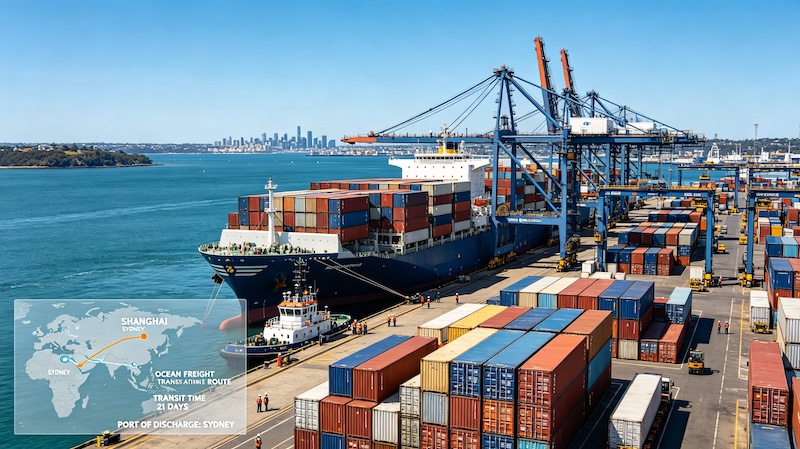
Note: Freight rates are subject to seasonal volatility, fuel surcharges, and geopolitical events. The following are estimated averages for early-to-mid 2026.
Estimated Sea Freight Costs
- 20ft Container (FCL): Ranging from $1,200 to $1,800 USD from major Chinese ports (e.g., Shenzhen, Shanghai) to major Australian ports (e.g., Sydney, Melbourne).
- 40ft Container (FCL): Ranging from $2,100 to $2,900 USD.
- LCL Shipments: Approximately $100 to $150 USD per cubic meter (CBM).
Estimated Air Freight Costs
- Standard Air Freight: Typically costs between $4.50 and $7.00 USD per kilogram, depending on volume and density.
- Express Courier: Generally starts at $7.50 to $12.00+ USD per kilogram for smaller parcels.
3. Transit Timelines: How Long Does It Take?
Planning inventory depends heavily on lead times. The transit times below encompass not just the voyage, but standard customs clearance and port handling.
- Sea Freight (Port to Port): 12 to 18 days.
- Sea Freight (Door to Door): 25 to 35 days (accounting for factory pickup, customs, and final delivery).
- Air Freight (Standard): 5 to 8 days.
- Air Express: 3 to 5 days.
Key Factors Affecting Timelines
- Port Congestion: During peak seasons (like the lead-up to Christmas or right before Chinese New Year), ports in both Shanghai and Sydney can experience bottlenecks.
- Customs Holds: Incomplete paperwork or random Australian Border Force (ABF) inspections can add days to your transit time.
- Inland Transport: Moving goods from inland Chinese factories to coastal ports adds both time and cost.
4. Navigating Australian Customs and Duties
Australia has strict biosecurity and customs regulations. When importing, you must account for the following:
- Goods and Services Tax (GST): A standard 10% GST applies to most imported goods, calculated on the Value of the Taxable Importation (VoTI), which includes the customs value, transport costs, insurance, and duty.
- Customs Duty: Typically ranges from 0% to 5%, depending on the HS code of your product.
- ChAFTA (China-Australia Free Trade Agreement): Many goods imported from China enjoy zero tariffs under ChAFTA. To claim this, you must have a valid Certificate of Origin (COO) provided by your Chinese supplier.
5. Tips for Optimizing Your 2026 Shipping Strategy
To minimize costs and avoid delays in your China to Australia shipping operations:
- Leverage ChAFTA: Ensure your suppliers correctly classify your goods and provide the required Certificates of Origin to eliminate unnecessary duties.
- Plan for Peak Seasons: Book containers 3-4 weeks in advance during September-November and January to avoid peak season surcharges (PSS) and rolled cargo.
- Optimize Packaging: Air freight charges by volumetric weight (whichever is greater: actual weight or dimensions). Efficient packaging saves significant money.
- Partner with Experts: Working with a dedicated supply chain partner like SourcePilot Global ensures that every aspect of your procurement, quality control, and logistics is managed seamlessly from the factory floor to your Australian warehouse.
Mastering the logistics of shipping from China to Australia doesn’t have to be overwhelming. By understanding costs, timelines, and regulations, you can build a resilient supply chain ready for 2026 and beyond.
Frequently Asked Questions
How long does shipping from China to Australia take in 2026?
Sea freight from China to Australia typically takes 12 to 18 days port-to-port, and 25 to 35 days door-to-door. Standard air freight takes 5 to 8 days, while air express takes 3 to 5 days.
What is the cost of shipping a container from China to Australia?
In 2026, a 20ft container (FCL) costs roughly $1,200 to $1,800 USD, while a 40ft container ranges from $2,100 to $2,900 USD. LCL shipments cost around $100 to $150 USD per cubic meter.
Do I have to pay import duty on goods from China to Australia?
It depends on the goods. While general duties are 0-5%, many goods are duty-free under the China-Australia Free Trade Agreement (ChAFTA) if you have a valid Certificate of Origin. You will still need to pay the 10% GST.