Choosing between LCL and FCL shipping is mostly a volume question, but the trade-offs go beyond simple cost per unit — transit time, handling risk, and flexibility all differ meaningfully between the two options.
FCL:フルコンテナ積載
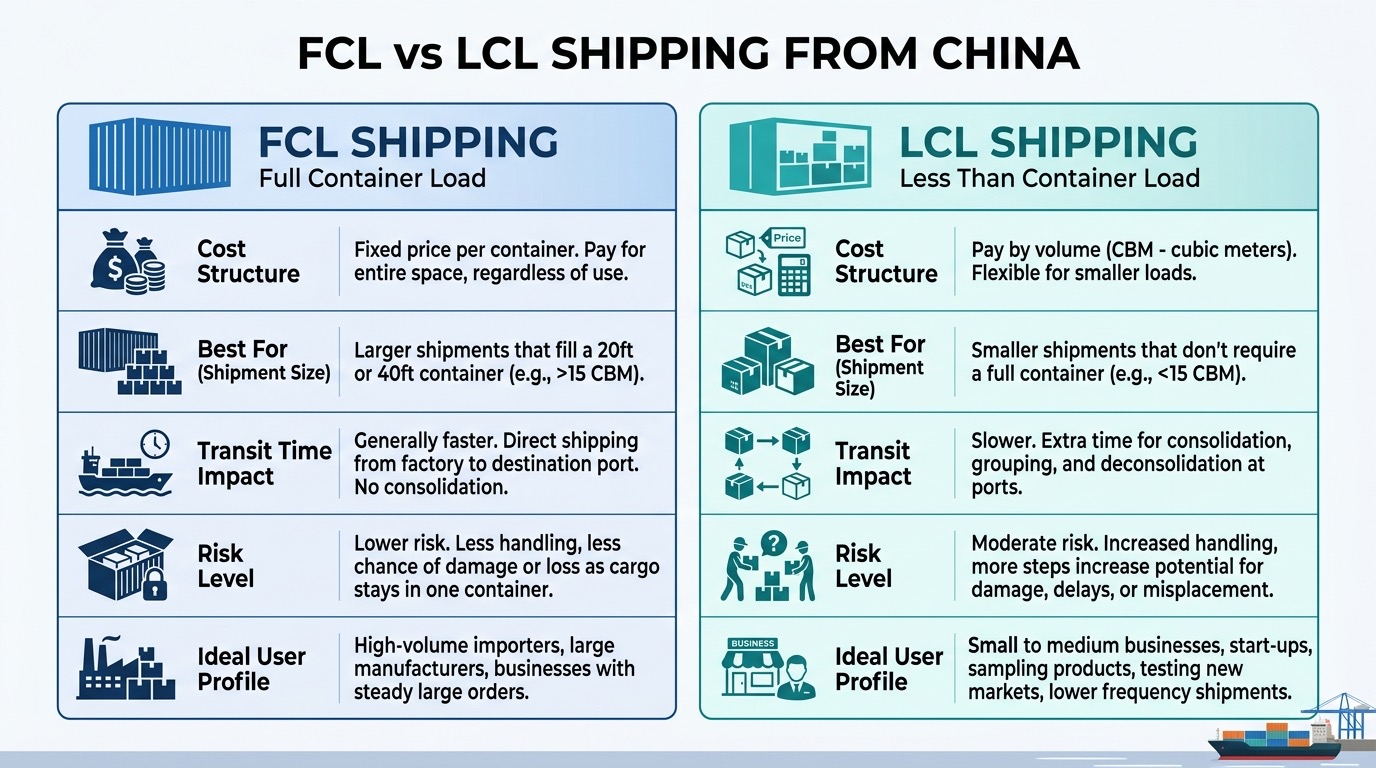
You book an entire container (typically 20ft or 40ft) exclusively for your goods. This is more cost-efficient per unit once your order volume fills a meaningful portion of the container, and it minimizes handling — your goods are loaded once at origin and unloaded once at destination, reducing damage risk from repeated handling.
LCL:コンテナ未満の積荷
お客様の貨物は、他の荷主の貨物とコンテナのスペースを共有し、集荷された後、仕向地で荷分けされます。これは、コンテナ1台分を埋めるほどではない小口注文には理にかなっていますが、輸送時間が長くなる(コンテナへの積み込みや仕向地での荷分けを待つ時間)ほか、お客様の貨物が関係のない他の貨物と一緒に何度も積み下ろしされるため、取り扱い上のリスクが若干高まります。
概算コストの損益分岐点
As a general guideline, once your shipment volume approaches roughly 12-15 cubic meters, FCL in a 20ft container often becomes cost-competitive with LCL on a per-unit basis, even if you’re not fully utilizing the container’s total capacity — the fixed handling and documentation costs of LCL start to outweigh the unused container space cost of FCL.
よくある質問
どの程度の出荷量になると、FCLはLCLよりも費用対効果が高くなるのでしょうか?
おおむね12~15立方メートル程度が一般的な目安ですが、正確な境界線は現在の運賃や具体的なルートによって異なります。
LCLはFCLに比べてかなり時間がかかるのでしょうか?
Yes, typically — LCL adds time for consolidation at origin and deconsolidation at destination, which can add several days to a week or more compared to a direct FCL shipment.
LCL輸送では、破損のリスクは高くなりますか?
一般的に言えば、その通りです。LCL貨物は、積み込み、混載、仕分け、荷降ろしといった作業の回数が多い上、他の荷主の貨物とスペースを共有するため、接触による損傷のリスクが高まるからです。