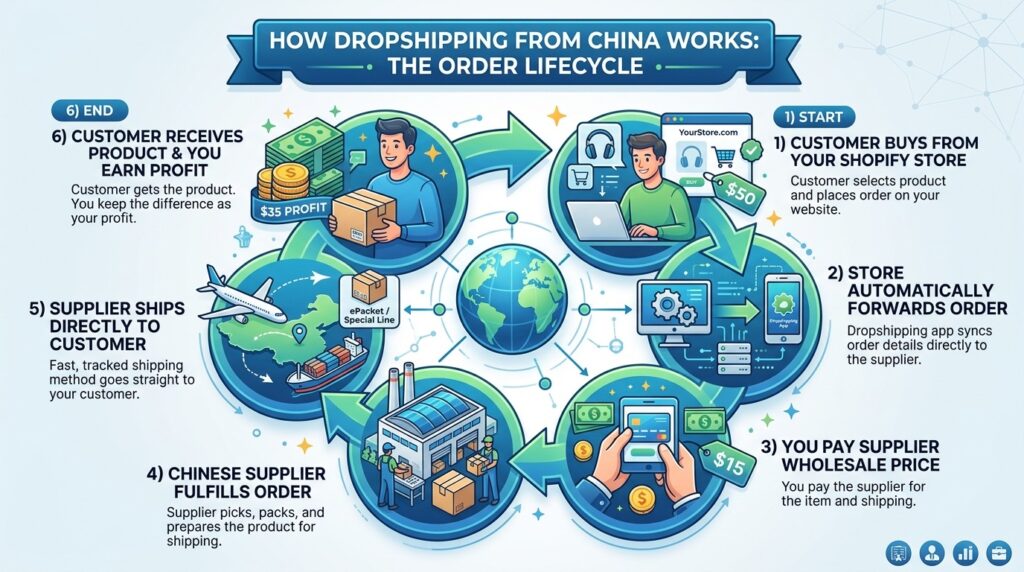
Dropshipping from China became one of the most widely promoted online business models between 2016 and 2020. The pitch was simple: list products from AliExpress, mark them up, run Facebook ads, and collect the margin without touching inventory. Thousands of people tried it; a small fraction made serious money; the majority found thin margins, 20-day shipping complaints, and customer service nightmares.
The model hasn’t disappeared — it’s evolved. The sellers doing well with China dropshipping in 2026 look different from the ones who tried in 2018. They’re using private agents instead of AliExpress, they’re branding their products and packaging, they’re often warehousing inventory in the US or EU to hit 3–5 day delivery expectations, and they’re treating dropshipping as a product testing method rather than a permanent business model.
This guide tells you honestly what’s working, what isn’t, and what the viable version of China dropshipping looks like today.
What Standard AliExpress Dropshipping Looks Like in 2026
The economics:
– AliExpress retail price: $8.50 for a product
– Your selling price: $24.99
– Facebook/Meta ad cost to acquire one customer: $12–18 (industry average for cold traffic e-commerce)
– Gross margin: $16.49
– Minus ads: $15.00 remaining
– Minus payment processing (3%): $7.49 remaining
– Minus returns/chargebacks (8–12% rate for dropship): ~$2.00
– Net profit per order: ~$5.49
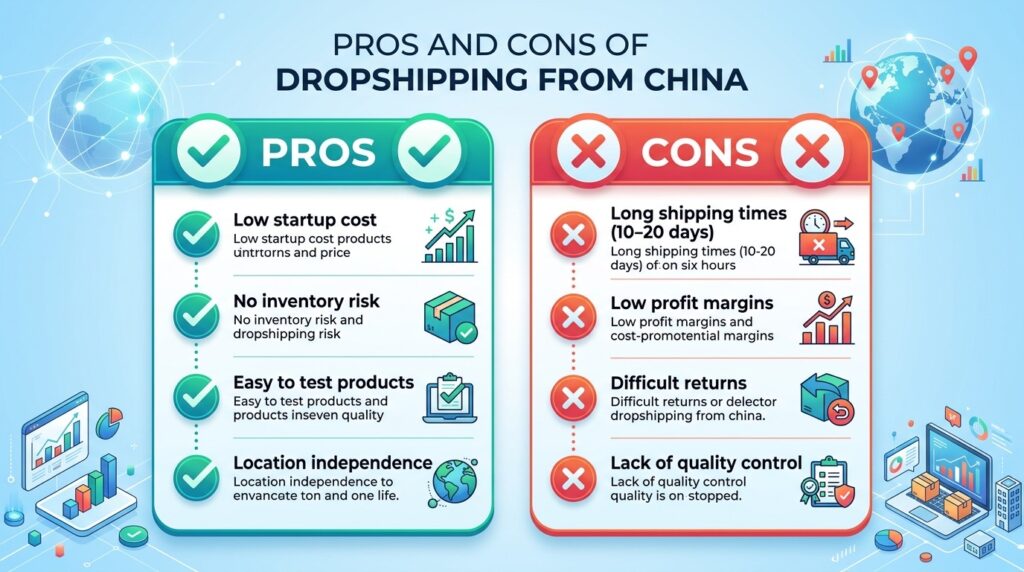
That’s a 22% net margin on paper — before customer service time, store overhead, and any refund disputes. And it assumes your ad cost stays at $15. When ad costs rise (they always do for profitable audiences), or when iOS privacy changes reduce targeting accuracy (ongoing), the margin evaporates.
The delivery problem:
Consumer delivery expectation in 2026 is 3–7 days for US/EU markets (Amazon Prime effect). AliExpress shipping to the US: 15–30 days standard, 7–15 days for ePacket or AliExpress Standard Shipping. Every day beyond 7 increases return rates and chargebacks. This is the structural problem standard AliExpress dropshipping hasn’t solved.
What Actually Works: The Evolved Model
Model 1: Branded Dropshipping with a Private Agent
Instead of ordering from random AliExpress sellers, you work with a dedicated China-based fulfillment agent who:
– Sources products at factory prices (typically 20–40% below AliExpress retail)
– Adds your branded packaging (custom poly bags, inserts, labels) to each shipment
– Ships via faster express routes (7–12 days to US/EU vs. 15–30 days standard)
– Provides tracking updates you can share with customers
How to find a dropshipping agent:
CJdropshipping, Zendrop, and HyperSKU are established platforms. Alternatively, search for private agents on Reddit’s r/dropshipping community or through Alibaba supplier contacts in Yiwu or Guangdong who offer fulfillment services.
Economics improvement:
Factory-priced sourcing through an agent: $5.80 vs. $8.50 on AliExpress (same product). That $2.70/unit improvement on 300 orders/month = $810/month additional margin — or the ability to reduce selling price and improve ad conversion.
Model 2: China-to-US/EU Warehouse Hybrid
Some dropshippers pre-stock their top 10 products in a US or EU 3PL warehouse (500–1,000 units per SKU), offering 2–5 day domestic delivery on bestsellers while using China dropshipping for the long tail of their catalog.
This hybrid model requires upfront inventory investment on proven sellers ($3,000–8,000 for a meaningful warehouse position) but solves the delivery problem for the products that matter most. Use dropshipping to test demand; move proven winners into the warehouse model.
Model 3: Dropshipping as a Testing Method Before Private Label
The most sustainable version of China dropshipping uses it explicitly as a product validation tool:
– Run ads on 5–10 products via dropshipping to identify the 1–2 that convert
– Once you’ve identified a winner (50+ sales at profitable CPA), source 500 units directly with branded packaging
– Transition that product from dropshipping to owned inventory with your branding
– Scale advertising with the improved margins of direct sourcing
This is how many successful private label brands started — dropshipping removed the inventory risk during product discovery.
Supplier Options: AliExpress vs. Agent vs. Platform
| AliExpress Direct | Dropship Agent | Platform (CJ/Zendrop) | |
|---|---|---|---|
| Price | Retail (highest) | Near-wholesale | Between |
| Branding options | None/basic | Full custom | Limited |
| Shipping speed | 15–30 days | 7–15 days | 7–20 days |
| Minimum commitment | None | Usually informal | None |
| Reliability | Variable | Agent-dependent | Platform-managed |
| Best for | Testing products | Established store | Beginners |
The De Minimis Situation (US Market)
The Section 321 de minimis exemption ($800 per person per day) has historically allowed China-origin packages under $800 to enter the US duty-free. This exemption is the economic foundation of direct-from-China dropshipping to US consumers.
As of 2025–2026, the US has proposed and implemented partial restrictions on de minimis eligibility for goods on Section 301 tariff lists. The situation is evolving. If you’re building a business around de minimis shipping from China to the US, monitor USTR and CBP announcements closely — a significant change to de minimis rules would materially affect the direct-from-China model.
The EU has its own de minimis threshold (€150 for duty, €22 for VAT — the VAT threshold was removed in 2021). EU packages from China above €150 face import duties; all packages regardless of value now face VAT. This has increased the cost of direct-from-China dropshipping to EU customers.
What Platforms Actually Work for China Dropshipping in 2026
Shopify + DSers (AliExpress integration): The most common starting point. Easy setup, direct AliExpress import, basic automation. Suitable for testing; margins are thin.
TikTok Shop: High-growth platform where China-based sellers (and their international dropshipping partners) have native advantages. If you’re targeting Gen Z consumers, TikTok Shop’s commerce infrastructure is worth serious consideration.
Etsy: Works for handmade-aesthetic products from China where you can genuinely differentiate with design. Etsy’s audience expects unique items — dropshipping generic products poorly fits the platform culture.
Amazon (Seller-Fulfilled): Dropshipping from China to fulfill Amazon orders requires maintaining accurate inventory counts and meeting Amazon’s performance metrics (including delivery time). Direct-from-China dropshipping struggles to meet Amazon’s delivery expectations. Most successful operators use this hybrid: dropship to validate, then FBA for scaling.
Related reading → How to Source Products from China for Your Shopify Store
Related reading → Private Label from China: The Complete Process for Brand Builders
Looking for a reliable China fulfillment agent for your dropshipping store? Our network includes vetted fulfillment partners across Guangdong, Yiwu, and Shenzhen.