Private labeling from China is the underlying business model for thousands of brands you’ve seen on Amazon, Shopify, and retail shelves — from wellness supplements to kitchen gadgets to pet accessories. The model is straightforward: a Chinese manufacturer produces a product; a brand owner adds their identity through branding, packaging, and positioning; the product is sold to consumers at a brand premium.
The mechanics are accessible. The execution — at a level that creates a defensible business rather than an undifferentiated commodity listing — is more demanding than most guides suggest.
This article covers the complete private label process: what it actually involves, what it costs, where most brand builders fail, and how to do it correctly.
What Private Label Actually Means
“Private label” means your brand name is on a product you don’t manufacture yourself. It’s distinct from:
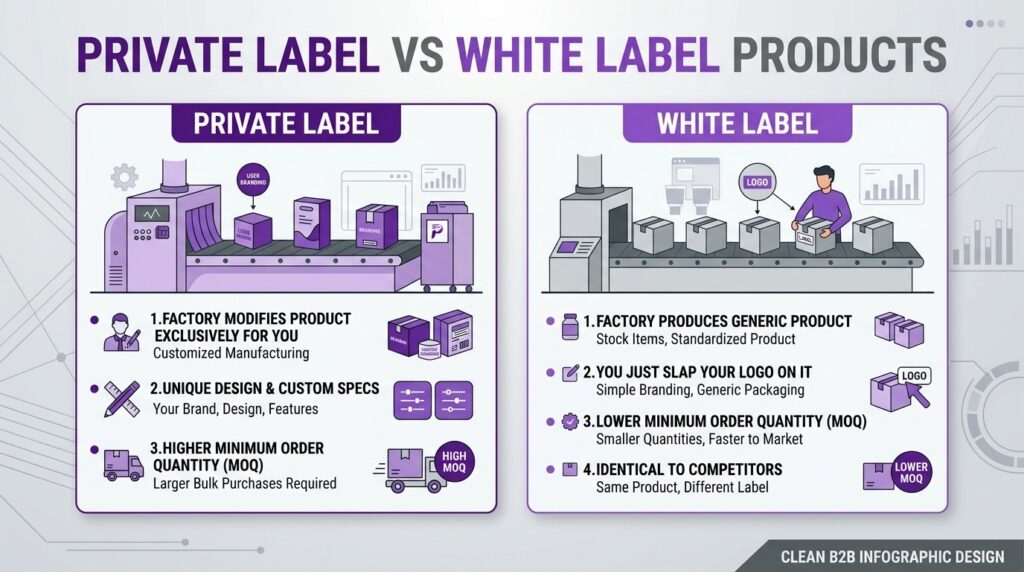
White label: You buy a standard product from a factory’s existing lineup and put your logo on it with minimal or no customization. Fastest and cheapest — also easiest to copy.
Private label: You take an existing product design and customize it — different color, different feature set, different packaging, sometimes different materials — to create a product that’s meaningfully differentiated from the factory’s standard offering.
OEM (Original Equipment Manufacturing): You provide the design specifications and the factory manufactures to your spec. Higher investment, higher differentiation.
ODM (Original Design Manufacturing): You brief the factory on what you want to achieve and they design and manufacture the product. Deepest investment, most differentiation.
Most entry-level China private labeling is white label with branding — it gets labeled private label, but functionally it’s your logo on an existing factory product. This is a viable starting point but is the most commoditized end of the spectrum. Sustainable private label businesses typically move toward genuine OEM or ODM as they scale.
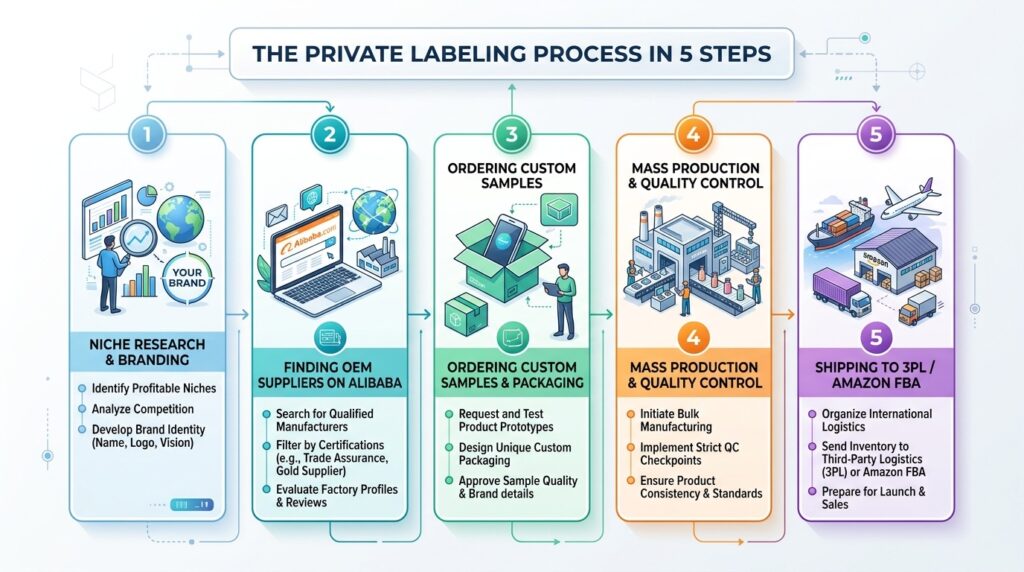
Step 1: Product Selection — The Decision That Determines Everything
The most common private label failure happens before any factory is contacted: selecting a product based on market size without understanding competitive differentiation.
The product selection framework:
Step A — Identify demand: What problem does the product solve? Is there consistent search demand (keyword tools like Jungle Scout, Ahrefs, or Google Trends)? Is it seasonal or year-round?
Step B — Analyze current offerings: What are the top-selling products in this category? Read reviews — specifically 3-star reviews that articulate specific frustrations. “Would be perfect if only…” complaints are your product brief.
Step C — Identify your differentiation: What specific improvement can you build into your version? This must be:
– Manufacturable (a Chinese factory can actually build it)
– Visible/communicable to buyers (they can understand the improvement from the product listing)
– Not already done by a dominant competitor with 10,000+ reviews
Step D — Validate unit economics: Can you source this product at a landed cost that leaves viable margin after platform fees, fulfillment, and marketing? Calculate this before contacting suppliers (see Article 29 for landed cost framework).
Step 2: Finding the Right Factory Type
Private label sourcing requires a factory that does OEM work — not just a trading company that sells standard products.
What to look for:
OEM experience: Ask directly: “Do you do OEM work? Can you show me examples of OEM products you’ve made for other brands?” A factory experienced in OEM understands brand packaging requirements, will work from your tech pack or brief, and knows what “white label” customization looks like in practice.
Minimum run size alignment: OEM runs for private label typically start at 200–500 units for simple products, 500–2,000 for products requiring custom molds or tooling. Know your planned first-run quantity before supplier discussions so you can immediately filter out factories whose MOQs are incompatible.
Product category specialization: The factory should specialize in your product category. A factory that makes “all kinds of products” is almost certainly a trading company. A factory that makes specifically food storage containers, or specifically silicone kitchen tools, or specifically cosmetic packaging — that specialization signals genuine manufacturing capability.
Certification credentials: For regulated product categories, the factory must already hold relevant certifications (FDA registration, CE testing history, REACH compliance). OEM work doesn’t change the compliance requirements — the certification must apply to your product.
Step 3: Customization — What You Can Actually Change
Logo application: Printing, embossing, debossing, screen printing, heat transfer, laser engraving. Most factories can do this with no tooling cost for flat-surface applications; 3D molded logos require tooling ($150–500 typically).
Color: Many products can be produced in custom colors with Pantone reference. Color matching adds a sample round (2–3 weeks) but no tooling cost for most materials. For injection-molded plastics, each color requires a separate material mix — usually no additional tooling, but minimum quantity per color applies.
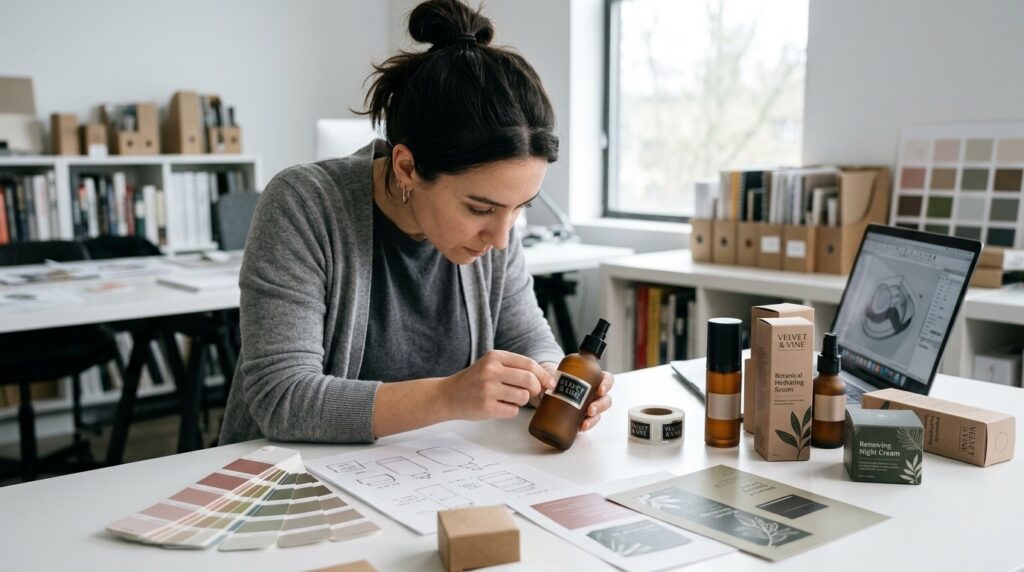
Packaging: This is often more important than product customization for brand building. Custom branded boxes, labels, inserts, tissue paper, hangtags — all customizable with your artwork files. Your packaging supplier may be separate from your product factory; a sourcing agent can coordinate both.
Product modification (true OEM): Adding a feature (a measuring scale to a container lid), changing a dimension (a handle length, a bottle capacity), removing a component, or changing a material grade. These require either factory engineering involvement (for significant changes) or just spec revision (for dimension changes within existing tooling).
Custom molds/tooling (ODM): Creating a unique product shape requires new tooling — typically $500–3,000 for simple plastic molds, $3,000–15,000 for complex shapes or metal tooling. Tooling is owned by the factory unless you negotiate and pay for tooling ownership transfer — which matters if you ever want to move production to another factory.
Step 4: Branding and Packaging Requirements
For private label, packaging is the primary brand communication vehicle. It must be specified precisely:
What to deliver to your factory/packaging supplier:
– Logo files in vector format (AI, EPS, SVG)
– Brand colors in Pantone and CMYK
– Packaging artwork in print-ready format (PDF with bleed and crop marks)
– Surface finish specification (matte, gloss, soft-touch, spot UV)
– Structural specification (box dimensions, closure type, insert design)
– Any required regulatory text (country of origin, materials, care instructions, barcode)
Packaging costs (500-unit run):
– Simple kraft box with 1-color print: $0.20–0.40/unit
– Custom printed mailer box (4-color): $0.45–0.80/unit
– Rigid gift box with magnetic closure: $1.20–2.50/unit
– Printed tissue paper: $0.08–0.15/sheet
– Custom label (for bottles/jars): $0.05–0.15/label
Step 5: The Sample Process for Private Label
Private label samples go through more rounds than standard product sourcing because each customization element must be confirmed:
Round 1 — Blank sample: Factory sends an existing product in your target configuration (size, material, basic function) without any branding. Purpose: confirm you’ve selected the right base product.
Round 2 — Branded proto: Factory applies your logo/branding to the blank product. Purpose: confirm branding placement, print quality, and color accuracy.
Round 3 — Packaging proto: Your packaging arrives (separately from the product manufacturer if packaging is external). Purpose: confirm box dimensions, print accuracy, and product fit.
Round 4 — Full OEM sample: Product with branding, in packaging. This is your pre-production approval sample. Approve in writing — this becomes the Golden Sample for all QC.
Timeline: 6–10 weeks from brief to approved full OEM sample for straightforward products. Products requiring new molds add 3–4 weeks for tooling.
Step 6: First Production Run — What to Get Right
Don’t cut corners on inspection: First OEM production runs are highest risk. Your approved sample was made carefully; production units are made by volume workers under time pressure. Pre-shipment inspection by an independent company is non-negotiable on your first run. See our pre-shipment inspection guide.
Order the right quantity: Enough to validate demand without overcommitting. For Amazon or Shopify validation, 300–500 units is usually sufficient for a 60–90 day test. Over-ordering before validation is how brands get stuck with $15,000 of inventory for a product that doesn’t convert.
Plan your reorder timing: With a 60–75 day production + shipping cycle, you need to place your reorder when you have approximately 45 days of inventory remaining. Calculate this before the first order arrives.
Investment Requirements: What Private Label Actually Costs
| Budget Level | What It Gets You |
|---|---|
| $2,000–5,000 | White label (logo only), simple packaging, 200–300 units, basic inspection |
| $5,000–15,000 | True private label with custom packaging, product color/feature modification, 300–600 units, full inspection |
| $15,000–40,000 | OEM with meaningful product differentiation, premium packaging, 500–1,500 units, compliance testing, inventory buffer |
| $40,000+ | ODM custom product design, full certification stack, brand launch inventory |
Most successful private label brands start in the $5,000–15,000 range for initial product validation and scale investment once demand is confirmed.
Common Private Label Failures
Choosing a product with no differentiation: White label with your logo on a product identical to 200 other sellers. You compete purely on price and advertising, with no sustainable advantage.
Under-specifying packaging: Providing an idea instead of a specification. The factory produces something you didn’t intend; remaking it adds cost and time.
Skipping the inspection: First production run quality doesn’t match the approved sample. You discover this when your Amazon FBA returns start arriving.
Over-ordering on the first run: 2,000 units of a product that doesn’t convert. Capital tied up in inventory that won’t move.
Not owning the molds: If you paid for custom tooling and didn’t get a tooling ownership agreement, the factory owns your mold. If the relationship deteriorates, you can’t take your design elsewhere without re-paying tooling costs.
Related reading → How to Get Product Samples from Chinese Manufacturers
Related reading → Pre-Shipment Inspection in China: What Gets Checked
Ready to launch a private label product from China? Our team manages the full private label process — factory sourcing, branding coordination, quality control, and shipping.