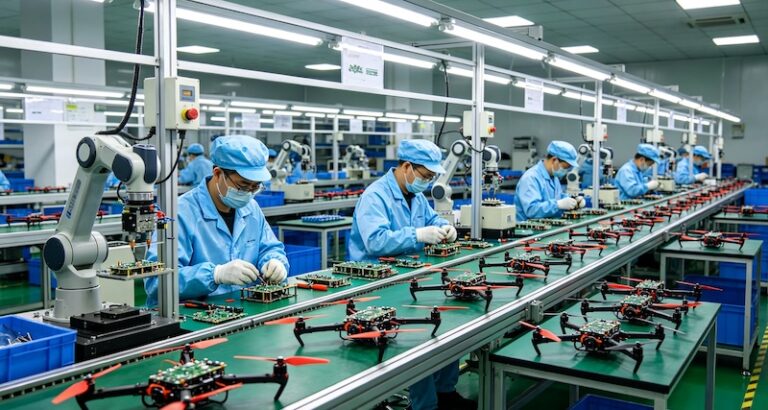
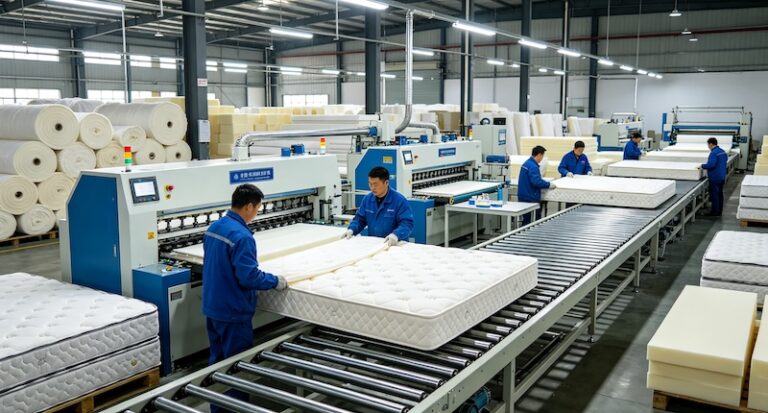
A buyer in Australia wired $38,000 to a “factory” in Guangdong they’d found through a Google ad. The website was professional. The email responses were prompt. The product photos were excellent. Three weeks after the payment cleared, the website was offline and the email address was returning bounce messages.
The money was never recovered.
This is not a rare story. It plays out with different dollar amounts, different product categories, different countries — but the same underlying mechanics. And in almost every case, at least three or four of the red flags below were present before the payment was made. The buyer just didn’t know what to look for.
This article gives you that list.

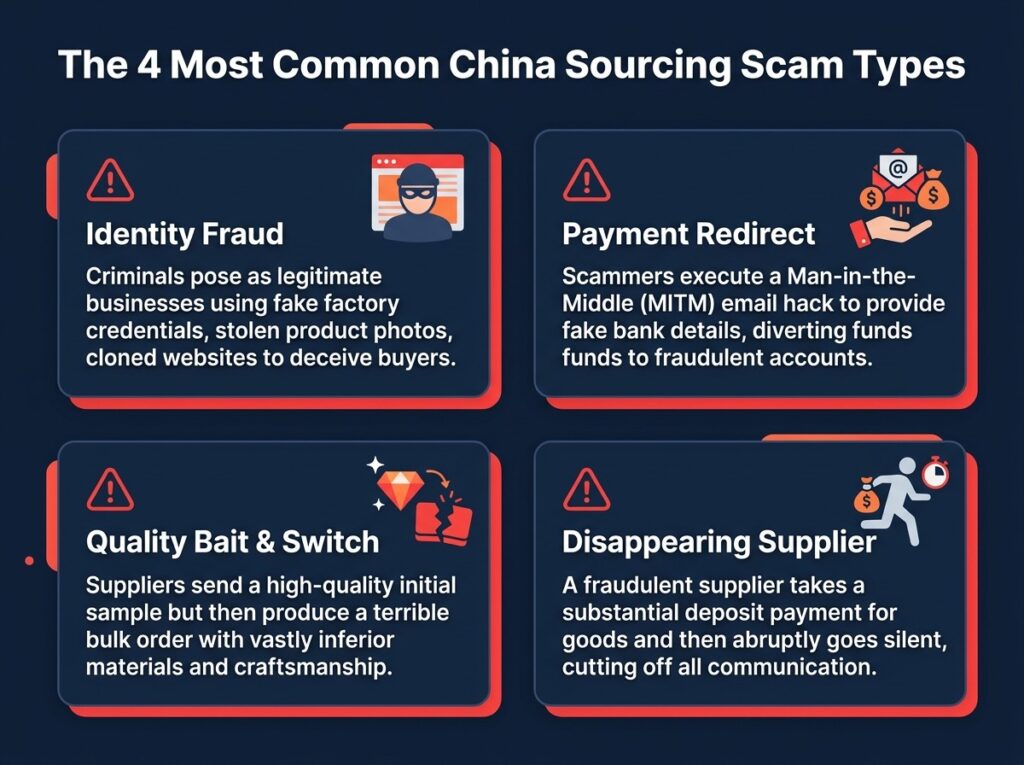
How China Sourcing Fraud Actually Works
Before the red flags, a short map of how these scams are structured — because understanding the mechanism makes the warning signs easier to recognize.
Identity Fraud is the most common category for new buyers. A fraudulent operator creates a fake company identity — cloned website, stolen product photos, fabricated business registration documents — and presents as a legitimate factory. They’re skilled at appearing real because they’ve studied what legitimate factories look like.
Payment Redirect (Man-in-the-Middle) targets existing supplier relationships. A fraudster monitors email traffic between a buyer and supplier — sometimes by compromising one party’s email account — and intercepts a payment request, substituting different bank account details. The buyer thinks they’re paying their usual supplier. They’re not.
Quality Bait and Switch is technically legal fraud. The sample is genuine — excellent quality, exactly what was agreed. The bulk order is produced with cheaper materials, lower quality components, or reduced specifications. By the time the goods arrive and are inspected, the supplier has been paid in full.
Disappearing Supplier is the bluntest form. Deposit received, goods never shipped, supplier becomes unreachable. Sometimes the supplier is entirely fake; sometimes it’s a real company that accepted more orders than it could fulfill and chose to prioritize others.
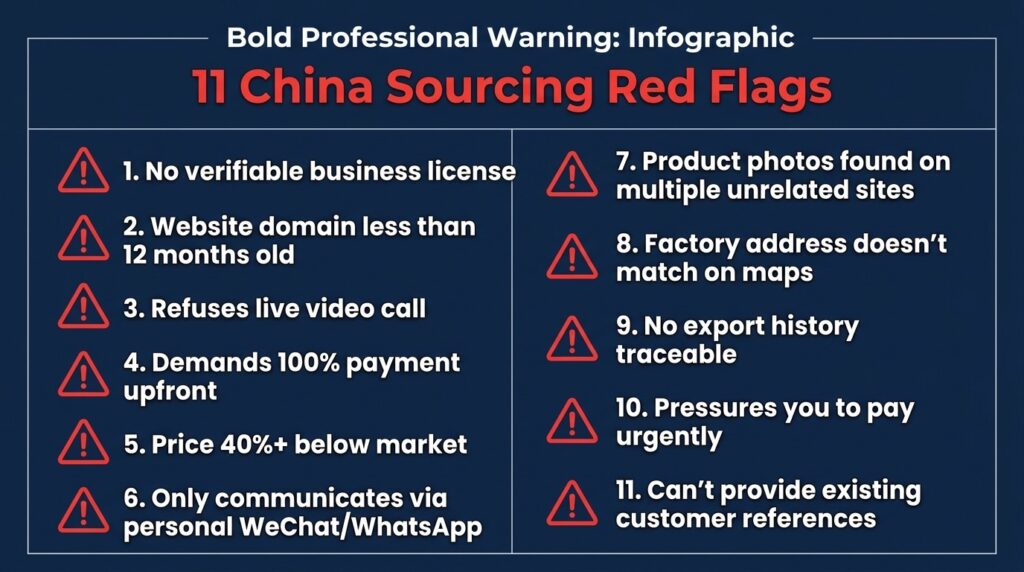
The 11 Red Flags — Explained
🚩 Red Flag #1: No Verifiable Business License
Every legitimate Chinese business has a business license registered with the State Administration for Market Regulation (SAMR). The license number — a unique 18-digit Unified Social Credit Code — can be verified in seconds on China’s public business registry.
A supplier who can’t or won’t provide their business license, or whose license number doesn’t return valid results on official databases, is not a legitimate registered business. This is a disqualifying flag, not a caution flag.
What to do: Request the business license image and independently verify the 18-digit code at gsxt.samr.gov.cn or via Tianyancha.
🚩 Red Flag #2: Website Domain Registered Less Than 12 Months Ago
Fraudulent operations spin up professional-looking websites quickly. A WHOIS lookup on the supplier’s domain takes 30 seconds and tells you when it was registered.
A factory claiming 8 years of operation with a website domain registered 4 months ago is a fundamental inconsistency. Real factories with multi-year track records either have older domains or have good explanations for recent website rebuilds (redesign, new branding, etc.) — and those explanations are verifiable.
What to do: Search WHOIS [supplierdomain.com] or use lookup.icann.org to check domain registration date.
🚩 Red Flag #3: Refuses or Consistently Delays a Live Video Call
In 2026, declining a live video call from a potential business partner is commercially abnormal. Every legitimate factory we’ve worked with has accommodated video calls — production floor tours, product reviews, team introductions.
The reasons a fraudulent supplier refuses: they have no factory to show, they’re operating from a different location than claimed, or their “representative” doesn’t actually work for the company whose identity they’ve borrowed.
Watch for these specific evasions: “Our internet connection isn’t good for video,” “Our factory manager is traveling,” “We’ll send you a video instead.” One postponement is understandable. A pattern of avoidance is not.
🚩 Red Flag #4: Demands 100% Payment Upfront
Standard payment terms in Chinese manufacturing are 30% deposit to begin production, 70% balance before shipment (confirmed by a pre-shipment inspection). Some first-order situations involve 50/50 splits. Payment in full before any work begins — for a new relationship — is outside normal commercial practice.
The only legitimate scenarios for higher deposits: custom tooling fees (paid separately and specifically for mold creation), or very small orders where the deposit/balance structure is administratively impractical. In both cases, the explanation is specific and logical.
A generic demand for 100% upfront from a supplier you’ve never worked with before is a significant warning.
🚩 Red Flag #5: Price Is More Than 40% Below Market Average
There’s a manufacturing cost floor — the minimum it takes to produce a product at acceptable quality given current material and labor costs. Prices far below that floor are only possible in three ways: the product is non-compliant (substandard materials, missing certifications), it’s bait (the bulk order quality will be nothing like what was quoted), or it’s fraud.
Before contacting suppliers, do basic price research: Alibaba range, 1688 range, competitor retail pricing. If one supplier is quoting 40–60% below every other comparable option, treat that as a warning, not a bargain.
🚩 Red Flag #6: Communicates Only Via Personal WeChat or WhatsApp
Legitimate businesses have company email addresses, registered phone numbers, and verifiable contact information. A supplier who insists on communicating exclusively through a personal messaging app has no organizational infrastructure — and no paper trail that connects them to a registered business entity.
This matters for a specific reason: if something goes wrong, your only evidence is a WhatsApp chat with a personal account that can be deleted at any time. There’s no company email server, no IP record tied to a registered business, nothing that connects the conversation to an entity you can pursue.
🚩 Red Flag #7: Product Photos Appear on Multiple Unrelated Supplier Websites
Reverse image search every photo a new supplier sends you. Tools like Google Images, TinEye, or Yandex Images can do this in seconds.
If the same product photos appear on multiple supplier websites — or, worse, on stock photo sites — the supplier does not produce that product themselves. They’ve taken photos from a real factory’s catalogue or a generic image database and are presenting them as evidence of their own production capability.
🚩 Red Flag #8: Factory Address Doesn’t Check Out on Maps
Request the factory’s physical address and look it up on Google Maps, Baidu Maps, and Google Street View. A factory claiming to have 200 workers and 5,000 sq meters of production space should appear as an industrial facility, not a residential apartment block or an empty lot.
Also check: does the address on the business license match the address they’ve given you? Discrepancies here warrant an explanation.
If a supplier claims the address doesn’t show on Maps because “it’s a new industrial zone,” that’s verifiable — new industrial zones in China appear in official planning documents and local government announcements.
🚩 Red Flag #9: No Export History Is Traceable
US Customs import data is publicly available and searchable via tools like ImportYeti, Panjiva, and similar services. A supplier claiming years of US export experience should appear in this database with at least some shipment history.
If a supplier claims 5 years of US market experience but has no traceable US Customs records — and can’t name verifiable US clients — their stated export experience is either fabricated or dramatically overstated.
This doesn’t apply to suppliers who genuinely haven’t exported to the US; adjust your search to their claimed primary markets.
🚩 Red Flag #10: Creates Artificial Urgency Around Payment
“The price is only valid until Friday.” “We need the deposit today to reserve your production slot.” “Another buyer is ready to take this order if you don’t confirm.”
Time pressure is a classic mechanism for bypassing due diligence. A supplier who needs you to move faster than you can verify is a supplier who knows they won’t survive verification.
Legitimate factories run full production schedules and genuinely do have limited slots — but they manage these professionally, with reasonable timelines. Manufactured urgency designed to prevent you from checking references or running a license verification is a deliberate tactic.
🚩 Red Flag #11: Can’t Provide Verifiable Customer References
A supplier with genuine multi-year export experience has clients who received their goods, who could verify the relationship, and who would be willing to speak briefly with a prospective buyer. This is normal business practice in every industry.
A supplier who can’t provide references — or who provides names and contact details that don’t check out — has something to hide about their actual track record. This doesn’t guarantee fraud, but it does mean you have no independent evidence that anyone has successfully completed a transaction with them.
Request two or three references from markets similar to yours. Contact them directly. Ask: did the goods arrive as described? Were there quality issues? How did the supplier handle problems?
Three Real Cases: What the Pattern Looked Like in Hindsight
These are composite cases based on real situations — details altered to protect buyer privacy.
Case 1 — The $42,000 Textile Order (Identity Fraud)
A UK clothing brand sourced a new knitwear supplier through a Google search. The website was convincing. The supplier provided a business license — which turned out to be for a different company in a different province. Red flags present: domain registered 7 months earlier (Flag #2), no verifiable export history (Flag #9), slight mismatch between business license company name and the trading name used in emails (Flag #1). The 30% deposit was paid. The goods never shipped.
Case 2 — The $78,000 Payment Redirect (MITM Fraud)
A German importer with a 3-year relationship with a Guangzhou packaging factory received an email — appearing to come from their regular supplier contact — stating that their bank account details had changed due to a “corporate restructuring.” The new account was in Hong Kong. The importer paid the balance on a $78,000 order. The real factory never received it. Red flag: the payment details change wasn’t confirmed via phone call to the factory’s registered number (Flag #6 variant — the buyer’s due diligence lapsed because the relationship felt established).
Case 3 — The $19,000 Bait and Switch (Quality Fraud)
A US e-commerce seller sourced silicone kitchen products from a Shenzhen manufacturer. Sample: excellent. Bulk order: different material thickness, changed colorants, packaging that didn’t match the agreed spec. By the time the goods arrived at their Amazon warehouse, 30% were rejected on arrival scanning. The supplier acknowledged “some quality variation” and offered a 5% discount on the next order. No pre-shipment inspection had been arranged (Flag missing — not a red flag from the supplier, but a gap in buyer process).
What to Do If You Spot Multiple Flags
One flag: Investigate further before proceeding. Ask for explanations. Verify independently.
Two flags: Do not pay until all flags are resolved with verifiable evidence, not just supplier explanation.
Three or more flags: Stop the engagement. The combination of flags indicates a pattern, not a coincidence. Move to the next supplier on your list.
The cost of walking away from a fraudulent supplier is zero. The cost of proceeding is potentially everything you’ve paid plus the weeks of supply chain disruption.
Related guide → How to Verify a Chinese Supplier Before You Pay (7 Steps)
The Pattern That Makes Scams Possible
China sourcing fraud persists because it exploits two very human tendencies: the excitement of a good deal, and the reluctance to slow down when things seem to be going well.
Fraudulent suppliers are often better at the early relationship — faster responses, more agreeable on terms, more forthcoming with photos and documents — than legitimate factories. This isn’t accidental. They’re optimized for the conversion, not the long-term relationship.
The eleven flags above are patterns that emerge when a supplier’s behavior is oriented toward your payment rather than toward your product. That’s what you’re looking for.
If you’d like support verifying a specific supplier before you commit — business license checks, export data review, local reputation research — our team can help.
Next in this series → Pre-Shipment Inspection in China: What Gets Checked and Why It Saves You Thousands
Cases referenced in this article are based on composite real situations with identifying details altered. Financial figures are approximations.