The message comes back from the factory: “Our MOQ is 1,000 units.”
You wanted 200.
At this point, most new buyers do one of two things: they either agree to order 800 more units they don’t need yet, or they walk away and start the search over. There’s a third option that experienced importers use regularly — and it involves understanding why that number exists before you try to change it.
MOQ isn’t arbitrary. It’s not a negotiating opening position the way a price quote might be. It’s a real operational constraint that reflects the factory’s cost structure. Once you understand that, you can negotiate it intelligently — and you’ll close a lot more deals.

What MOQ Actually Means (And Why It Exists)
MOQ stands for Minimum Order Quantity — the smallest number of units a supplier is willing to produce in a single order.
Most buyers treat it as a policy. It’s actually economics.
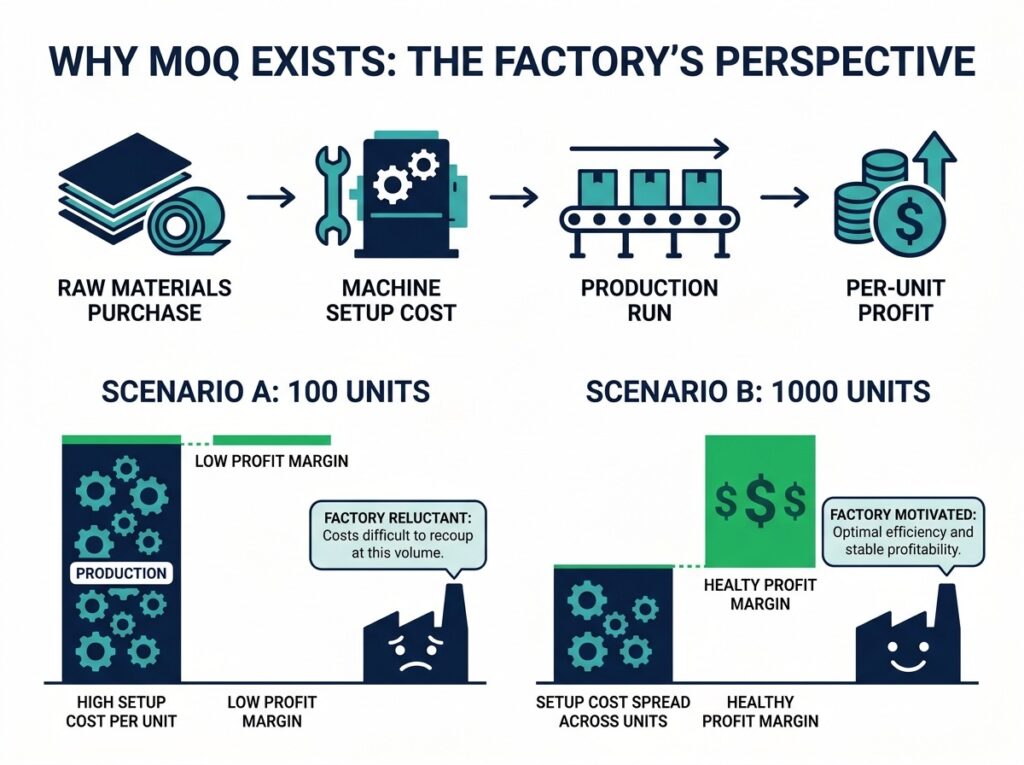
Every production run has fixed costs that don’t scale with volume:
- Raw material sourcing: Factories buy materials in bulk. A minimum purchase from their supplier might be 50kg of fabric or 200kg of plastic granules — whether you order 100 units or 2,000.
- Machine setup: Configuring injection molds, calibrating cutting dies, setting up silk screen frames — this takes hours of skilled labor and costs the same regardless of run size.
- Quality control overhead: The cost of checking 100 units isn’t dramatically lower than checking 500.
- Administrative processing: Creating a production schedule, issuing a work order, coordinating with material suppliers — fixed cost per order, not per unit.
When a factory sets an MOQ of 1,000 units, they’re not being difficult. They’re telling you the volume at which their fixed costs spread thinly enough that the order is worth running. Below that, the margin either disappears or goes negative.
Why MOQ Varies So Much Between Products and Factories
A clothing manufacturer might set an MOQ of 300 pieces per colorway because dye setup requires that volume to be cost-effective. An electronics factory might set 500 units because the PCB run and mold tooling costs are high. A simple packaging supplier might do 100 units because their production is largely automated with low setup cost.
| Product Category | Typical MOQ Range | Key Driver |
|---|---|---|
| Clothing / Apparel | 100–500 per style/color | Dye lot setup |
| Plastic goods (injected) | 500–2,000 | Mold tooling cost |
| Electronics accessories | 300–1,000 | PCB run + assembly |
| Custom packaging | 500–5,000 | Print plate setup |
| Simple hardware | 100–500 | Low setup, high automation |
| Furniture | 20–100 pieces | High unit value, labor intensive |
| Promotional/gift items | 50–500 | Varies widely by material |
These are reference ranges, not rules. The same product at two different factories can have wildly different MOQs depending on their equipment, client base, and current production load.
What Happens When You Order Below MOQ
Factories don’t always say no outright. More often, they say yes — with a price adjustment.
If a factory’s MOQ is 500 units but you want 200, they may accept your order at a higher unit price. The math works like this: they need the order to cover fixed costs plus generate acceptable margin. Fewer units means each unit has to carry more of the fixed cost burden. The unit price goes up accordingly.
The premium for going below MOQ typically runs 20–50% above the standard unit price. On a product quoted at $3.50 per unit at 500 MOQ, you might pay $4.80–$5.25 at 200 units. Sometimes that trade-off is worth it — especially for a first order where you’re validating demand before committing to larger inventory.
Other times, a factory will decline entirely. This usually means one of two things: their current production schedule is full and a small order isn’t worth the scheduling disruption, or your product has high setup costs that can’t be recovered at low volumes regardless of unit price.
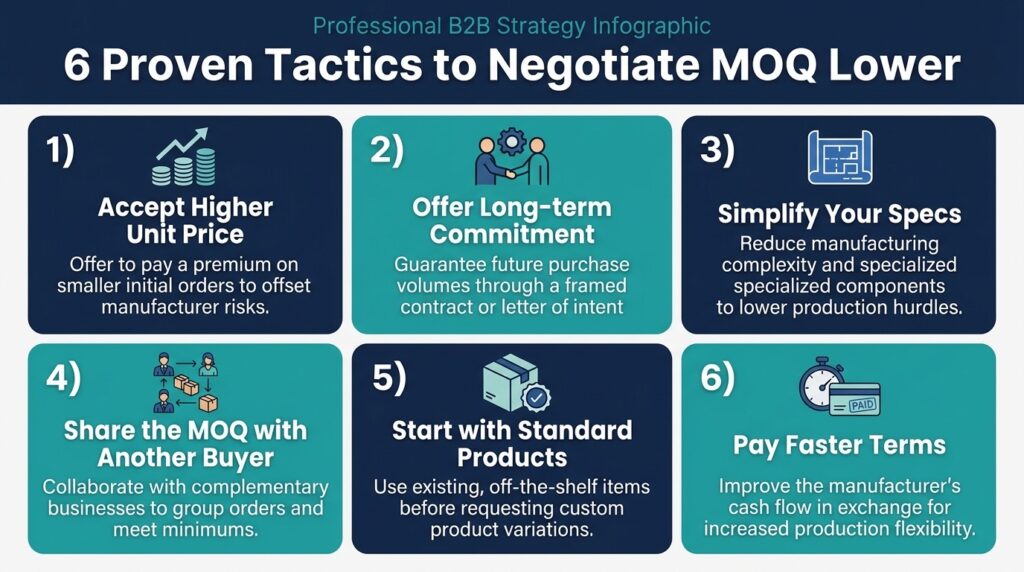
6 Tactics That Actually Work for Lowering MOQ
Understanding the factory’s economics is step one. Step two is using that understanding to create conditions where a lower MOQ makes sense for them too.
Tactic 1: Accept a Higher Unit Price — Explicitly
Rather than just asking “can you lower the MOQ?” tell the factory: “I’d like to order 200 units. I understand this is below your standard MOQ. What would the unit price need to be to make a run of 200 work for you?”
This reframes the conversation. Instead of asking the factory to absorb a loss, you’re inviting them to tell you the economics. Most factories will engage with this question honestly, and the number they give you is usually negotiable.
The key is making the offer explicit and in writing. A factory representative who agrees verbally to a below-MOQ order at a higher price — and then forgets — is a common source of confusion. Get the adjusted unit price and quantity confirmed on the Proforma Invoice before you pay a deposit.
Tactic 2: Offer a Future Volume Commitment
Factories set MOQs partly to protect themselves from unpredictable buyers who place one small order and disappear. If you can credibly commit to future volume, you change the risk calculation.
A Letter of Intent (not legally binding but a formal expression of intent) stating something like: “Subject to satisfactory quality on the initial trial order of 200 units, our intention is to place quarterly orders of 500–1,000 units over the following 12 months” changes the factory’s view of your relationship.
This works best when:
– You can make the commitment plausibly (based on realistic sales projections)
– You’re willing to put something in writing
– The factory has some reason to believe you — a professional website, a track record with other suppliers, a referral from a trusted contact
Don’t make commitments you won’t keep. A factory that feels misled on volume promises becomes a difficult supplier on quality and delivery.
Tactic 3: Simplify Your Product Specifications
Custom specifications drive MOQ up. More colors mean more dye lots. More materials mean more purchasing runs. Custom packaging means more print plate setups. Every layer of customization adds fixed costs that require higher volume to justify.
If you’re struggling with MOQ on a custom product, ask yourself what’s truly essential for your first order. Can you launch with one colorway instead of three? Can you use standard packaging for the first batch and add custom printing once volume justifies it? Can you choose materials that use the factory’s existing stock rather than a special order?
Reducing specification complexity is often the fastest path to a lower MOQ — and it costs you nothing on the factory side.
Tactic 4: Split the MOQ With Another Buyer
For standard products (not custom), this is a legitimate option that’s more common than most buyers realize. If a factory requires 1,000 units and you need 250, finding three other buyers who each need 250 satisfies the MOQ without any one party over-ordering.
This works through:
– Sourcing agents who consolidate orders from multiple clients for the same factory (a standard part of what good agents do)
– Industry communities — buyer forums, trade associations, and Amazon seller groups often have members who will split MOQ on complementary products
– Wholesale platforms — some platforms pool orders from multiple buyers to meet factory MOQ thresholds
The complication: you need to trust whoever you’re sharing an order with, because quality control and delivery timing become collective concerns. This approach is lower-risk for standard products where the spec is fixed and measurable.
Tactic 5: Start With the Factory’s Standard Product Range
Most factories have a catalog of standard products they manufacture regularly for multiple clients. These products have no setup cost — the molds exist, the raw materials are in stock, the production line knows the spec. MOQs on standard products are typically 30–60% lower than on custom orders.
Sourcing a standard product first — even if it’s not your exact final product — lets you establish a relationship with the factory, validate their quality and reliability, and build trust before you ask them to take on a custom development project. Once they know you’re a reliable buyer, MOQ flexibility on custom work follows naturally.
Tactic 6: Offer Better Payment Terms
Factories have cash flow concerns just like any business. A buyer who offers to pay 50% deposit (vs. the standard 30%) or who pays the balance faster (before shipment rather than 30 days after) reduces the factory’s working capital risk on a smaller order.
This doesn’t work with every factory, and it’s more effective in situations where:
– The factory is a small-to-medium operation (larger factories care less about individual order cash flow)
– You’re asking for a significant reduction in MOQ (500 down to 150, for example)
– You can actually execute on the faster payment — don’t offer 50% deposit if it strains your capital
Better payment terms are a concession you’re making; use them strategically, not as your first move.
What to Say: Actual Scripts That Work
Many buyers know the tactics but freeze when it comes time to write the message. Here are three templates you can adapt:
When you need below-MOQ quantity and are willing to pay more:
“Thank you for your quotation. We’d like to start with a trial order of [your quantity] units to validate market demand before committing to larger volumes. We understand this is below your standard MOQ. Could you let us know what the adjusted unit price would be at this quantity? We’re happy to pay a premium for the smaller run.”
When you’re offering future volume:
“We’re planning to launch this product in Q3 and are targeting initial sales of [X] units per month. Our first order would be [small quantity] for product testing, with the intention of placing orders of [larger quantity] every [timeframe] thereafter. Would you be open to accommodating the first order at a lower quantity given this projected ongoing business?”
When asking about standard catalog options:
“We noticed your MOQ for custom products is [X]. Do you have any standard products in a similar category with a lower MOQ that we could order as a first step? We’d like to establish a working relationship before moving into custom development.”
Tone matters. These messages position you as a reasonable business partner who understands the factory’s constraints, not as a buyer trying to extract something for free.
When to Walk Away From an MOQ
Not every MOQ situation is negotiable, and recognizing the no-win scenarios saves you time.
Walk away when:
– The factory is at full capacity and a small order would genuinely disrupt their schedule — they’ll deprioritize it anyway
– The setup cost is genuinely prohibitive (e.g., custom injection molds for a new product require an upfront tooling fee of $3,000–$8,000 that can’t be justified at low volumes)
– The product requires specialized raw materials with high minimum purchase quantities from the factory’s own supplier
Look for a different supplier when:
– Multiple factories for the same product all have the same high MOQ — this is an industry signal that the product genuinely needs volume to be cost-effective
– The factory is unwilling to discuss the economics behind the MOQ — this suggests an inflexible commercial policy rather than a genuine cost constraint
Consider a trading company when:
– You genuinely need very small quantities that no factory will accommodate — trading companies often sell lower quantities by consolidating orders from multiple clients, though at a higher unit price
Related guide → How to Import Products from China: A Step-by-Step Playbook
The Bigger Picture: MOQ as a Market Signal
Across thousands of sourcing conversations, one pattern is consistent: buyers who approach MOQ negotiation transactionally — as an obstacle to get past — have worse outcomes than buyers who approach it educationally.
When you understand why the number exists, you can make a genuine offer that works for both parties. When you’re just trying to get the factory to absorb more risk on your behalf, you get resistance — and when the factory does say yes under pressure, the relationship starts on the wrong foot.
The six tactics above work because each one gives the factory a real reason to say yes. The goal isn’t to extract a concession — it’s to find a commercial arrangement where a smaller first order makes sense for both of you.
That’s the foundation of every good long-term supplier relationship.
If you’d rather have someone with established factory relationships handle this conversation on your behalf — with leverage and local knowledge you don’t have yet — reach out to our team.
Next in the series → 11 China Sourcing Scam Red Flags Every Importer Must Know
MOQ ranges and product category data in this article are based on 2025–2026 sourcing experience across consumer goods, electronics, home products, and apparel categories in Guangdong, Zhejiang, and Fujian provinces.