A buyer who contacts a Chinese factory and asks “what’s your best price?” will receive a price. It will be the factory’s standard export price for an unknown buyer — usually 15–25% above the price the same factory quotes to a buyer who demonstrates order commitment, industry knowledge, and a plausible reorder path.
The difference isn’t usually dramatic in absolute terms, but it compounds. On $40,000 worth of orders per year, a 15% negotiation improvement is $6,000. Over three years, with reorders, it’s meaningful.
Effective negotiation with Chinese suppliers is not aggressive bargaining. It’s structured communication that demonstrates you’re a serious buyer, creates the conditions for mutual concessions, and builds a relationship the factory wants to maintain. This guide covers how to do that across price, MOQ, payment terms, and lead time.

The Negotiation Mindset: What Actually Works in China
Before tactics, the framing:
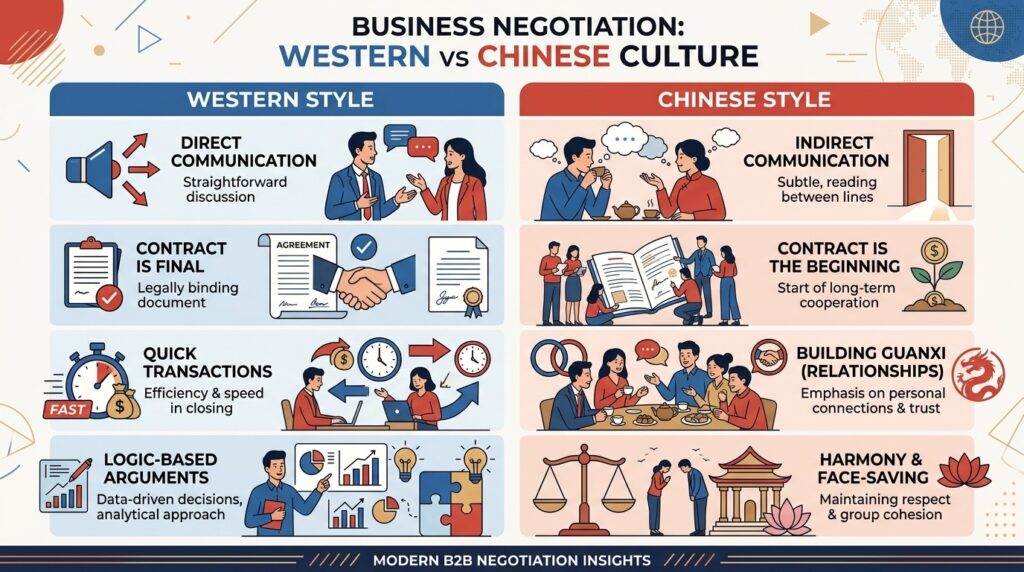
Factories prioritize long-term relationships. Chinese manufacturing culture places high value on stable, repeating business relationships (关系, guānxi). A buyer who demonstrates credibility, consistent reorders, and professional conduct gets progressively better terms over time. Aggressive one-time price extraction that damages the relationship is a short-term win with long-term costs.
Price negotiation is expected, not rude. Quoting a price and expecting the buyer to counter-offer is standard practice. Not negotiating at all signals that you don’t know the market, which makes the factory less confident you’re a serious importer.
Leverage comes from alternatives, not pressure. The most effective negotiation position is “we have other suppliers we’re evaluating” — and meaning it. Factories don’t respond well to aggressive pressure or ultimatums, but they respond strongly to the risk of losing a buyer to a competitor. Genuine competitive evaluation creates real leverage.
Specificity creates credibility. A buyer who says “I need 500 units, in this specific material, with this certification, shipped by this date” is taken more seriously than one who says “I’m interested in buying some of these.” Operational specificity signals that you know what you’re doing and that your order is real.
Negotiating Price
Establish a Target Price Before Any Conversation
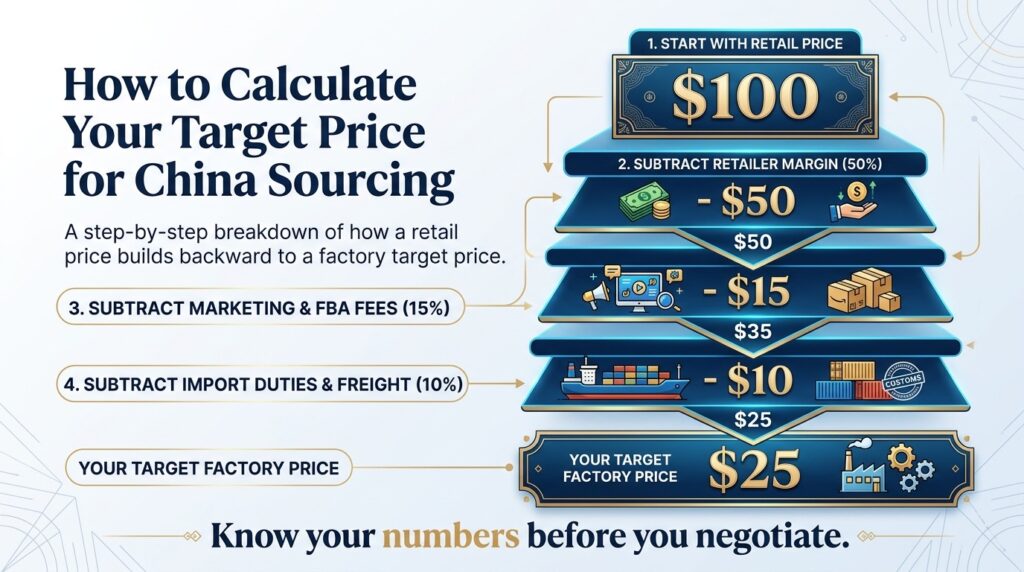
Before contacting suppliers, research the market price for your product. Use:
– Alibaba listings for equivalent products (filter by MOQ similar to yours)
– 1688.com listings (via agent or Google Translate) for domestic pricing reference
– Multiple supplier quotes on the same specification
Your target price should be below the average of competitive quotes by 10–15%. This gives you a realistic negotiating range — asking for 40% discounts produces friction without results; asking for 12% off with a credible order commitment produces movement.
The Effective Price Negotiation Sequence
Step 1 — Get multiple quotes on identical specifications.
Send the same detailed specification to 3–5 candidate suppliers simultaneously. When you respond to each one, you can honestly say “we’re evaluating multiple suppliers on this specification.”
Step 2 — Counter-offer with a specific number, not a percentage request.
Don’t say “can you do better?” Say: “We’re targeting USD 4.20/unit FOB Shenzhen for 1,000 pcs. Our other quotes are coming in around this level. Can you match this?” A specific number anchors the negotiation and gives the factory a clear decision to make.
Step 3 — Justify your target with volume or relationship.
“We place orders every 6–8 weeks. If the first order goes well, we expect to reorder at 2–3x this quantity within 90 days.” This gives the factory a reason to offer you a better price — not as a concession, but as an investment in a future relationship.
Step 4 — Offer something in exchange for price concessions.
The most effective negotiation exchanges are: accept a slightly longer lead time → get a better price; increase quantity by 20% → get a better per-unit price; simplify packaging → reduce cost; accept payment of 50% vs. 30% upfront → get a small price improvement.
Step 5 — Accept gracefully or walk away cleanly.
If the factory’s best price is still above your target, either accept (if the supplier is otherwise strong) or disengage professionally: “Thank you — we’ll proceed with a different supplier for this round, but we’d like to work with you on future products.” This leaves the door open and is often followed by a revised offer within 48 hours.
Negotiating MOQ
Minimum order quantities frustrate most new importers. Factory MOQs reflect production economics — setup costs, material procurement minimums, and scheduling efficiency. They’re not arbitrary.
When MOQ Negotiation Works
You commit to a higher total quantity over time. “Our first order is 300 units, but we’ll reorder 1,000 units within 60 days if the product performs.” Some factories will accept below-MOQ first orders with a written commitment to the reorder.
You accept a price premium for small quantity. Factories have a per-unit economics floor. If you accept $0.80–1.50/unit above their standard pricing to cover the fixed cost of a smaller run, many will agree to lower MOQs.
You consolidate with other products. “We’re ordering 300 units of Product A and 200 units of Product B — can we run both together to meet the MOQ?” Factories that make multiple product types often calculate MOQ on total production value, not per-SKU unit count.
You’re flexible on color or finish. If the factory already has another order running in a specific color, adding your order to that run reduces their MOQ threshold substantially. Ask: “What colors are you currently running in production? We can be flexible on color if it helps us work with a lower MOQ.”
When MOQ Is Fixed
Some factory MOQs are genuinely fixed — tooling minimums, material batch sizes, or contractual obligations with their own suppliers. When you hit a real floor, your options are: accept the MOQ, find a trading company that aggregates smaller orders, or switch to a different factory with lower MOQs (often at higher per-unit cost).
Negotiating Payment Terms
Payment terms are often more negotiable than price, and the risk impact of payment structure is often more significant than a 5% price difference.
Standard starting position: Request 30% deposit / 70% against bill of lading. Most legitimate factories accept this — 30% covers raw material costs. If a factory demands 50%+ upfront from a new buyer, that’s negotiable.
Leverage for better terms:
– Reference your payment history with other factories: “We’ve worked with [X] factories on 30/70 terms without issues — this is our standard.”
– Offer a slightly higher price in exchange for better payment terms: “We can pay $0.10/unit more, but we need 30/70 against inspection.”
– Offer faster payment on the balance: “We’ll wire the 70% within 24 hours of receiving the B/L — would that work for 30/70 terms?”
What not to negotiate on: Never reduce deposit below 20–25% — factories need working capital for materials. A factory that accepts 0% deposit has either already produced the goods (not your custom order) or has cash flow concerns that should worry you.
Negotiating Lead Time
Lead time is often constrained by real production scheduling, but there is room to negotiate:
Book early: Factories plan production schedules in advance. Buyers who confirm orders 4–6 weeks earlier than needed often get better scheduling priority and sometimes lower prices (predictable production is cheaper to operate than rush production).
Be explicit about your deadline: “We need goods to ship by [date] to arrive in time for [event/season].” Factories that know the reason for a deadline often work harder to meet it than those who receive a generic request.
Ask what delays the timeline: “What’s your current production queue? Is there anything we can do on our end to help you start earlier?” Sometimes the delay is specification finalization — your faster approval of samples can pull the timeline forward.
Accept longer lead time for a better price: “If you need an extra 10 days, we can be flexible — would that allow you to offer a better unit price?” This frequently works and produces mutual benefit.
Cultural Considerations That Matter
Save face in both directions. Aggressive public criticism of a supplier’s quality or price — especially in group communications — damages the relationship. Address problems privately and frame them as collaborative problem-solving rather than accusations.
Relationship before transaction. A brief video call before the first order, following up after samples arrive, expressing genuine interest in how their production is going — these small investments in the human relationship compound into better terms and better service over time.
Patience with timelines. Chinese New Year (January/February), Golden Week (October), and other public holidays create factory downtime that buyers often don’t account for. Factor these into production scheduling and don’t use them as negotiation leverage — they’re structural, not factory-specific delays.
Written confirmation of verbal agreements. Always follow up a phone or video negotiation with a written summary of what was agreed. “Per our call today, we’ve agreed: 500 units at USD 4.20 FOB Shenzhen, 30/70 payment, ship by October 15.” This creates the paper trail and also surfaces any misunderstandings before they become disputes.
Related reading → Payment Terms with Chinese Suppliers: T/T, L/C, and Trade Assurance
Related reading → How to Write a Purchase Order for Chinese Suppliers
Need experienced negotiation support for a specific supplier? Our sourcing team negotiates on behalf of clients across all product categories.