An e-commerce seller sourced silicone kitchen products from a Guangdong factory at $3.20/unit FOB. Shipping, insurance, and freight to the US added $0.45/unit. So far: $3.65 landed at port.
Then customs: standard MFN duty on silicone kitchen articles (HTS 3924.10) is 6.5%. Section 301 tariff on this product category: 15%. Total duty: 21.5% × $3.65 = $0.78/unit. Total landed cost: $4.43/unit.
The seller had priced for a $3.65 landed cost. The actual landed cost was 21% higher. On 10,000 units, that’s $7,800 of unplanned cost that compressed the margin on a product the seller had already committed to importing.
This happens routinely to importers who treat duty calculation as something to figure out after the sourcing decision is made. This guide makes sure it doesn’t happen to you.
How Import Duties Work: The Basics
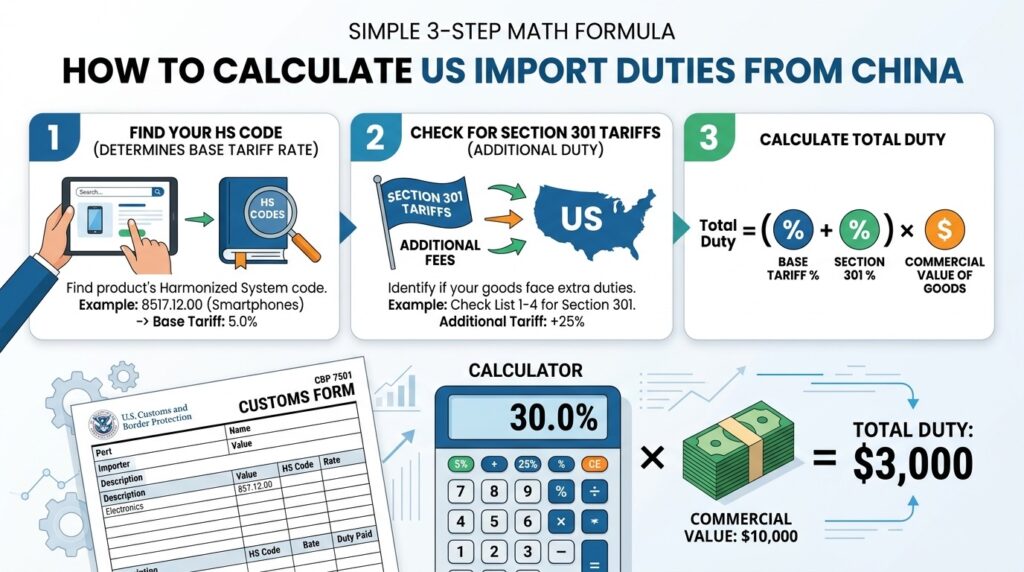
Import duties are taxes charged by the destination country’s customs authority on goods entering from foreign countries. They are calculated as a percentage of the customs value of the goods — typically the CIF value (cost + insurance + freight to the destination country’s port) in most markets, or the FOB value in the US.
Every product has an HS code: The Harmonized System (HS) is the international standard classification for traded goods — a 6-digit code that identifies what a product is, used by customs authorities worldwide. Countries add additional digits to create their own tariff schedules (8-digit in the EU, 10-digit HTS in the US).
The HS code determines the duty rate. Different products have different duty rates. A stainless steel kitchen knife might have a 0% base duty rate; a stainless steel consumer electronic device might have 3.7%. The specific HS classification for your product determines what rate applies — which is why misclassification (intentional or accidental) is both risky and common.
Finding the Right HS Code for Your Product
For US Importers: HTS (Harmonized Tariff Schedule)
The USITC (United States International Trade Commission) maintains the US HTS at hts.usitc.gov. You can search by product keyword or browse by chapter. Each 10-digit HTS number shows:
– General duty rate (applies to most-favored-nation countries, including China)
– Special rates (for free trade agreement partners — does not apply to China)
– Column 2 rate (applies to non-MFN countries, not China)
– Section 301 tariff designation (where applicable)
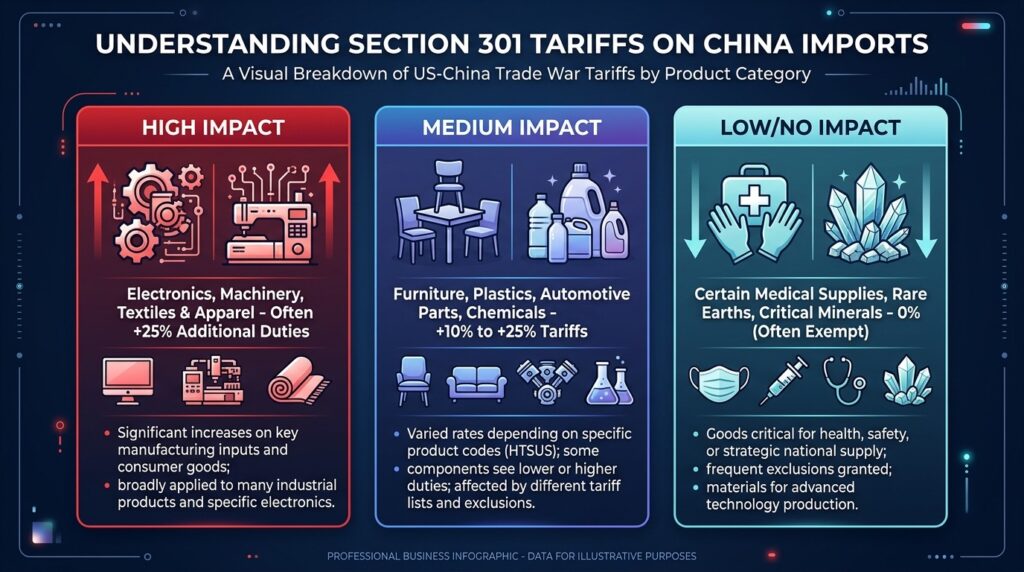
The Section 301 complication: Starting in 2018, the US imposed additional tariffs on Chinese goods under Section 301 of the Trade Act. These apply on top of standard MFN rates and range from 7.5% to 25% depending on the product category (with some categories at higher rates after 2024 updates). You must look up both the standard HTS duty and whether Section 301 applies to your HTS number.
Check Section 301 applicability at: ustr.gov (US Trade Representative) Section 301 tariff lists.
For EU Importers: Combined Nomenclature (CN)
The EU uses the Combined Nomenclature — an 8-digit code based on the HS system. The EU’s TARIC database (taxation and customs union, ec.europa.eu/taxation_customs/dds2/taric) is the reference. Enter your CN code and destination EU member state to see the applicable duty rate.
The EU has not imposed blanket additional tariffs on Chinese goods equivalent to US Section 301, but has implemented specific anti-dumping duties on certain product categories (steel, solar panels, ceramic tiles, e-bikes, and others). Check TARIC for anti-dumping duty flags on your product.
For UK Importers (Post-Brexit)
The UK Global Tariff replaced EU CN codes with UK Global Trade Tariff codes. Reference: gov.uk/trade-tariff. Standard UK duty rates are broadly similar to EU rates, but differ in specific categories. The UK has its own anti-dumping duties that don’t always match EU ones.
Current US Tariff Situation for Chinese Goods (2026)
The US-China tariff environment has evolved significantly since 2018 and continues to change. As of 2026:
Standard MFN duties: Range from 0% (many electronics components, some raw materials) to 20%+ (some apparel categories). Average across all Chinese imports is approximately 6–8% before Section 301.
Section 301 tariffs (Lists 1–4B): Apply to approximately $370 billion worth of Chinese goods annually. Rates:
– List 1 (machinery, aerospace): 25%
– List 2 (chemicals, steel): 25%
– List 3 (consumer goods, electronics): 25% (raised from 10% in 2024)
– List 4A (general consumer goods): 7.5%
– List 4B (initially suspended, now partially in effect): 7.5%–25%
Combined effective tariff on common categories (illustrative):
| Product Category | HTS Chapter | Base Duty | Sec. 301 | Total |
|---|---|---|---|---|
| Plastic consumer goods | 3924 | 3.4–6.5% | 15% | 18.4–21.5% |
| Consumer electronics | 8517/8518 | 0–3.7% | 25% | 25–28.7% |
| Clothing (woven) | 61–62 | 12–32% | 7.5% | 19.5–39.5% |
| Metal hardware | 8302 | 3.9–5% | 25% | 28.9–30% |
| Toys | 9503 | 0% | 0% | 0% |
| Furniture | 9401–9403 | 0% | 25% | 25% |
Note: Tariff rates change. Always verify current rates in USITC HTS and USTR Section 301 lists before finalizing sourcing decisions.
Calculating Your Landed Cost Correctly
US landed cost formula:
FOB Price
+ Ocean/Air Freight
+ Marine Insurance (~0.3-0.5% of cargo value)
= CIF Value (used in some calculations)

For US duty calculation:
Dutiable Value = FOB value (US customs uses FOB, not CIF)
Duty = Dutiable Value × (MFN rate + Section 301 rate)

Total Landed Cost at Port =
  FOB + Freight + Insurance + Duty + Customs Broker Fee ($150-400)
  + Port/Handling Fees ($200-500)

Total Landed Cost (Delivered) =
  Port costs above + Inland freight to your warehouse
Work backward from retail price:
Sustainable DTC margin requires landed cost at ≤30–35% of retail price. For Amazon FBA, landed cost should be ≤25–30% of retail given additional FBA fees. If your landed cost calculation (including duties) exceeds this threshold, the product is not viable at your planned retail price — not a sourcing problem, a product selection problem.
Legal Strategies to Reduce Tariff Exposure
1. Correct HS Classification
Ensure your product is correctly — not aggressively — classified. Products can legitimately fall into multiple HS categories depending on their primary function and composition. A correctly classified product in a lower-duty category is legal; misclassification for duty avoidance is customs fraud.
Work with a licensed customs broker to confirm your classification, especially for products that could plausibly be classified in multiple chapters.
2. First Sale Valuation (US)
For goods that pass through an intermediary before US import, US customs allows valuation based on the “first sale” price (factory to importer) rather than the “last sale” price (intermediary to importer). This reduces the dutiable value when trading companies are involved. Requires documentation of the manufacturing transaction.
3. Bonded Warehouses and Foreign Trade Zones (US)
Goods stored in a licensed bonded warehouse or Foreign Trade Zone (FTZ) don’t pay duty until released for US consumption. If you re-export some portion of your inventory, you don’t pay duty on that portion at all. Useful for businesses with mixed domestic/international distribution.
4. Section 301 Exclusion Requests
USTR periodically opens exclusion request processes for specific Section 301 HTS categories. Businesses can apply for exclusions if they can demonstrate that: the product is not available from non-Chinese sources, and/or the tariff causes severe economic harm. Approved exclusions are retroactive. Monitor USTR announcements for open exclusion periods.
5. Manufacturing Relocation Considerations
For high-volume, high-tariff categories, some importers have shifted production to Vietnam, Bangladesh, Cambodia, or Mexico (for USMCA compliance). This is a significant supply chain decision with its own risks and costs — not a first-order solution, but relevant for businesses where Chinese goods are subject to 25%+ combined tariff rates.
Related reading → How to Find a Freight Forwarder for China Imports
Related reading → Incoterms Explained: Which Shipping Terms Protect China Importers
Questions about duty calculation or HS classification for specific products? Our sourcing team works with licensed customs brokers and can help estimate landed costs before you commit to sourcing.