A massive percentage of manufacturing defects aren’t caused by factory negligence; they are caused by miscommunication. When dealing with Chinese suppliers, the language barrier is real, but it is entirely manageable if you adapt your communication style.
If you write emails to Chinese factories the same way you write to colleagues in New York or London, you are asking for trouble. Here is how to communicate clearly and avoid expensive misunderstandings.
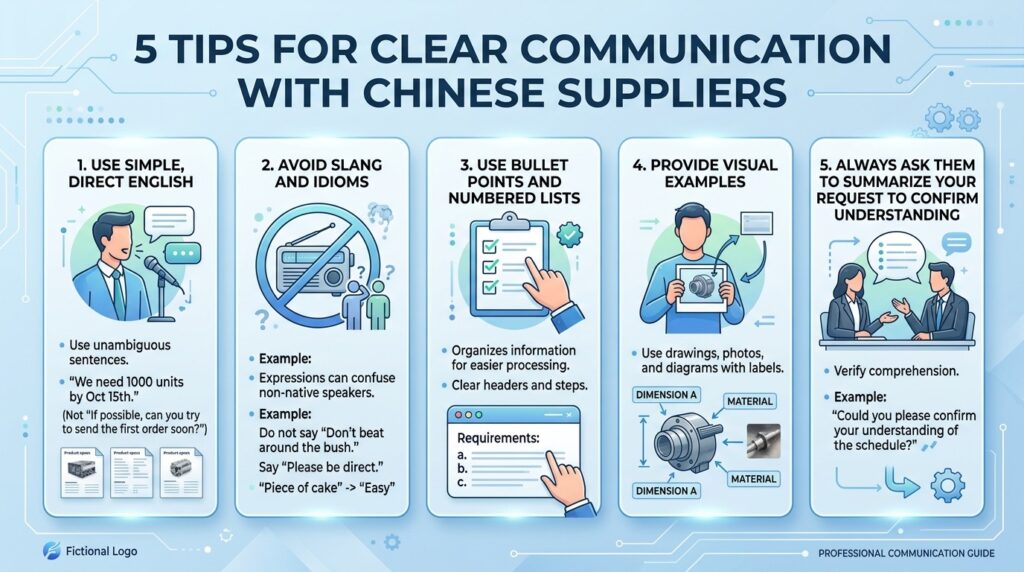
1. The Golden Rules of Written Communication
Most of your communication with suppliers will be written. English proficiency varies wildly among factory sales reps.
Keep It Simple
Use short, declarative sentences. Do not use compound sentences with multiple clauses.
- Bad: “If it’s not too much trouble, we’d like to see if you could possibly expedite the sample shipping, assuming it doesn’t compromise the quality.”
- Good: “Please ship the sample faster. Do not reduce the quality.”
Avoid Idioms and Slang
Phrases like “hit the ground running,” “ballpark figure,” or “on the same page” do not translate well. Use literal language.
Number Your Points
If you send a paragraph with three questions, you will usually only get an answer to the last one. Always use numbered lists.
1. Question 1
2. Question 2
3. Question 3
2. Using Visuals Instead of Words
A picture is worth a thousand words, especially when those words need translating.
Whenever possible, replace text with images. If you need a specific dimension changed, don’t just describe it. Take a photo of the product, draw a red arrow pointing to the exact spot, and write the new dimension next to it.
If a sample arrives with a defect, send a side-by-side photo: “Sample A (Correct)” and “Sample B (Wrong).” Red circles and arrows are your best friends in international sourcing.
3. Mastering WeChat
If you are sourcing from China, you must use WeChat. It is the lifeblood of Chinese business communication.
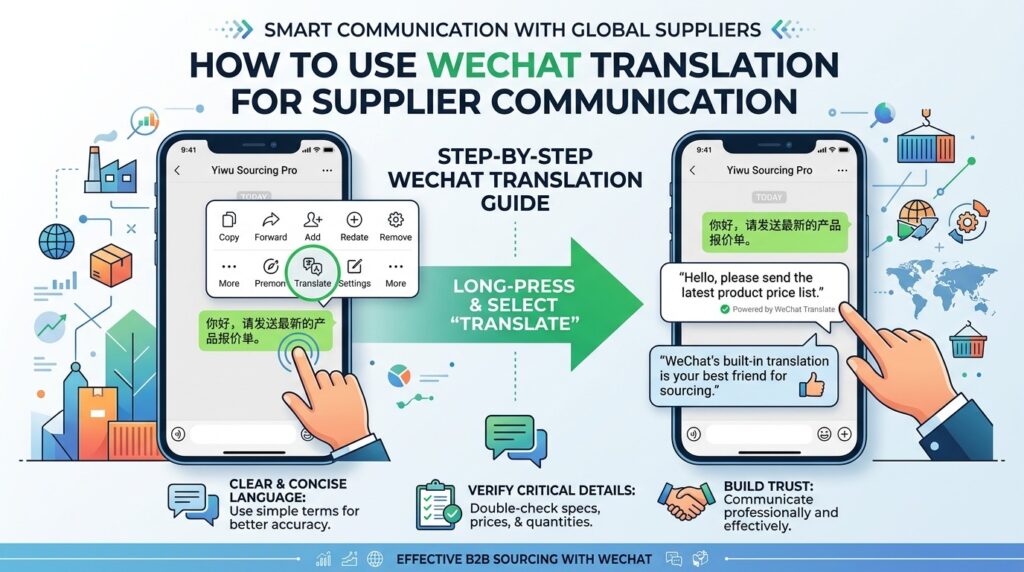
The Translation Feature
WeChat has a built-in translation tool. If a supplier messages you in Chinese, you simply long-press the message and tap “Translate.” It is incredibly efficient.
Because both parties are often using translation tools, it is even more critical to keep your sentences simple and grammatically correct to ensure the translation AI doesn’t get confused.
Summary: What to Take Away
Clear communication with Chinese suppliers requires intention. Simplify your English, rely heavily on visual aids, and embrace WeChat.
If you are struggling to get clear answers from your suppliers, reach out to our sourcing team. We have native speakers on the ground who can bridge the gap.
Further reading → How to Write a Purchase Order for a Chinese Supplier
Frequently Asked Questions
Q: Why do miscommunications happen so often with Chinese suppliers?
A: Most factory sales reps have varying levels of English proficiency, and complex sentences, idioms, and slang often get lost in translation — leading to costly mistakes even when the factory isn’t at fault.
Q: What’s the fastest way to explain a product change to a factory?
A: Use images instead of long descriptions. Take a photo of the product, draw a red arrow at the spot that needs to change, and write the new instruction directly next to it.
Q: Do I need to use WeChat to communicate with Chinese suppliers?
A: Yes, in most cases. WeChat is the standard business communication tool in China and includes a built-in translation feature that lets you read and reply to messages in real time.