Most importers treat the purchase order as an administrative step — something you send to a factory after the real negotiation is done. This is a costly misunderstanding.
The purchase order is the legal document that defines your agreement with a Chinese factory. When goods arrive and something is wrong — wrong color, wrong material, wrong quantity, wrong packaging — the purchase order is the first thing both parties refer to. If what went wrong is clearly documented as a deviation from PO terms, you have a strong basis for a claim. If the PO was vague, generic, or silent on the relevant point, the factory’s position is essentially: “We made what you ordered.”
This guide covers what a China-ready purchase order must contain, why each element matters, and what happens when key clauses are missing.
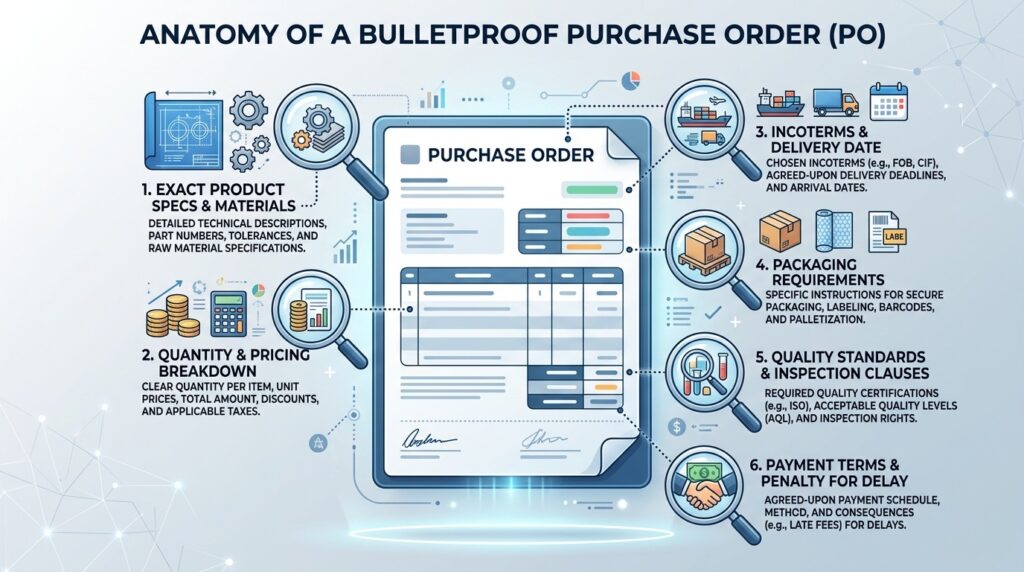
Why a Standard “PO Template” Isn’t Enough for China
Generic purchase order templates — the kind that come with accounting software or business form websites — cover the basics: item name, quantity, unit price, total. For China sourcing, they’re inadequate.
The gaps matter because:
Chinese factories operate on detailed specifications. A vague item description (“blue water bottle, 500ml”) leaves every material, finish, and packaging decision to the factory’s discretion. Their discretion will favor production efficiency, not your requirements.
Quality standards must be defined to be enforceable. “Good quality” is not a specification. Without measurable quality criteria, a factory can argue that any production output meets the requirement — because you never defined what “good” meant.
Lead times and delivery terms must be explicit. A factory that misses your delivery window by three weeks can claim force majeure, production complexity, or supply chain disruption. A PO that specifies production lead time, ship date, and consequences for delay gives you something to stand on.
The 12 Essential Clauses in a China Purchase Order
1. Buyer and Seller Information
Full legal entity names, registered addresses, and contact details for both parties. The seller name must match the company name on their business license — not a trading name or nickname.
2. PO Number and Date
A unique reference number you generate. All subsequent communication, shipment documents, and invoice numbers should reference this PO. This makes documentation tracking traceable across the entire order cycle.
3. Product Specification — In Detail
This is the most important section and the one most often under-specified. For each line item, include:
- Full product name (English and Chinese if possible)
- SKU or product code
- Materials and composition (specify grades, not just types: “304 stainless steel” not “stainless steel”; “180gsm 100% cotton” not “cotton”)
- Color (Pantone or RAL reference — not descriptive color names)
- Dimensions with tolerances (e.g., “300mm × 200mm × 15mm, ±2mm”)
- Weight
- Finish / surface treatment
- Any unique features or components
4. Approved Sample Reference
“Production must conform to the approved pre-production sample dated [date], held by buyer. Any deviation from the approved sample requires buyer’s written approval before proceeding.”
This links the PO to your Golden Sample and makes sample conformity a contractual requirement.
5. Quantity and Unit Price
- Quantity per SKU
- Unit price (in USD or your agreed currency — specify the currency explicitly)
- Total order value
- Price basis (FOB [city], EXW, DDP — specify the Incoterm clearly)
6. Production Lead Time
“Production to be completed within [X] calendar days of PO confirmation and deposit receipt.” Be specific about what triggers the clock — factories sometimes argue that “production started” begins when they feel ready, not when you confirmed the order.
7. Shipping Terms
- Incoterm (FOB Shanghai, EXW Guangzhou, etc.)
- Latest ship date from factory / port
- Destination port or address
- Packaging and carton requirements (dimensions, weight limits, label requirements)
- FNSKU labeling instructions if shipping to Amazon FBA
8. Quality Standards and Inspection Rights
“Goods must conform to [specific standards]. Buyer reserves the right to conduct pre-shipment inspection before goods leave origin. Factory must provide 5 business days’ notice before goods are ready for inspection and must provide access to goods and facilities.”
Include your acceptable defect rate: “AQL 2.5 for major defects, AQL 4.0 for minor defects” is a standard starting point for most consumer goods.
9. Packaging Requirements
Specify in detail:
– Inner packaging (poly bag, foam, blister — material, dimensions)
– Outer carton (dimensions, weight, corrugated grade — e.g., “5-ply corrugated”)
– Carton labeling (what information must appear on each carton face)
– Units per inner pack, inner packs per carton
– Pallet requirements if applicable
10. Payment Terms
- Deposit amount and timing (e.g., “30% upon PO confirmation”)
- Balance payment trigger (e.g., “70% against bill of lading” or “70% after pre-shipment inspection approval”)
- Payment method (T/T, Letter of Credit, Alibaba Trade Assurance — specify)
- Bank account details for wire transfer (and the instruction to phone-verify any account change request)
11. Compliance and Certification Requirements
“Supplier confirms that goods comply with [list applicable standards: REACH, RoHS, CPSC, ASTM, CE, FCC, etc.] and will provide test reports from accredited third-party laboratories upon request.”
For regulated product categories, list the specific certifications required as a condition of payment.
12. Dispute Resolution
“Any disputes arising from this purchase order shall be resolved by [specify: negotiation first; if unresolved, arbitration under [CIETAC / ICC / local court jurisdiction]].”
Specifying Chinese arbitration (CIETAC is China’s main international arbitration body) is often more practically enforceable than specifying your home country courts — Chinese courts are unlikely to enforce foreign court judgments against Chinese entities.
A Practical PO Template Structure
PURCHASE ORDER

PO Number: [PO-2026-0001]
PO Date: [Date]

BUYER:
[Company Name], [Registered Address], [Country]
Contact: [Name, Email, Phone]

SELLER:
[Company Legal Name], [Registered Address, China]
Contact: [Name, Email, WeChat/Phone]
Business License No.: [18-digit USCC]

─────────────────────────────────────────────

LINE ITEMS:

Item 1:
  Product Name: [Full product name]
  SKU: [Your SKU code]
  Specification: [Material / Dimensions / Color (Pantone) / Weight / Finish]
  Quantity: [X] units
  Unit Price: USD [X.XX] FOB [Port]
  Line Total: USD [X,XXX.XX]

[Repeat for additional items]

ORDER TOTAL: USD [XX,XXX.XX]

─────────────────────────────────────────────

TERMS AND CONDITIONS:

1. APPROVED SAMPLE: Production must conform to approved PPS dated [date].
2. LEAD TIME: [X] calendar days from deposit receipt.
3. SHIP DATE: No later than [Date] from [Origin Port].
4. INCOTERM: FOB [Port], FREIGHT COLLECT
5. QUALITY: AQL 2.5 major / AQL 4.0 minor. Pre-shipment inspection rights reserved.
6. PACKAGING: [Detailed packaging spec — see Section 9 above]
7. PAYMENT: [30% deposit on PO confirmation / 70% against B/L copy]
8. COMPLIANCE: [List applicable certifications required]
9. DISPUTE: CIETAC arbitration, Guangzhou seat

BUYER SIGNATURE: _______________ Date: ______
SELLER CONFIRMATION: ___________ Date: ______
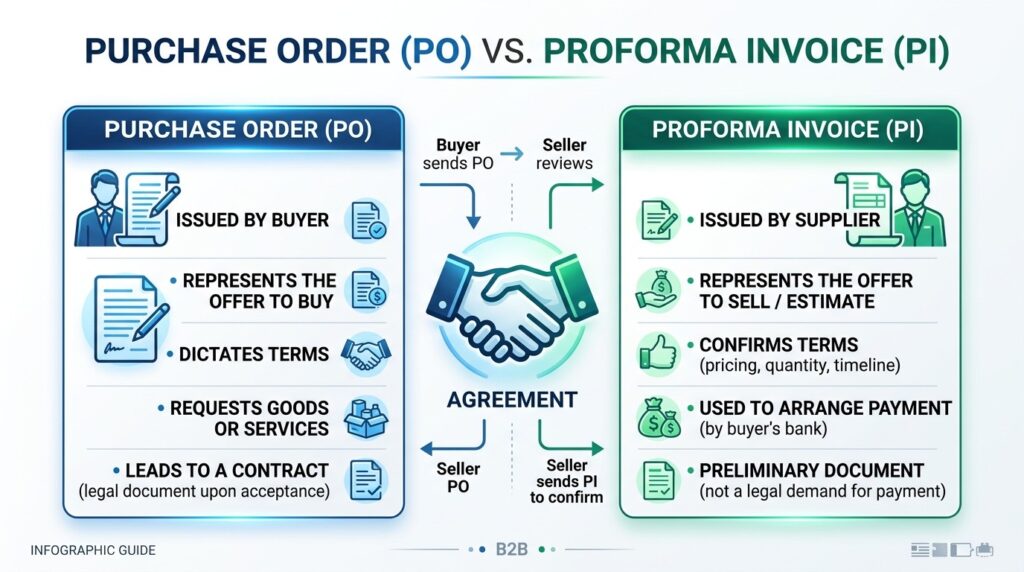
What Happens Without a Detailed PO
Scenario A — Wrong material:
Your PO said “stainless steel water bottle.” Factory shipped aluminum. Without a material specification, the factory argues “stainless steel” referred to the exterior finish, not the body material. Dispute takes 3 months; you absorb a 60% refund.
Scenario B — Wrong color:
Your PO said “navy blue.” Factory produced a color they call navy blue that looks purple in natural light. Without a Pantone reference, the dispute is unresolvable. No refund.
Scenario C — Packaging failure:
Your goods arrive at Amazon FBA and are rejected because carton labeling doesn’t meet FBA requirements. Your PO didn’t specify labeling requirements. You pay return shipping + relabeling. Factory position: “You didn’t tell us.”
Scenario D — Late delivery:
Factory is 4 weeks late on a seasonal product order, costing you the selling window. Your PO has a ship date but no consequence clause. No compensation.
A detailed PO prevents most of these outcomes — not because it’s a magic document, but because writing it forces both parties to agree on specifics before production, when changes are cheap.
Related reading → Payment Terms with Chinese Suppliers: T/T, L/C, and Trade Assurance Explained
Related reading → How to Verify a Chinese Supplier Before You Pay
Need help reviewing or drafting supplier purchase orders for your China sourcing program? Our team assists clients with PO preparation and supplier contract review.