A buyer reached out to us last year after losing $22,000 to a supplier they found through a Google search. The website looked professional. The product photos were high-resolution. The price was competitive but not suspiciously low. They exchanged a dozen emails, everything seemed fine, and then they wired the deposit.
The supplier went quiet. The website disappeared four days later.
This is not a freak occurrence. Sourcing fraud targeting overseas buyers is a persistent, well-organized problem — and the tactics have gotten more sophisticated. Fake verification badges, cloned factory websites, Alibaba accounts with borrowed reviews — the surface presentation has never been easier to fabricate.
What follows is the verification process we use before recommending any supplier to a client. It’s not foolproof — nothing is — but working through these seven steps systematically catches the vast majority of bad actors and significantly reduces your risk with everyone else.

Why Supplier Verification Matters More Than Platform Trust
A common misconception: if a supplier is on Alibaba with Trade Assurance, they’re safe.
Trade Assurance protects you financially if an order fails to ship or doesn’t match the agreed specification. It does not prevent a fraudulent supplier from accepting your payment and providing nothing. It does not protect you from quality manipulation. And it requires you to file and win a dispute claim — a process that can take weeks and isn’t always resolved in the buyer’s favor.
Platform listings — on Alibaba, Made-in-China, Global Sources — are not the same as verification. They’re directories with varying levels of vetting. Treat platform presence as a starting point, not a conclusion.
Real verification means confirming, through independent channels, that:
1. The business entity is legally registered and active
2. The entity is what it claims to be (factory vs. trading company)
3. The entity has a credible track record of export
4. The product capability matches what’s being claimed
Here’s how to do that.
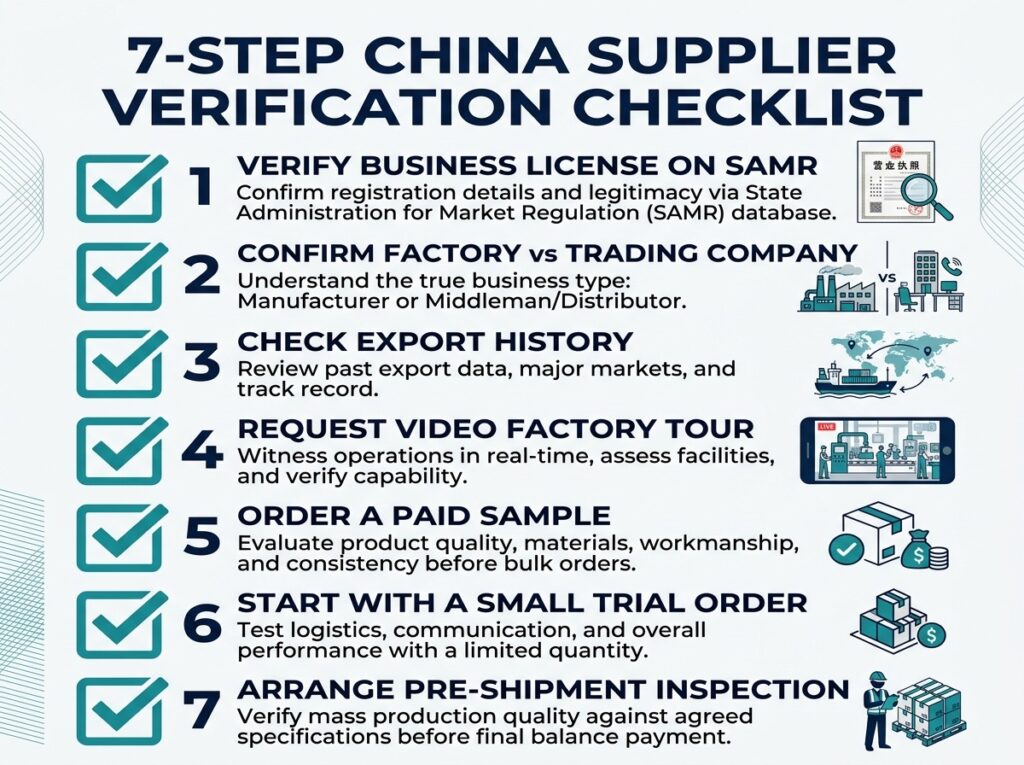
The 7-Step China Supplier Verification Process
Step 1: Verify the Business License Through China’s Official Registry
Every legitimate Chinese business has a registered business license (营业执照, yíngyè zhízhào) issued by the State Administration for Market Regulation (SAMR). This is a public record, and it’s searchable.
How to check:
Ask the supplier for a copy of their business license. Then verify it independently through:
- National Enterprise Credit Information Publicity System (qixin.samr.gov.cn) — China’s official business registry. Search by company name or Unified Social Credit Code (统一社会信用代码, an 18-digit number on every license).
- Tianyancha (tianyancha.com) or Qichacha (qcc.com) — Chinese business intelligence platforms with English-partial interfaces. Both show registration status, legal representative, registered capital, and litigation history.
What you’re confirming:
– The company name on the license matches what they’ve told you
– The business is currently active (not cancelled or suspended)
– The registered address is consistent with what they’ve provided
– The business scope includes manufacturing or trading of your product type
Red flag: The license shows a registered capital of ¥10,000–50,000 (roughly $1,400–$7,000). For a factory claiming to export $500,000+ in goods annually, that’s inconsistent. Legitimate manufacturers typically have registered capital in the ¥500,000–5,000,000+ range.
Step 2: Determine If They’re a Factory or a Trading Company
This matters for two reasons: price and accountability. Factories have direct control over production quality and can modify specs. Trading companies don’t — they’re purchasing from a manufacturer and reselling. When something goes wrong in production, the trading company is one more layer between you and the person who can fix it.
How to tell them apart:
- Business scope on the license: Factory registrations typically include “manufacturing” (制造, zhìzào) or “production” (生产, shēngchǎn). Trading companies are registered for “trade” (贸易, màoyì) or “commerce” (商贸, shāngmào).
- Company name suffix: In Chinese, factories often have “厂” (chǎng, factory) or “制造有限公司” (manufacturing Co., Ltd.) in their name. Trading companies often have “贸易有限公司” (trading Co., Ltd.).
- Cross-reference on 1688: Search the supplier’s product on 1688. If the same factory appears there at a lower price, that’s confirmation they’re a direct manufacturer. If you can’t find them, they may be a trading company buying from a factory you haven’t identified.
- Ask directly: “Are you the manufacturer or a trading company?” A legitimate factory answers without hesitation. A trading company often hedges — “we have our own factory and also work with partner factories” is code for trading company.
Trading companies aren’t automatically bad. Some are well-managed, have excellent factory relationships, and provide genuinely useful services. But you should know what you’re dealing with before you negotiate price or assign quality responsibility.
Step 3: Check Their Export History
A supplier claiming five years of export experience should have a verifiable track record. Here’s how to check:
Customs export data: Companies like ImportYeti (importyeti.com), Panjiva, or Flexport’s supplier search tool compile US Customs import records, which are publicly available. Search for the supplier’s company name or the name of their products. If they’ve been exporting to the US, you’ll see shipment history — dates, ports, volumes, and the names of their US buyers.
This tells you:
– Whether they actually export (or just claim to)
– Who their existing buyers are (you can sometimes contact these companies directly as references)
– What products they’ve shipped and in what volumes
– Whether their export activity has been consistent or has suddenly spiked (a red flag for a newly-fabricated export history)
Ask for customer references: Request contact details for two or three existing overseas customers, preferably in markets similar to yours. Then contact them. Ask: did the goods arrive as described? Were there quality issues? How did the supplier handle problems?
A supplier who can’t or won’t provide references has either no significant export history or clients they don’t want you to talk to. Both are concerning.
Step 4: Request a Live Video Call and Virtual Factory Tour
In 2026, a request for a video call is a completely standard part of the supplier vetting process. Any supplier serious about doing business will accommodate it. Anyone who refuses, deflects, or offers only pre-recorded videos is raising a significant flag.
What to ask for on the video call:
- A live walk through the production floor — not the showroom, the actual factory
- Show the machinery they claim to use for your product category
- Show the current production line (if active)
- Hold up the product you’ve been discussing and point to the specifications you care about
- Show the quality control area
What to observe:
- Does the factory match the scale they’ve implied? A supplier claiming to produce 100,000 units per month should not be standing in a room with ten workers.
- Are there products being produced that look consistent with what they’re selling you?
- Do the workers seem familiar with the products, or is it clearly unfamiliar territory?
- Does the factory address visible on signage or elsewhere match their registered address?
Video calls also give you a read on the individual you’re dealing with. Someone comfortable, confident, and transparent on camera is a better sign than someone nervous, evasive, or reading from a script.
Step 5: Order a Paid Sample — and Evaluate It Against Your Spec
A free sample costs you nothing — and tells you proportionally little. When a factory provides a free sample, they often send their best showroom piece, not a representative production unit. When you pay for a sample (typically $20–$150 plus courier), you’re ordering a production sample — made through the actual manufacturing process.
What to specify when ordering:
Send your written spec sheet with the sample request. Be explicit: you want a sample that reflects actual production quality, made from the materials specified, with the packaging and labeling as discussed.
How to evaluate the sample:
Don’t just look at it. Test it.
| Evaluation Area | What to Check |
|---|---|
| Dimensions | Measure against your spec — every dimension |
| Material | Feel, weight, texture — does it match what was quoted? |
| Color | Compare against your Pantone reference or approved swatch |
| Function | Does it work correctly under normal use? |
| Stress test | What happens under reasonable physical stress? |
| Packaging | Is it protective? Does labeling match your requirements? |
| Smell | Unusual chemical smells can indicate non-compliant materials |
Document every discrepancy with photos and timestamps. Send the supplier a written list of what needs to change before you approve production. Do not verbally approve anything.
Step 6: Verify Payment Details Match the Business Registration
This step catches a specific and common form of fraud: Man-in-the-Middle (MITM) payment redirection. In this scam, a fraudster intercepts your email communication with a legitimate supplier and substitutes different bank account details. You send money to an account that looks almost right — but isn’t the factory’s.
Protocol:
Before any payment, call the supplier directly (voice or video) and confirm the exact bank account details verbally. Cross-check the account name against the company name on their business license. If the bank account is registered to a different entity than the company you’re dealing with — even if the supplier says “that’s our payment account” — this is a serious red flag that requires resolution before any money moves.
Also verify: Does the bank account country match where the factory is registered? A Chinese manufacturer with a factory in Guangdong should typically have a Chinese bank account. Payment routed through Hong Kong, Singapore, or a third country isn’t automatically suspicious, but it warrants an explanation.
Step 7: Start with a Minimum Viable Trial Order
Even after completing steps 1–6 successfully, the trial order is not optional. It’s the final verification — the one that tests the supplier under real conditions: a real production run, a real shipping timeline, a real inspection, a real delivery.
Trial order parameters:
– Size: enough to be representative of your actual product needs, small enough that a failure doesn’t break your business. For most categories, $3,000–$8,000 is the right range.
– Inspection: arrange a pre-shipment inspection through a third-party inspection company (QIMA, SGS, Bureau Veritas). This is non-negotiable for a first order with any supplier.
– Payment terms: 30% deposit to start production, 70% balance only after the inspection report comes back satisfactory.
What you’re evaluating beyond product quality:
– How does the supplier communicate during production? Proactive or radio silence?
– Do they hit the agreed production timeline?
– How do they respond when you identify issues in the inspection report?
A supplier who handles a small order professionally is a supplier you can scale with. One who cuts corners when the order value is low will cut more corners when the value is high.
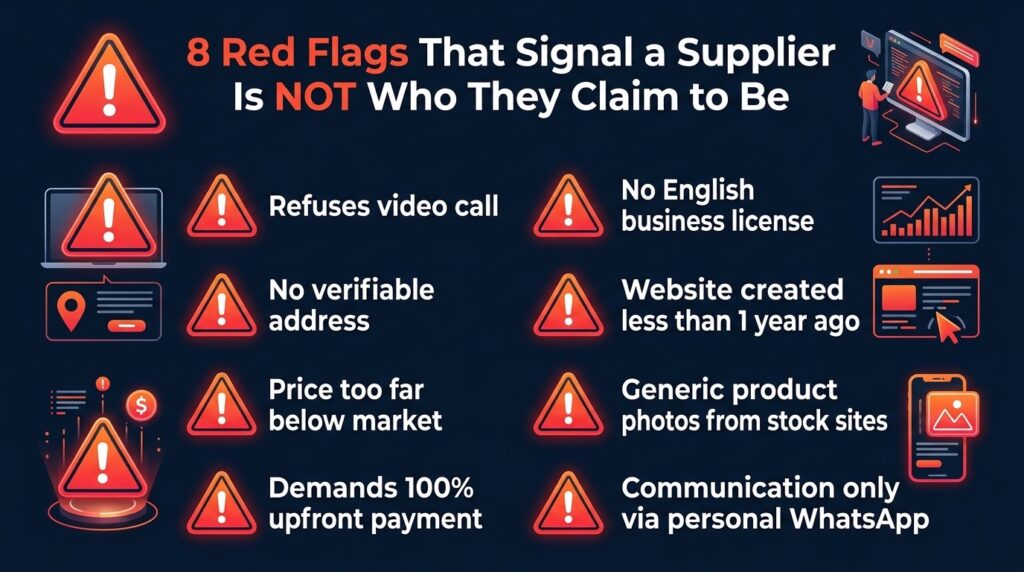
8 Red Flags That Should Stop You Cold
Beyond the seven-step process, watch for these specific signals at any point in the supplier relationship:
1. Refuses to do a live video call.
There is no legitimate business reason for an active factory to refuse a video call in 2026. If they’re offering only WhatsApp text or pre-recorded videos, treat this as disqualifying.
2. Can’t produce a verifiable business address.
If the address on their license doesn’t appear on any map, or if Google Street View shows a residential building where they claim to have a factory, investigate before proceeding.
3. Price is more than 30% below market average.
There’s a floor to what something can genuinely cost to manufacture. Prices far below that floor are either bait (quality won’t match), the product is non-compliant, or it’s fraud. All three outcomes are bad.
4. Demands 100% payment upfront.
Standard payment terms are 30% deposit, 70% before shipment. Any supplier requiring full payment in advance from a first-time buyer is outside the norm and deserves serious scrutiny.
5. Business license registered less than one year ago.
This alone isn’t disqualifying — businesses do start legitimately. Combined with any other flag on this list, a new registration is a significant concern.
6. Product photos appear on multiple unrelated supplier websites.
Reverse image search the product photos. If identical images appear on multiple supplier websites, they’re stock photos or stolen from a different factory’s catalogue — not evidence of actual production capability.
7. Communication happens only via a personal phone number or personal email.
Legitimate factories communicate via company email domains and have registered business contact numbers. A supplier who insists on communicating only through a personal WeChat account or Gmail address has no organizational infrastructure — a major concern for any business relationship.
8. They push hard for you to pay urgently.
Time pressure is a classic fraud mechanism. “The price is only available until Friday,” “we need the deposit today to hold the production slot” — these urgency triggers exist to prevent you from doing the verification steps above. Any legitimate supplier will wait the few days it takes you to verify their credentials.
When Verification Fails: What to Do
Sometimes the verification process reveals that a supplier isn’t what they claimed. The response depends on what you found:
If the business license doesn’t check out: Stop the engagement immediately. Do not send money. Do not provide further personal or company information.
If they’re a trading company but presented as a factory: Decide if the relationship still makes sense. Trading companies can be legitimate partners — but renegotiate knowing what you’re actually dealing with. Their price needs to reflect that you’re not getting factory-direct.
If the sample quality is significantly below spec: Provide written feedback. Give the supplier one opportunity to provide a corrected sample. If the corrected sample still doesn’t meet your requirements, the factory either can’t make what you need or isn’t taking your specifications seriously. Move on.
If payment details don’t match the registered entity: Halt all payments immediately and contact the supplier through a verified channel (the phone number from their business license, not the one in the email) to report the discrepancy. This is a potential MITM fraud situation and requires immediate action.
Related reading → 11 China Sourcing Scam Red Flags Every Importer Must Know
Putting It Together: Verification as Standard Operating Procedure
The buyers who get burned in China sourcing are almost never unlucky. They skipped steps. They prioritized speed over due diligence. They trusted platform presence over independent verification. They sent money before the sample arrived.
The seven steps above take time. They require some persistence — pushing past the friction of asking suppliers for documents they’d rather not provide. But every legitimate factory passes these steps without difficulty, because there’s nothing to hide. Suppliers who push back on basic verification requests are telling you something important.
If you’d rather have an experienced team handle verification on your behalf — business license checks, in-person factory visits, export data analysis, and ongoing quality oversight — talk to us. Verification is core to what we do, and it’s significantly more thorough when done from inside China.
Next in this series → China Sourcing Agent Fees: Commission, Flat Rate, and the Hidden Costs Nobody Talks About