The sea vs. air freight decision from China is one of the most consequential per-order decisions importers make — and one of the most commonly made by gut feel rather than analysis.
The instinct is usually: “sea freight is cheaper, use sea freight.” This is correct for large shipments of low-value-density goods where lead time flexibility exists. It’s wrong for high-value compact products with tight reorder windows, or for any situation where the cost of being out of stock outweighs the freight cost difference.
This guide gives you the actual numbers and the decision framework to choose correctly every time.
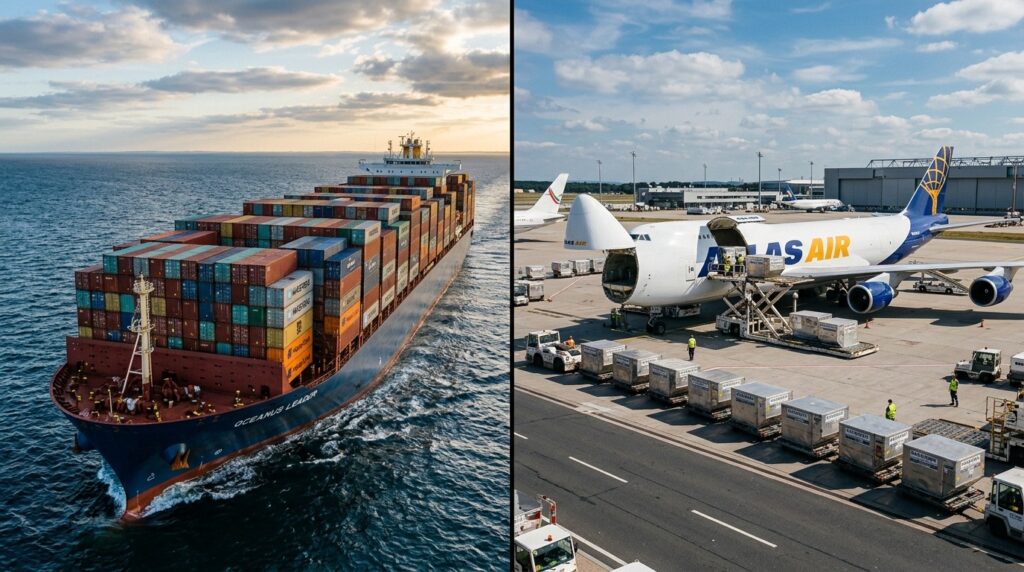
Current Rate Benchmarks (2026)
Freight rates fluctuate significantly with market conditions. The rates below are approximate benchmarks for 2026 — verify with your freight forwarder before making decisions.
Sea Freight (Ocean)
LCL (Less than Container Load):
– Rate: $60–120/CBM (cubic meter) for China–US West Coast
– Rate: $80–140/CBM for China–US East Coast (via Panama Canal)
– Rate: $50–90/CBM for China–Europe (Hamburg, Rotterdam)
– Minimum charge: Typically 1 CBM
– Transit time: 20–35 days (China–US), 25–35 days (China–EU/UK)
– Additional costs: Destination handling $150–300, customs clearance $150–400
FCL (Full Container Load):
– 20ft container: $1,200–2,500 (China–US West), $1,800–3,500 (China–East)
– 40ft container: $1,800–3,500 (China–US West), $2,500–5,000 (China–East)
– Viable when: shipment exceeds ~15 CBM (20ft container) or 28 CBM (40ft)
– Transit time: Same as LCL
Air Freight
Standard air freight (via forwarder, not express courier):
– Rate: $3.50–6.00/kg for China–US
– Rate: $3.00–5.50/kg for China–EU/UK
– Minimum charge: Typically 45kg or 100kg minimum
– Transit time: 3–7 days (excluding customs clearance)
Express courier (DHL/FedEx/UPS):
– Rate: $8–15/kg for China–US/EU/UK
– Transit time: 2–5 days
– Best for: Under 100kg, samples, urgent restocks
Chargeable weight note: Airlines charge whichever is greater — actual weight or volumetric weight (L×W×H cm ÷ 5,000 = kg). Bulky, lightweight goods are charged at volumetric weight, which can dramatically increase effective air freight cost.
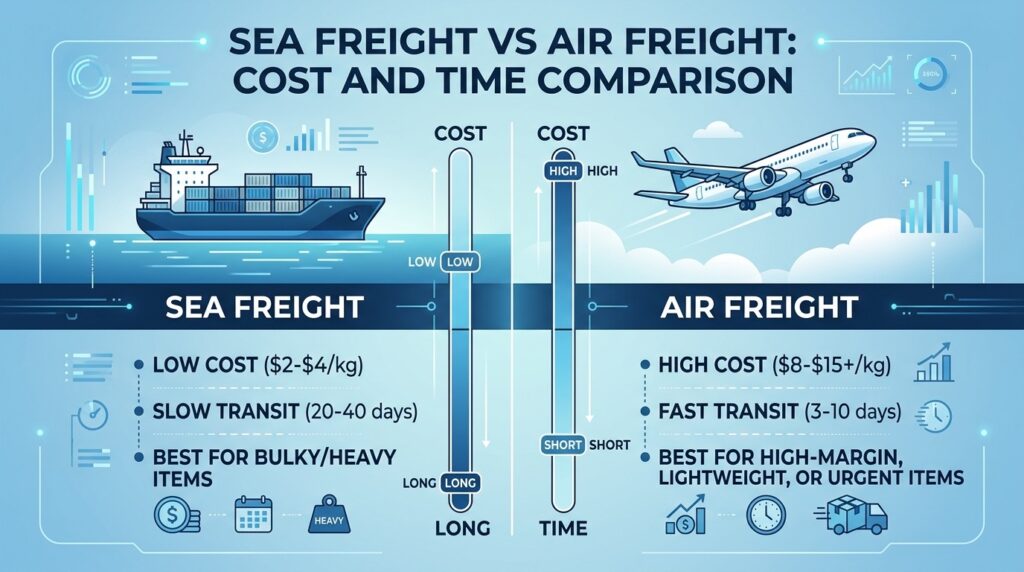
The Break-Even Analysis: Where Sea and Air Cost the Same
For a typical shipment, the break-even volume between sea and air freight is approximately 200–500 kg, depending on the specific lanes and current rates.
Illustrative example:
| Shipment | Sea LCL | Air Freight | Cost Gap |
|---|---|---|---|
| 50 kg, 0.1 CBM | $180 + $350 fixed | $250 | Air cheaper |
| 150 kg, 0.3 CBM | $250 + $350 fixed | $750 | Sea ~$150 less |
| 500 kg, 1 CBM | $470 + $350 fixed | $2,500 | Sea $1,680 less |
| 2,000 kg, 4 CBM | $960 + $350 fixed | $10,000 | Sea $8,690 less |
The fixed costs of sea freight (destination handling, customs, port fees) mean that for very small shipments, air freight is actually competitive or cheaper on a total cost basis. The advantage of sea freight grows dramatically with shipment size.
Decision Framework: Which to Choose
Use Air Freight When:
1. High value density (value per kg is high)
Electronics, jewelry, cosmetics, supplements — products where the ratio of product value to weight is high. A $5,000 shipment that weighs 30 kg costs approximately $180–200 by air. The 30 days saved is worth $180 in almost any scenario involving a $5,000 inventory asset.
The rule of thumb: If your product value exceeds approximately $25/kg, air freight becomes economically competitive even for larger shipments.
2. Tight reorder window / low inventory runway
If you’re running low on stock and your sea freight transit time would cause a stockout, the stockout cost (lost revenue + potential ranking penalties on Amazon, customer churn on DTC) typically exceeds the freight premium.
Calculate your stockout cost: (Daily revenue from this product) × (Days of stockout sea freight would create). If that number exceeds the air-vs-sea cost difference, air freight is the correct choice.
3. First orders / product validation
For a 200–500 unit validation order, the inventory commitment is modest and the cost difference between air and sea is often $300–600. Faster validation — arriving in 7 days vs. 35 days — accelerates your ability to make go/no-go decisions and start the reorder cycle sooner. The time value of faster validation frequently exceeds $600.
4. Seasonal or trend-sensitive products
If you’re delivering goods for a specific selling window (Q4 Christmas, summer seasonal), a 30-day transit time creates a 30-day planning cushion requirement. Missing the window has binary cost — all the margin vs. none. Air freight eliminates the planning buffer requirement.
5. Hazardous material / temperature-sensitive items
Some products (lithium battery-heavy items, temperature-sensitive cosmetics, certain chemicals) face sea freight restrictions. Air freight may be the only viable mode, or the only mode that maintains product integrity.
Use Sea Freight When:
1. Large, heavy, or bulky goods
Furniture, machinery, large quantities of clothing, commodity-weight consumer goods. When volumetric weight for air exceeds actual weight and your product is large/heavy, sea freight is dramatically cheaper.
The rule of thumb: Products under $10/kg in value are almost always more economical by sea.
2. Predictable reorder cycles with adequate planning runway
If you have 60+ days of inventory when you place your reorder, you have the runway for sea freight. The 25–35 day transit time fits within your buffer and you save the freight premium for reorder capital.
3. FCL quantities (15+ CBM)
At FCL quantities, sea freight per-CBM rates drop further and fixed costs spread across a larger shipment. The economics of air freight for FCL quantities are almost never competitive.
4. Non-time-sensitive B2B/wholesale orders
Industrial buyers, wholesale customers, and B2B purchasers with planned procurement cycles can accommodate sea freight lead times in their purchasing planning. The freight cost saving is meaningful to their procurement economics.
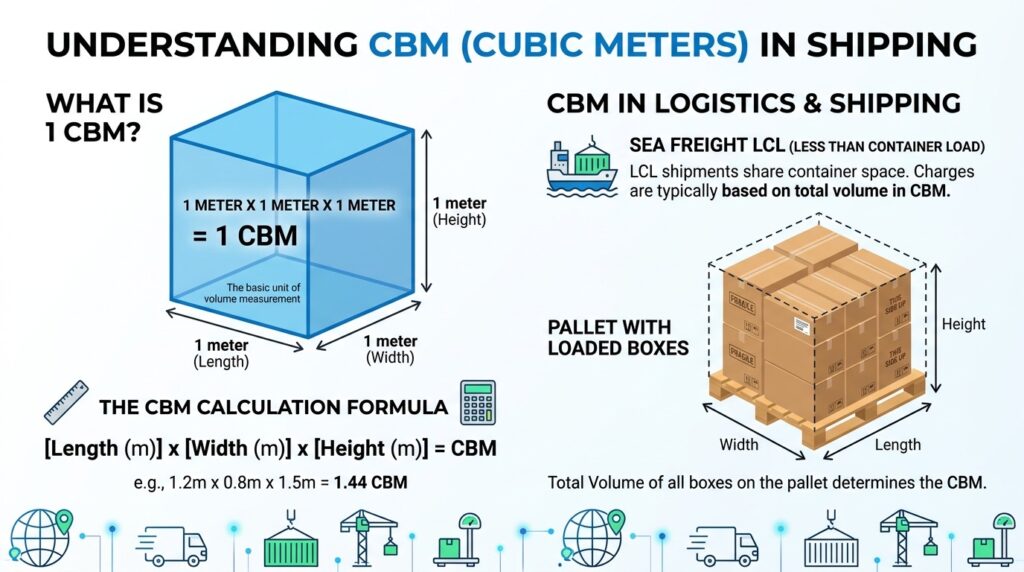
LCL vs FCL: The Sea Freight Sub-Decision
LCL (Less than Container Load): Your goods are consolidated with other shippers’ goods in a shared container. Cost: per CBM. More flexible, no minimum volume commitment. Slight additional handling risk (goods move between facilities for consolidation/deconsolidation).
FCL (Full Container Load): You rent the entire container. Cost: flat rate per container, regardless of fill. More economical above ~50–60% utilization of the container. Lower handling risk (goods sealed at origin, opened at destination). Required for some hazardous goods.
FCL break-even:
– 20ft container (25–28 CBM usable): FCL is cost-competitive at 15+ CBM
– 40ft container (55–60 CBM usable): FCL is cost-competitive at 30+ CBM
The Hidden Costs of Each Mode
Sea freight hidden costs:
– Port congestion surcharges (variable, $0–500/container depending on port conditions)
– Peak season surcharges (typically June–September for US holiday goods)
– Customs hold (if selected for examination: $300–800 in handling, 3–10 additional days)
– Destination terminal handling charges (typically $200–400)
– Chassis fees at US ports ($50–150/container)
Air freight hidden costs:
– Fuel surcharges (variable, typically 20–40% of base rate)
– Security surcharges
– Customs examination (same risk as sea, but shorter total delay)
– Dimensional weight uplift on bulky goods
Total landed cost must include all surcharges, not just the quoted base rate. Request an all-in quote from your freight forwarder before comparing options.
Related reading → How to Find a Freight Forwarder for China Imports
Related reading → Incoterms Explained: Which Shipping Terms Protect China Importers
Need a freight quote for a China shipment? Our logistics team works with vetted freight forwarders across all major China export ports.