A $34,000 Lesson Nobody Plans for
Marcus ran a mid-size outdoor furniture brand in Ontario. His supplier in Foshan shipped 480 cartons of patio sets—a full 40-foot container—on schedule. The freight forwarder he’d hired based on a Google search and the lowest quote handled the booking. Nineteen days later, the container was sitting at the Port of Vancouver in a customs examination queue. Nobody had flagged that Canadian Food Inspection Agency markings on the wooden pallet treatment certificates were missing. The container sat for eleven days. Demurrage, examination fees, and a rushed third-party fumigation service came to just over $34,000 CAD on top of his original freight bill. His peak summer selling window was gone.
Marcus isn’t an outlier. Freight forwarding is one of those industries where the price difference between a competent forwarder and an incompetent one shows up only after your cargo is already mid-ocean.
This guide covers what freight forwarders actually do, how to evaluate them before you commit, and the specific questions to ask so you don’t end up in Marcus’s situation.
What a Freight Forwarder Actually Does (8 Core Functions)
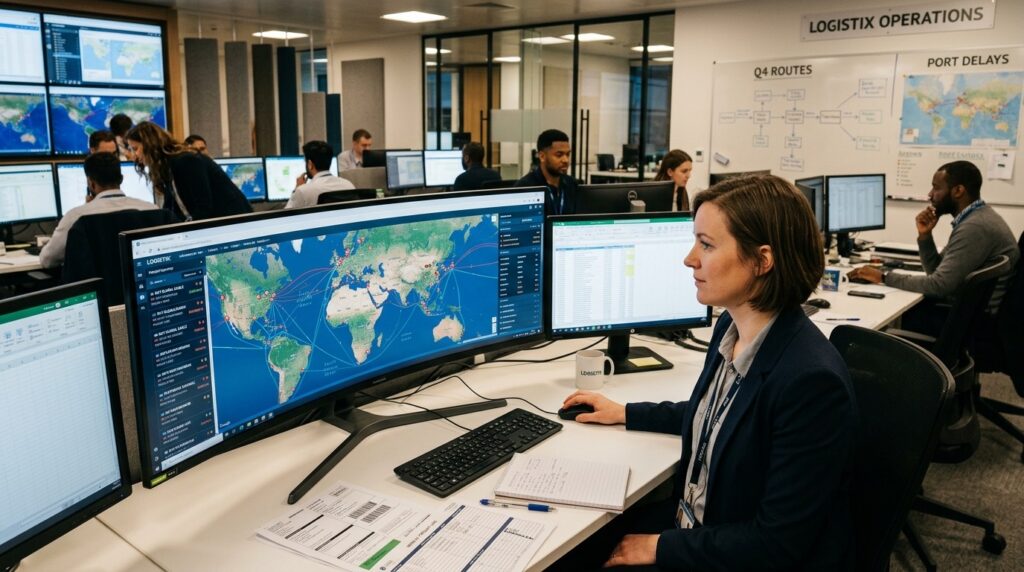
A freight forwarder is not a carrier. They don’t own ships or planes. They are logistics coordinators—specialists who arrange transportation, handle documentation, and manage the moving parts between your factory and your warehouse door.
Here is what a full-service freight forwarder handles on a China import shipment:
1. Cargo Pickup and Inland Trucking (Origin)
Before a container goes anywhere, someone has to pick up the goods from the factory. A forwarder arranges trucking from your supplier’s facility to the nearest port or consolidation warehouse. If you’re not buying on EXW terms, this may already be covered by your supplier—but on EXW, it’s your cost and your forwarder’s job.
2. Export Customs Clearance in China
China requires export customs declarations for commercial shipments. Your forwarder (or their China-based agent) prepares the export declaration, confirms HS codes, and ensures the shipment clears Chinese customs. Errors here cause delays at origin, not just destination.
3. Carrier Booking and Space Reservation
Ocean and air carriers allocate space in advance. Your forwarder books space on the appropriate vessel or flight, negotiates rates based on volume, and issues a House Bill of Lading (HBL) or House Airway Bill (HAWB) to you as the shipper.
4. LCL Consolidation (If Applicable)
If your shipment doesn’t fill a full container, your forwarder consolidates your cargo with other shippers’ goods in a shared container. This is called Less than Container Load (LCL). They handle the physical grouping, the documentation split, and the deconsolidation at destination.
5. Cargo Insurance Arrangement
Marine cargo insurance is not automatically included in freight. Your forwarder can arrange all-risk or named-perils coverage on your behalf. Whether you buy it through them or separately is your choice, but don’t skip it.
6. Import Customs Clearance (Destination)
This is where most problems happen. Your forwarder (or their customs broker partner) files the import entry, classifies your goods under the correct HTS/HS tariff code, and arranges duty payment. Missing or incorrect commercial invoices, packing lists, or certificates of origin get caught here—and delay release.
7. Destination Port Handling and Drayage
Once the shipment clears customs, someone has to move it from the port to your door. Your forwarder arranges drayage (local port trucking) and coordinates delivery appointments.
8. Documentation Management
The paper trail on an international shipment is extensive: commercial invoice, packing list, bill of lading, certificate of origin, product certificates (CE, FDA, FAMA, etc.), fumigation certificates for wood packaging. Your forwarder tracks, requests, and transmits these documents on your behalf. A single missing document can hold an entire container.
How to Evaluate a Freight Forwarder: 5 Dimensions
Not all forwarders are equally equipped to handle China imports. Use these five dimensions to compare candidates before you commit.
Dimension 1: China-Specific Experience
China has its own customs procedures, export licensing requirements, and practical realities (such as Golden Week shutdowns affecting factory production and port capacity). A forwarder who handles mostly European or intra-North American freight will not have the same depth of knowledge or the same network of China-side agents.
Ask directly: How many China import shipments did you handle last year? Do you have your own office or a dedicated agent in Shenzhen, Shanghai, or Guangzhou?
Dimension 2: Customs Brokerage Capability
Customs clearance at destination is a licensed activity in most countries. Your forwarder should either hold a customs broker license themselves or have a clear, documented partnership with a licensed broker. Vague answers like “we work with various brokers” are a yellow flag.
Ask: Who files our import customs entries? Are they licensed, and can we speak to them before our first shipment?
Dimension 3: Commodity Knowledge
A forwarder who specializes in automotive parts is not automatically equipped to handle regulated products like cosmetics, children’s toys, or food contact materials. Different commodities have different documentation requirements, different examination rates at customs, and different insurance considerations.
Ask: Have you shipped [your product category] from China before? What documentation typically causes delays for this type of cargo?
Dimension 4: Communication and Transparency
Freight moves across time zones, and problems tend to surface overnight your time. The question isn’t whether problems will occur—they will—it’s whether your forwarder tells you immediately or lets you find out when your cargo is already delayed.
Test this in the sales process: How quickly do they respond to your inquiry? Do they answer your questions directly, or do they deflect? Do they proactively explain what they’re quoting (rather than sending a bare rate sheet)?
Dimension 5: Financial Stability and References
Freight forwarders handle your money (for duties, taxes, destination charges) and your cargo. A forwarder that goes out of business mid-shipment creates a serious problem. Check that they are members of a recognized industry body (FIATA, NCBFAA, Canadian Society of Customs Brokers, etc.), carry errors and omissions insurance, and can provide verifiable references from existing clients in your industry.
The 10 Questions to Ask Before Hiring a Freight Forwarder
Most importers get one or two quotes, pick the lowest, and move on. That approach is how you end up with Marcus’s outcome. Ask these ten questions during your evaluation:
1. What is included in your all-in rate?
Freight quotes are notorious for listing ocean freight while excluding origin charges, destination handling, customs clearance fees, and local delivery. Ask for a full cost breakdown with every line item labeled.
2. Which carrier(s) will you use for this lane?
Carrier reliability varies significantly by route. Ask which steamship lines they typically use for China-to-[your port] shipments, and whether they have fallback options if space gets tight.
3. What is the typical transit time, door to door?
Ocean transit from Shenzhen to Los Angeles is roughly 14–17 days. But total transit time—including inland trucking at origin, port cut-off, and destination drayage—can be 28–35 days or more. Make sure you’re comparing apples to apples.
4. How do you handle customs classification for my products?
Ask who determines the HS/HTS code, whether they verify it against the actual product specifications, and who bears the cost if a classification error results in additional duties.
5. What happens if my shipment is selected for customs examination?
Examinations are random and unavoidable. Ask what their process is, what typical exam fees run, and who pays for any holds.
6. Do you provide cargo insurance, and what does it cover?
Confirm whether the quote includes insurance or not. If it does, ask whether it’s all-risk coverage and what the per-kg liability limit is (standard carrier liability on ocean freight is very low—often USD 2 per kg).
7. Who is your China-side agent, and how do they communicate with your team?
The handoff between the Chinese agent and the destination-country forwarder is a common source of miscommunication. Understanding how this works in practice matters.
8. How will you keep me updated throughout the shipment?
Some forwarders provide online tracking portals. Others send email updates. Others go quiet until there’s a problem. Know what to expect before the container leaves Shanghai.
9. What are your payment terms for duties and taxes?
Import duties and taxes must be paid before customs releases your cargo. Some forwarders advance these on your behalf (with a fee); others require you to fund a deposit account. Know the terms so you’re not scrambling for a wire transfer at midnight.
10. Can you provide three references from clients who import from China in a similar product category?
This is the most revealing question. A forwarder who hesitates or can’t provide China-specific references is telling you something important.
Ocean Freight vs. Air Freight: When to Use Each
Most China imports move by ocean. But there are situations where air freight makes more sense. The comparison below is based on typical commercial shipments—your actual numbers will vary by lane, carrier, and season.
| Factor | Ocean Freight | Air Freight |
|---|---|---|
| Transit Time | 14–35 days (door to door) | 5–10 days (door to door) |
| Cost per kg | USD 0.10–0.40 | USD 4–8+ |
| Minimum Cargo Size | LCL available from 1 CBM | No minimum |
| Cargo Volume Limit | No practical limit | Aircraft-dependent |
| CO₂ per kg | Much lower | Very high |
| Best For | Large volumes, non-urgent goods | Urgent, high-value, low-weight |
| Risk of Delay | Port congestion, weather | Capacity constraints, customs |
| Documentation | More complex | Somewhat simpler |
When ocean makes sense: Furniture, electronics in bulk, apparel, machinery, consumer goods where you’re replenishing inventory on a planned cycle. If your goods are not urgently needed and weigh more than a few hundred kilograms, ocean freight almost always wins on cost.
When air makes sense: Product launches with tight deadlines, high-value items (jewelry, precision instruments) where insurance cost on ocean is prohibitive, or small samples and initial orders where ocean LCL minimum fees eat into your margins.
A practical middle option: For some lanes, sea-air combinations (ocean to a hub like Dubai or Singapore, then air to final destination) offer a middle ground on cost and speed. Ask your forwarder if this applies to your specific route.
FCL vs. LCL: Choosing the Right Container Strategy
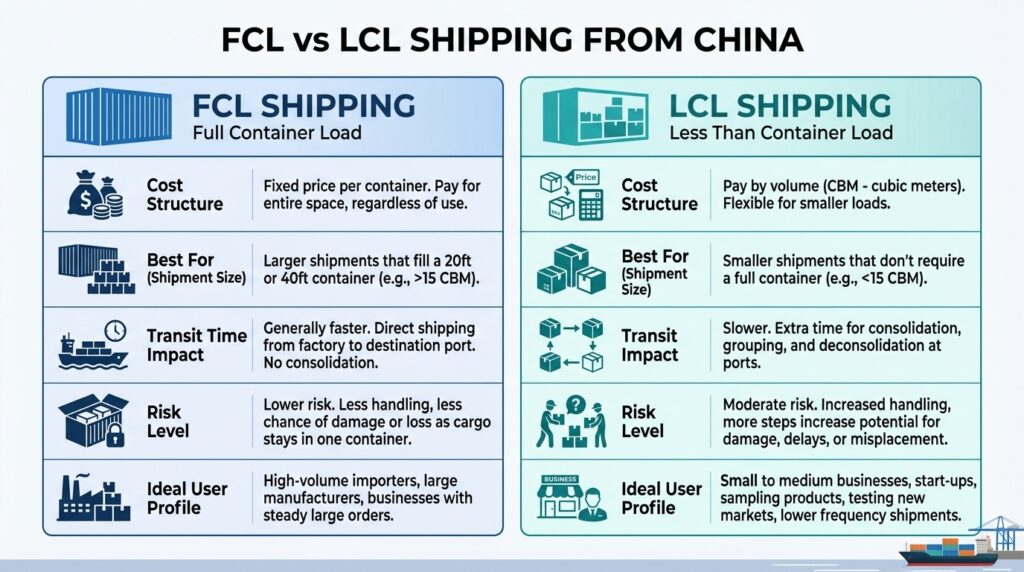
If you’re shipping by ocean, one of the first decisions is whether to use a full container load (FCL) or less than container load (LCL). This affects your cost, your risk exposure, and your transit time.
| Factor | FCL (Full Container) | LCL (Shared Container) |
|---|---|---|
| You Pay For | Entire container | Cargo volume (CBM) |
| Min. Volume to Consider | ~10–12 CBM+ | 1–10 CBM |
| Transit Time | Direct routing possible | Additional consolidation/deconsolidation time (add 3–7 days) |
| Cargo Security | Only your goods | Shared space, higher handling risk |
| Peak Season Availability | Need to book early | Generally more flexible |
| Customs Examination Risk | One exam for your container | Your goods examined with others’ cargo |
| Damaged Goods Risk | Lower (sealed unit) | Higher (more handling) |
FCL container sizes: Standard options are 20-foot (approx. 25 CBM, 21,700 kg payload) and 40-foot (approx. 55 CBM, 26,500 kg payload). A 40HC (high cube) adds about 10% more volume.
Rule of thumb: If your cargo exceeds 15 CBM, get both FCL and LCL quotes. At 15 CBM, the math often tilts toward FCL once you factor in LCL surcharges, longer transit, and the added handling risk.
If you’re still figuring out your overall import process from China, the guide on how to import from China covers the full picture from sourcing through delivery.
For shipments where cargo security and condition on arrival matter, a pre-shipment inspection before the factory loads the container is worth considering—problems caught before loading cost far less than problems found at your warehouse after a 30-day ocean voyage.
Red Flags to Watch For
Some warning signs are subtle. Others are obvious in retrospect. Keep an eye out for these:
Quotes with suspiciously round numbers and no line items. A quote that says “USD 2,500, all in” for a China-to-Chicago FCL shipment is almost certainly incomplete. Real freight quotes have origin charges, ocean freight, destination handling, customs clearance, and local delivery listed separately.
No straight answer on who handles customs clearance. If a forwarder is vague about who files your import entries, how they determine HS codes, or what happens during an examination, that vagueness will show up in an actual crisis.
Communication delays during the sales process. If it takes them three days to respond to a quote request, don’t expect better treatment once they have your cargo.
Pressure to sign immediately. Rates fluctuate, and there are genuinely time-sensitive situations in freight. But a forwarder who applies heavy pressure to commit before you’ve had time to do due diligence is not a partner you want.
No mention of incoterms. A freight quote that doesn’t specify the incoterm basis (EXW, FOB, CIF, etc.) is incomplete. The incoterm determines who pays for what segment of the journey. Mismatched incoterm assumptions between you, your supplier, and your forwarder cause billing disputes. If you need a refresher on how incoterms work, the incoterms guide for China importers breaks down the most commonly used terms.
Working with Your Forwarder: Practical Habits That Save Money
Once you’ve selected a forwarder, the relationship quality depends as much on your behavior as theirs.
Give them lead time. Ocean freight bookings for peak season (August–October) fill up fast. If you tell your forwarder about a shipment two weeks before factory completion, you may not get your preferred carrier or sailing date. A 4–6 week heads-up is realistic for planned shipments.
Send complete documents early. Customs clearance moves at the speed of your paperwork. Have your commercial invoice, packing list, and any required certificates ready before the vessel arrives at destination. Missing paperwork is the single most common cause of unnecessary demurrage.
Understand your HS codes before you ship. Don’t rely solely on your forwarder to determine tariff classification. Review the classification yourself, confirm it with your customs broker, and document the reasoning. If your goods get re-classified during an examination, having documented your classification decision matters.
Keep a shipment log. Track every shipment: booking confirmation, bill of lading number, vessel name, ETD, ETA, actual arrival, total landed cost. After three or four shipments, patterns become visible—which carrier consistently runs late, which charges appear every time and aren’t in the quote, where delays tend to cluster.
Review the final invoice against the quote. Freight invoices frequently contain charges that weren’t in the original quote. Some are legitimate (fuel surcharge adjustments, peak season surcharges). Others are padding. Review every line and ask for an explanation of any charge that wasn’t disclosed upfront.
How to Start Vetting Freight Forwarders Right Now
A practical sequence for finding your first (or next) China import forwarder:
Define your shipment profile — commodity, approximate volume per shipment, frequency, origin city in China, destination port and final address.
Ask your supplier for referrals — factories that ship regularly often know which forwarders perform well on their specific lane. This isn’t the only input, but it’s a useful starting point.
Request quotes from three to five forwarders — use the ten-question framework above. Send identical shipment details to each so you’re comparing equivalent quotes.
Check industry memberships — FIATA (international), NCBFAA (US), Canadian Society of Customs Brokers (Canada), BIFA (UK). Membership isn’t a guarantee of quality, but absence of any membership is a flag.
Speak to references — specifically ask: Did they communicate proactively when there was a problem? Were there charges on the final invoice that weren’t in the quote? Would you use them again for China imports?
Run a test shipment — if possible, start with a smaller or less time-sensitive shipment before committing a large order to a new forwarder.
Review performance after the first shipment — total cost vs. quoted cost, actual transit time vs. stated estimate, communication quality, document accuracy. Use this data to decide whether to continue or look elsewhere.
If you’re at the stage where you’re still setting up your overall import operation and need help navigating the process, reach out to us — we work with importers sourcing from China across multiple categories and can help you avoid the expensive mistakes that come from working with the wrong logistics partner.