Guangzhou has cemented its reputation as a global powerhouse for fashion jewelry manufacturing and wholesale. As the hub of China’s jewelry industry, it offers an incredible array of products, from affordable trendy pieces to high-quality stainless steel and brass accessories. If you’re an international buyer looking to source fashion jewelry from Guangzhou, understanding the nuances of the local market, materials, and compliance is crucial.
This guide from SourcePilot Global will walk you through the essential steps and considerations for a successful sourcing journey.
The Epicenter of Fashion Jewelry: Guangzhou’s Markets
Guangzhou is home to several specialized wholesale markets dedicated to fashion jewelry. Unlike scattered factories, these centralized hubs make it easy to compare suppliers, assess quality, and negotiate prices.
Xijiao Building (西郊大厦)
Xijiao Building is widely regarded as one of the best markets for medium to high-end fashion jewelry. Here, you’ll find suppliers focusing on brass, stainless steel, and cubic zirconia (CZ) jewelry. The market is well-organized, with many manufacturers offering custom OEM and ODM services.
Taikang Plaza (泰康城广场)
If your target market is fast fashion or you’re looking for more affordable options, Taikang Plaza is the place to go. It features hundreds of small stalls selling trendy accessories, hair ornaments, and budget-friendly alloy jewelry.
Liwan Plaza (荔湾广场)
Liwan Plaza is famous for semi-precious stones, beads, crystals, and raw materials. It’s the perfect destination if you are designing your own pieces and need to source specific stones or components.
Understanding Jewelry Metals
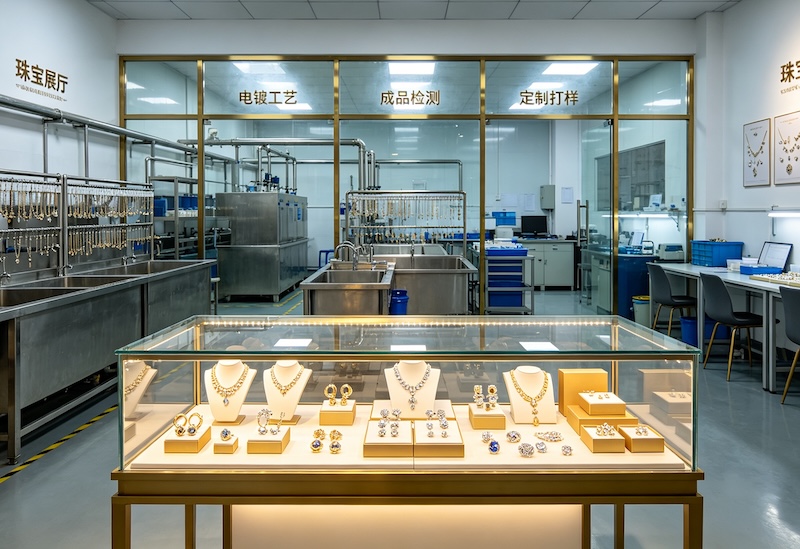
When sourcing jewelry, the base metal dictates the product’s quality, durability, and target price point. In Guangzhou, the most common base metals include:
- Stainless Steel (304 and 316L): Highly durable, hypoallergenic, and resistant to tarnishing. Stainless steel is increasingly popular for everyday wear and waterproof jewelry brands. 316L is medical-grade and preferred for high-quality items.
- Brass: A premium choice for fashion jewelry. It’s heavier than alloys, easy to cast into intricate designs, and takes plating very well. Brass is commonly used in higher-end boutique jewelry.
- Zinc Alloy: The most affordable option. It’s lightweight and used extensively in fast-fashion pieces. However, zinc alloy is prone to oxidation and tarnishing if not heavily plated, and it may cause skin irritation in some people.
- 925 Sterling Silver: While a precious metal, it is heavily sourced in Guangzhou. It’s perfect for fine fashion jewelry but requires careful storage to prevent tarnishing.
Demystifying the Plating Process
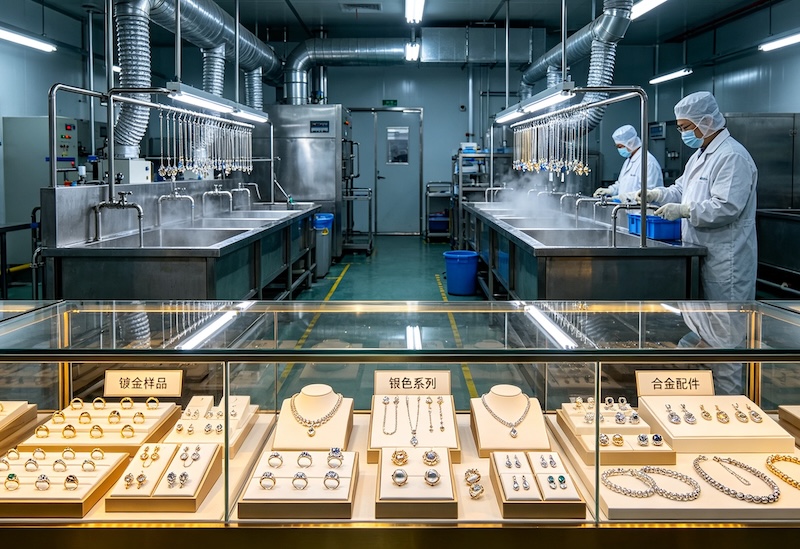
The plating determines the final look and longevity of your jewelry. Guangzhou factories offer several plating methods:
Electroplating vs. PVD Coating
- Electroplating: The traditional method using electrical currents to bond a thin layer of gold, silver, or rhodium to the base metal. While cost-effective, electroplating on alloys can wear off quickly depending on the thickness (measured in microns).
- PVD (Physical Vapor Deposition) Coating: Primarily used on stainless steel, PVD is a vacuum coating process that produces an incredibly durable and long-lasting finish. PVD-coated stainless steel jewelry is often marketed as “waterproof” and “tarnish-free.”
Plating Thickness
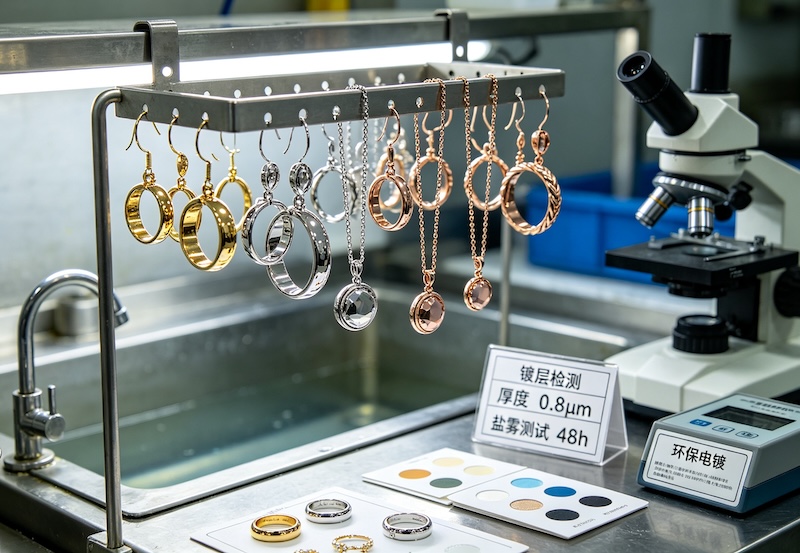
When negotiating with suppliers, always specify plating thickness. Flash plating (less than 0.1 microns) is cheap but wears off in days. For decent quality, aim for at least 0.5 to 1.0 microns of gold plating (often called demi-fine). For premium pieces, 2.5 microns (vermeil) is the standard.
Navigating Compliance and Safety Standards
Compliance is arguably the most critical aspect of sourcing fashion jewelry, especially for markets in the US and Europe. Non-compliant jewelry can be seized at customs or lead to severe legal issues.
The “Big Three” Toxins
You must ensure your jewelry is free from or within acceptable limits for:
1. Lead: Extremely strictly regulated, especially in children’s jewelry.
2. Cadmium: A toxic heavy metal often used to add weight and shine to cheap alloys.
3. Nickel: A common cause of contact dermatitis (allergies). Most EU countries strictly regulate nickel release.
Key Regulations by Region
- European Union (REACH): The REACH regulation strictly limits the use of nickel, lead, and cadmium in jewelry. Suppliers must be able to provide REACH test reports.
- United States (Prop 65 & CPSIA): California’s Proposition 65 requires warnings for products containing toxic chemicals, while the Consumer Product Safety Improvement Act (CPSIA) heavily restricts lead in children’s products.
Best Practices for Compliance
- Ask for Test Reports: Always ask suppliers for recent lab test reports (from SGS, Intertek, or TUV) proving their products meet your country’s standards.
- Conduct Independent Testing: Do not rely solely on the factory’s word. Send samples to an independent third-party lab before mass production.
- Specify “Hypoallergenic”: Clearly state in your manufacturing contract that the goods must be nickel, lead, and cadmium-free.
Conclusion
Sourcing fashion jewelry from Guangzhou is a highly profitable venture if done correctly. By understanding the differences in base metals, investing in quality plating like PVD, and rigorously enforcing compliance standards, you can build a reputable and successful jewelry brand. Partnering with a reliable sourcing agent like SourcePilot Global can further streamline this process, ensuring you find the right suppliers and maintain consistent quality control.
Frequently Asked Questions
1. Is it better to source stainless steel or brass jewelry?
It depends on your target market. Stainless steel with PVD coating is excellent for durable, waterproof, and hypoallergenic everyday wear. Brass allows for finer, more intricate designs and a premium feel, making it suitable for higher-end fashion jewelry.
2. How do I verify a supplier’s compliance claims?
Always request recent, third-party lab test reports (like SGS or Intertek) specifically for the materials you are buying. Additionally, you should independently test a batch of samples before committing to a large order.
3. Can Guangzhou factories create custom designs (OEM)?
Yes, most factories in Guangzhou are well-equipped for OEM (Original Equipment Manufacturer) services. You can provide 3D CAD files, sketches, or physical samples, and they can create molds and produce your custom designs.