Un acquirente in Australia ha versato 38.000 dollari a una “fabbrica” nel Guangdong che aveva trovato tramite un annuncio su Google. Il sito web aveva un aspetto professionale. Le risposte via e-mail erano tempestive. Le foto dei prodotti erano eccellenti. Tre settimane dopo l’accredito del pagamento, il sito web era offline e l’indirizzo e-mail restituiva messaggi di errore.
Il denaro non è mai stato recuperato.
This is not a rare story. It plays out with different dollar amounts, different product categories, different countries — but the same underlying mechanics. And in almost every case, at least three or four of the red flags below were present before the payment was made. The buyer just didn’t know what to look for.
Questo articolo ti fornisce proprio quell'elenco.

Come funzionano effettivamente le frodi nell'approvvigionamento dalla Cina
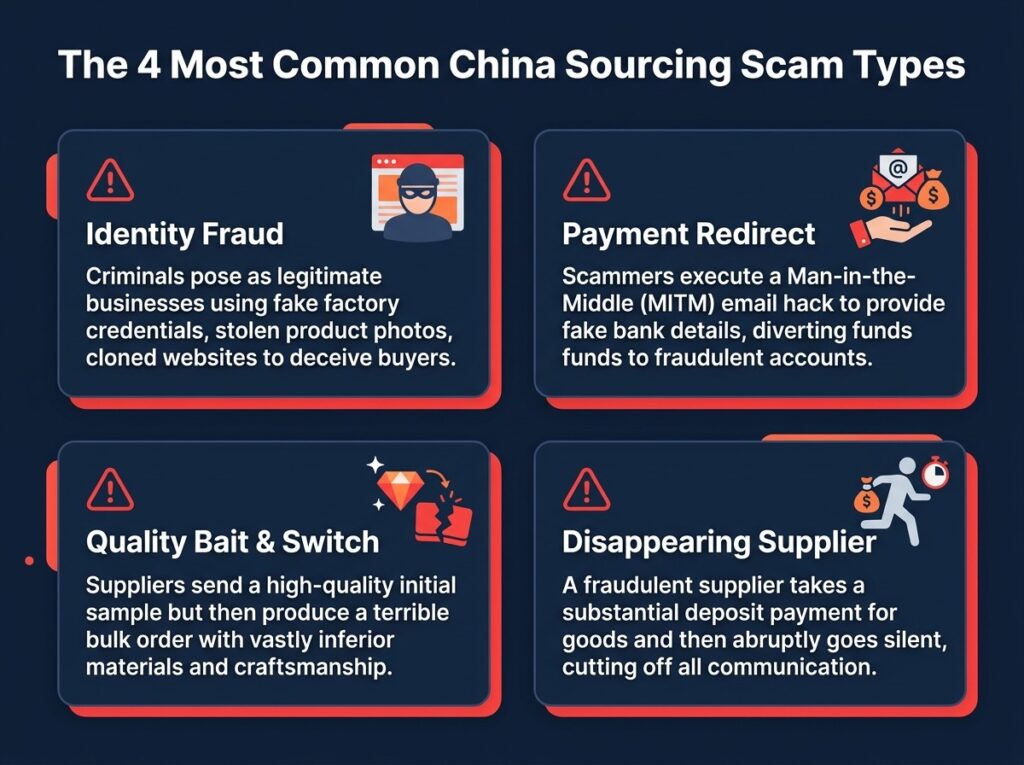
Before the red flags, a short map of how these scams are structured — because understanding the mechanism makes the warning signs easier to recognize.
Frode d'identità is the most common category for new buyers. A fraudulent operator creates a fake company identity — cloned website, stolen product photos, fabricated business registration documents — and presents as a legitimate factory. They’re skilled at appearing real because they’ve studied what legitimate factories look like.
Reindirizzamento del pagamento (attacco "man-in-the-middle") targets existing supplier relationships. A fraudster monitors email traffic between a buyer and supplier — sometimes by compromising one party’s email account — and intercepts a payment request, substituting different bank account details. The buyer thinks they’re paying their usual supplier. They’re not.
Pubblicità ingannevole di qualità is technically legal fraud. The sample is genuine — excellent quality, exactly what was agreed. The bulk order is produced with cheaper materials, lower quality components, or reduced specifications. By the time the goods arrive and are inspected, the supplier has been paid in full.
Fornitore in via di scomparsa è la forma più palese. Si riceve l’acconto, la merce non viene mai spedita e il fornitore diventa irraggiungibile. A volte il fornitore è del tutto fasullo; altre volte si tratta di un’azienda reale che ha accettato più ordini di quanti potesse evadere e ha deciso di dare la priorità ad altri.
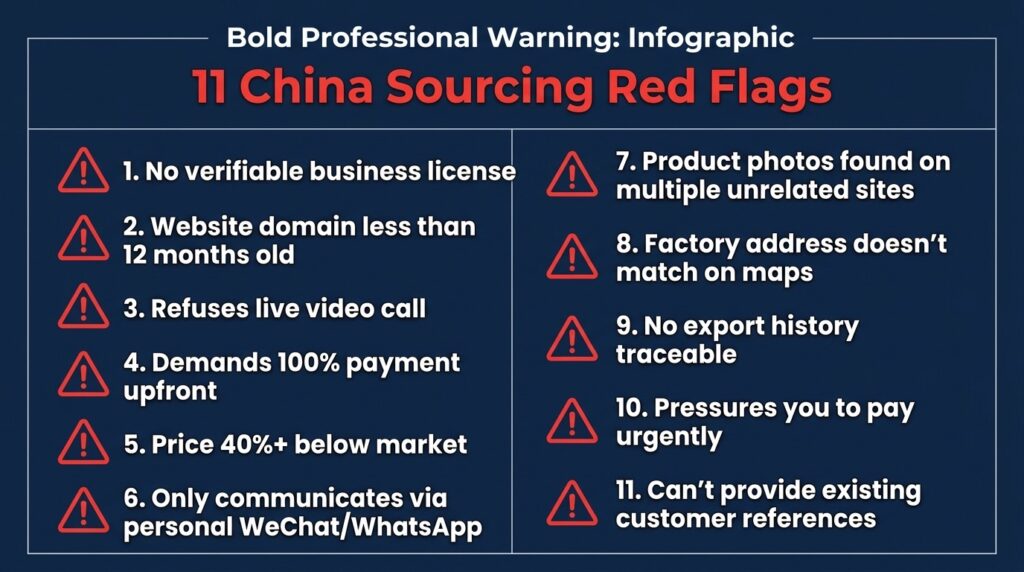
The 11 Red Flags — Explained
🚩 Red Flag #1: No Verifiable Business License
Every legitimate Chinese business has a business license registered with the State Administration for Market Regulation (SAMR). The license number — a unique 18-digit Unified Social Credit Code — can be verified in seconds on China’s public business registry.
Un fornitore che non possa o non voglia esibire la propria licenza commerciale, o il cui numero di licenza non dia risultati validi nelle banche dati ufficiali, non è un’azienda registrata in modo legittimo. Si tratta di un motivo di esclusione, non di un semplice avvertimento.
Cosa fare: Richiedi l'immagine della licenza commerciale e verifica autonomamente il codice di 18 cifre all'indirizzo gsxt.samr.gov.cn oppure tramite Tianyancha.
🚩 Red Flag #2: Website Domain Registered Less Than 12 Months Ago
Le operazioni fraudolente consentono di creare rapidamente siti web dall’aspetto professionale. Una ricerca WHOIS sul dominio del fornitore richiede 30 secondi e permette di scoprire quando è stato registrato.
A factory claiming 8 years of operation with a website domain registered 4 months ago is a fundamental inconsistency. Real factories with multi-year track records either have older domains or have good explanations for recent website rebuilds (redesign, new branding, etc.) — and those explanations are verifiable.
Cosa fare: Cerca WHOIS [supplierdomain.com] oppure usa lookup.icann.org per verificare la data di registrazione del dominio.
🚩 Red Flag #3: Refuses or Consistently Delays a Live Video Call
In 2026, declining a live video call from a potential business partner is commercially abnormal. Every legitimate factory we’ve worked with has accommodated video calls — production floor tours, product reviews, team introductions.
I motivi per cui un fornitore fraudolento rifiuta: non ha uno stabilimento da mostrare, opera da una sede diversa da quella dichiarata oppure il suo “rappresentante” in realtà non lavora per l’azienda di cui ha usurpato l’identità.
Fai attenzione a queste scuse specifiche: “La nostra connessione Internet non è adatta alle videochiamate”, “Il nostro responsabile di stabilimento è in viaggio”, “Ti invieremo un video al posto della videochiamata”. Un rinvio è comprensibile. Un comportamento sistematico di evitamento non lo è.
🚩 Red Flag #4: Demands 100% Payment Upfront
Standard payment terms in Chinese manufacturing are 30% deposit to begin production, 70% balance before shipment (confirmed by a pre-shipment inspection). Some first-order situations involve 50/50 splits. Payment in full before any work begins — for a new relationship — is outside normal commercial practice.
Gli unici casi legittimi in cui è giustificato richiedere un acconto più elevato sono: i costi per gli stampi personalizzati (pagati separatamente e specificatamente per la realizzazione degli stampi) oppure ordini di entità molto ridotta, per i quali la struttura di pagamento con acconto e saldo risulti poco pratica dal punto di vista amministrativo. In entrambi i casi, la motivazione è chiara e logica.
Una richiesta generica di pagamento anticipato del 100% da parte di un fornitore con cui non hai mai lavorato prima rappresenta un segnale d'allarme significativo.
🚩 Red Flag #5: Price Is More Than 40% Below Market Average
There’s a manufacturing cost floor — the minimum it takes to produce a product at acceptable quality given current material and labor costs. Prices far below that floor are only possible in three ways: the product is non-compliant (substandard materials, missing certifications), it’s bait (the bulk order quality will be nothing like what was quoted), or it’s fraud.
Before contacting suppliers, do basic price research: Alibaba range, 1688 range, competitor retail pricing. If one supplier is quoting 40–60% below every other comparable option, treat that as a warning, not a bargain.
🚩 Red Flag #6: Communicates Only Via Personal WeChat or WhatsApp
Legitimate businesses have company email addresses, registered phone numbers, and verifiable contact information. A supplier who insists on communicating exclusively through a personal messaging app has no organizational infrastructure — and no paper trail that connects them to a registered business entity.
Questo è importante per un motivo ben preciso: se qualcosa va storto, l’unica prova a tua disposizione è una chat di WhatsApp con un account personale che può essere cancellata in qualsiasi momento. Non c’è alcun server di posta elettronica aziendale, nessun registro IP collegato a un’azienda registrata, nulla che colleghi la conversazione a un soggetto che tu possa perseguire.
🚩 Red Flag #7: Product Photos Appear on Multiple Unrelated Supplier Websites
Effettua una ricerca per immagini su ogni foto che ti invia un nuovo fornitore. Strumenti come Google Immagini, TinEye o Yandex Immagini ti consentono di farlo in pochi secondi.
If the same product photos appear on multiple supplier websites — or, worse, on stock photo sites — the supplier does not produce that product themselves. They’ve taken photos from a real factory’s catalogue or a generic image database and are presenting them as evidence of their own production capability.
🚩 Red Flag #8: Factory Address Doesn’t Check Out on Maps
Richiedi l'indirizzo fisico dello stabilimento e cercalo su Google Maps, Baidu Maps e Google Street View. Uno stabilimento che dichiara di avere 200 dipendenti e 5.000 metri quadrati di superficie produttiva dovrebbe apparire come un complesso industriale, non come un condominio residenziale o un terreno incolto.
Verifica anche se l’indirizzo riportato sulla licenza commerciale corrisponde a quello che ti hanno fornito. Eventuali discrepanze in merito richiedono una spiegazione.
If a supplier claims the address doesn’t show on Maps because “it’s a new industrial zone,” that’s verifiable — new industrial zones in China appear in official planning documents and local government announcements.
🚩 Red Flag #9: No Export History Is Traceable
I dati doganali statunitensi relativi alle importazioni sono disponibili al pubblico e consultabili tramite strumenti come ImportYeti, Panjiva e servizi simili. Un fornitore che dichiara di avere anni di esperienza nelle esportazioni verso gli Stati Uniti dovrebbe figurare in questo database con almeno qualche registrazione relativa alle spedizioni effettuate.
If a supplier claims 5 years of US market experience but has no traceable US Customs records — and can’t name verifiable US clients — their stated export experience is either fabricated or dramatically overstated.
Ciò non vale per i fornitori che effettivamente non hanno mai esportato negli Stati Uniti; adatta la tua ricerca ai mercati principali da loro indicati.
🚩 Red Flag #10: Creates Artificial Urgency Around Payment
“Il prezzo è valido solo fino a venerdì.” “Abbiamo bisogno dell’acconto oggi per riservarti la fascia di produzione.” “Se non confermi, c’è un altro acquirente pronto a prendere questo ordine.”
La pressione dei tempi è un classico espediente per aggirare la due diligence. Un fornitore che ti chiede di agire più rapidamente di quanto tu possa verificare è un fornitore che sa di non superare la verifica.
Legitimate factories run full production schedules and genuinely do have limited slots — but they manage these professionally, with reasonable timelines. Manufactured urgency designed to prevent you from checking references or running a license verification is a deliberate tactic.
🚩 Red Flag #11: Can’t Provide Verifiable Customer References
Un fornitore con una comprovata esperienza pluriennale nell’esportazione ha clienti che hanno ricevuto la merce, che possono confermare il rapporto commerciale e che sarebbero disposti a scambiare qualche parola con un potenziale acquirente. Si tratta di una prassi commerciale normale in ogni settore.
A supplier who can’t provide references — or who provides names and contact details that don’t check out — has something to hide about their actual track record. This doesn’t guarantee fraud, but it does mean you have no independent evidence that anyone has successfully completed a transaction with them.
Chiedi due o tre referenze ad aziende operanti in settori simili al tuo. Contattale direttamente. Chiedi: la merce è arrivata come descritta? Ci sono stati problemi di qualità? Come ha gestito i problemi il fornitore?
Tre casi reali: come si è delineato il quadro nel retrospettivo
These are composite cases based on real situations — details altered to protect buyer privacy.
Case 1 — The $42,000 Textile Order (Identity Fraud)
A UK clothing brand sourced a new knitwear supplier through a Google search. The website was convincing. The supplier provided a business license — which turned out to be for a different company in a different province. Red flags present: domain registered 7 months earlier (Flag #2), no verifiable export history (Flag #9), slight mismatch between business license company name and the trading name used in emails (Flag #1). The 30% deposit was paid. The goods never shipped.
Case 2 — The $78,000 Payment Redirect (MITM Fraud)
A German importer with a 3-year relationship with a Guangzhou packaging factory received an email — appearing to come from their regular supplier contact — stating that their bank account details had changed due to a “corporate restructuring.” The new account was in Hong Kong. The importer paid the balance on a $78,000 order. The real factory never received it. Red flag: the payment details change wasn’t confirmed via phone call to the factory’s registered number (Flag #6 variant — the buyer’s due diligence lapsed because the relationship felt established).
Case 3 — The $19,000 Bait and Switch (Quality Fraud)
A US e-commerce seller sourced silicone kitchen products from a Shenzhen manufacturer. Sample: excellent. Bulk order: different material thickness, changed colorants, packaging that didn’t match the agreed spec. By the time the goods arrived at their Amazon warehouse, 30% were rejected on arrival scanning. The supplier acknowledged “some quality variation” and offered a 5% discount on the next order. No pre-shipment inspection had been arranged (Flag missing — not a red flag from the supplier, but a gap in buyer process).
Cosa fare se si individuano più bandiere
Una bandiera: Approfondisci la questione prima di procedere. Chiedi chiarimenti. Verifica in modo indipendente.
Due bandiere: Non effettuare il pagamento finché tutti i problemi non saranno stati risolti con prove verificabili, non solo sulla base delle spiegazioni fornite dal fornitore.
Tre o più bandiere: Interrompi la trattativa. La combinazione di questi segnali indica uno schema ricorrente, non una coincidenza. Passa al fornitore successivo della tua lista.
Il costo di abbandonare un fornitore disonesto è pari a zero. Il costo di continuare a collaborare con lui potrebbe ammontare a tutto ciò che avete già pagato, oltre alle settimane di interruzione della catena di approvvigionamento.
Guida correlata → Come verificare un fornitore cinese prima di effettuare il pagamento (7 passaggi)
Il meccanismo che rende possibili le truffe
Le frodi nell’approvvigionamento dalla Cina continuano a verificarsi perché sfruttano due tendenze tipicamente umane: l’entusiasmo per un buon affare e la riluttanza a rallentare quando le cose sembrano andare bene.
Fraudulent suppliers are often better at the early relationship — faster responses, more agreeable on terms, more forthcoming with photos and documents — than legitimate factories. This isn’t accidental. They’re optimized for the conversion, not the long-term relationship.
Gli undici segnali sopra indicati sono indizi che emergono quando il comportamento di un fornitore è orientato al pagamento piuttosto che al prodotto. È proprio questo che dovete cercare.
If you’d like support verifying a specific supplier before you commit — business license checks, export data review, local reputation research — il nostro team può aiutarti.
Next in this series → Ispezione pre-spedizione in Cina: cosa viene controllato e perché ti fa risparmiare migliaia
I casi citati in questo articolo si basano su situazioni reali ricomposte, con i dettagli identificativi modificati. I dati finanziari sono approssimativi.