La maggior parte degli acquirenti stranieri richiede la licenza commerciale del fornitore, ma non sa cosa guardare quando la riceve.
The document arrives — official-looking, red stamps, Chinese characters — and the buyer files it away, satisfied that they’ve done their due diligence. What they’ve actually done is received a document without reading it.
This guide changes that. By the end, you’ll know what every field on a Chinese business license means, what to check, what red flags look like, and how to independently verify that the document you received is genuine — in about three minutes.
Perché la licenza commerciale è importante per gli acquirenti stranieri
China’s business registration system is administered by the State Administration for Market Regulation (SAMR, 国家市场监督管理总局). Every legally registered business entity in China — whether a factory, trading company, or individual business — holds a business license issued by their local SAMR bureau.
La licenza è il documento giuridico fondamentale di una società cinese. Senza di essa, l’entità non può legalmente:
– Aprire un conto corrente aziendale
– Sottoscrivere contratti legalmente vincolanti
– Ottenere i certificati di esportazione
– Emissione di fatture formali (fapiao)
Un fornitore sprovvisto di una licenza commerciale valida e verificabile opera illegalmente oppure non esiste come entità che dichiara di essere. Entrambe le situazioni comportano l'esclusione.
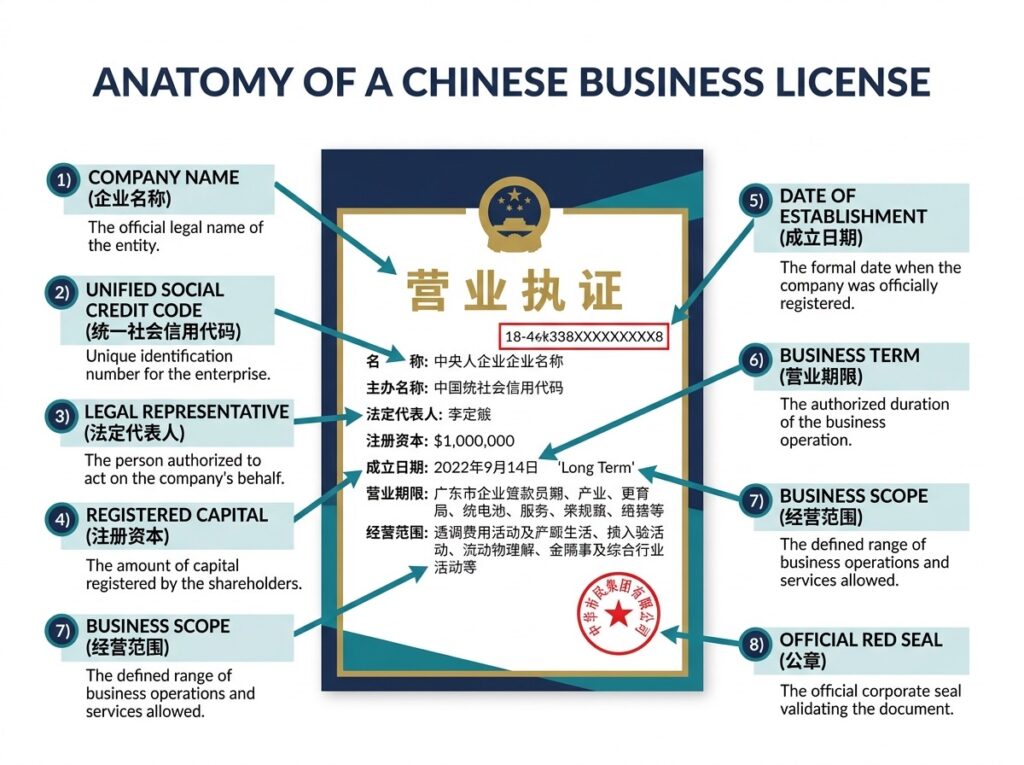
The 8 Fields on a Chinese Business License — Explained
Field 1: Company Name (企业名称 / Qǐyè Míngchēng)
La denominazione sociale ufficiale e registrata dell’entità aziendale. In Cina, le denominazioni sociali seguono un formato strutturato:
[Regione] + [Denominazione commerciale] + [Descrizione del settore] + [Tipo di entità]
Example: 广州华诚贸易有限公司 = Guangzhou (region) + Huacheng (trade name) + Trade (industry) + Limited Company (entity type)
Cosa controllare: Does the company name on the license exactly match the name used in all your correspondence and contracts? Any discrepancy — including simplified vs. traditional characters, or an abbreviated trade name — needs to be explained. A supplier trading as “Huacheng Electronics” whose license shows “Guangzhou Huacheng Trade Co., Ltd.” is operating under a trade name, which is normal — but verify the connection explicitly.
Field 2: Unified Social Credit Code (统一社会信用代码 / USCC)
This 18-character alphanumeric code is the most important field on the license. It’s China’s equivalent of a company registration number, tax ID, and organizational code — combined into one unique identifier.
La struttura del codice USCC a 18 cifre:
– Characters 1–2: Registration authority code
– Character 3: Type of entity (企业 = enterprise, 机关 = government, etc.)
– Characters 4–8: Administrative division code (province/city)
– Characters 9–17: Organization identifier (sequential registration number)
– Carattere 18: cifra di controllo (derivata matematicamente, utilizzata per verificare la validità delle altre cifre)
Cosa controllare: Questo è il numero da inserire nel database ufficiale cinese di verifica. Se il numero non restituisce alcun risultato, oppure restituisce risultati relativi a un'azienda diversa da quella con cui stai trattando, la licenza è falsa oppure l'azienda è stata cancellata dal registro.
Field 3: Legal Representative (法定代表人 / Fǎdìng Dàibiǎorén)
La persona legalmente autorizzata a firmare contratti e ad assumere impegni vincolanti per conto della società. Secondo la legislazione cinese, solo il rappresentante legale (o chi sia in possesso di una procura da lui rilasciata) può effettuare legalmente determinate operazioni commerciali.
Cosa controllare: If you’re signing a purchase agreement or significant contract with a Chinese supplier, the signatory should be either the legal representative named here, or someone presenting a signed authorization document (授权委托书) from the legal representative. Agreements signed by other individuals without authorization have reduced legal enforceability.
Field 4: Registered Capital (注册资本 / Zhùcè Zīběn)
L'importo del capitale sociale dichiarato dagli azionisti della società al momento della registrazione. Espresso in yuan cinesi (RMB).
Avvertenza importante: A seguito della riforma del diritto societario cinese del 2014, il capitale sociale rappresenta un impegno a versare un determinato importo, non un capitale effettivamente versato e verificato. Una società può registrarsi legalmente con un capitale sociale di 10 milioni di RMB senza aver effettivamente versato tale importo. Tale cifra è più significativa come indicatore relativo che come indicatore assoluto.
Cosa controllare: For large orders, registered capital should be proportional to the scale of business being represented. A factory claiming $5 million in annual exports with a registered capital of RMB 50,000 (~$7,000 USD) is an inconsistency worth questioning — though not automatically disqualifying, as many legitimate small factories have modest registered capital.
Field 5: Date of Establishment (成立日期 / Chénglì Rìqī)
La data in cui la società è stata ufficialmente costituita.
Cosa controllare: Does this match the company’s claimed history? A supplier claiming “20 years of manufacturing experience” with a license established in 2021 has a fundamental credibility problem. The establishment date also tells you roughly how stable and established the operation is — companies registered less than 2 years ago carry higher first-order risk than those with 5–10 year track records.
Field 6: Business Term (营业期限 / Yíngyè Qīxiàn)
The authorized duration of the business registration. Most companies register as “长期” (cháng qī — long-term/permanent), meaning no fixed expiry date. Some registrations have fixed terms.
Cosa controllare: If the business term shows an expiration date, verify that date is current. An expired business license means the company’s registration is no longer valid. Also look for any indication of suspension (吊销) or cancellation (注销) in the status field when you verify online.
Field 7: Business Scope (经营范围 / Jīngyíng Fànwéi)
I tipi specifici di attività commerciali che la società è legalmente autorizzata a svolgere. Questo aspetto è spesso sottovalutato dagli acquirenti stranieri, ma riveste una notevole importanza dal punto di vista commerciale.
Cosa controllare: Does the business scope cover the product you’re buying? A company whose business scope lists “clothing and textile products” but is trying to sell you industrial machinery is operating outside their authorized scope — which may affect the legal standing of any contracts and export documentation.
For export-oriented suppliers, look for language related to “import and export” (进出口) in the scope. Companies without import/export authorization in their business scope typically need to export through a licensed freight forwarder — not a problem in itself, but worth knowing.
Field 8: Official Seal (公章 / Gōngzhāng)
Il timbro rosso circolare apposto dall'ufficio SAMR competente per il rilascio. Una licenza valida reca il sigillo ufficiale dell'ufficio locale di vigilanza sul mercato. Nel caso delle licenze digitali (sempre più diffuse), questo può presentarsi sotto forma di firma digitale verificata anziché di timbro fisico.
Cosa controllare: The seal should be clearly legible, correctly positioned, and match the issuing authority indicated elsewhere on the document. A blurred, poorly positioned, or absent seal on a physical license is unusual. In practice, verifying the seal authenticity requires cross-referencing with the database — which is exactly what the next step covers.
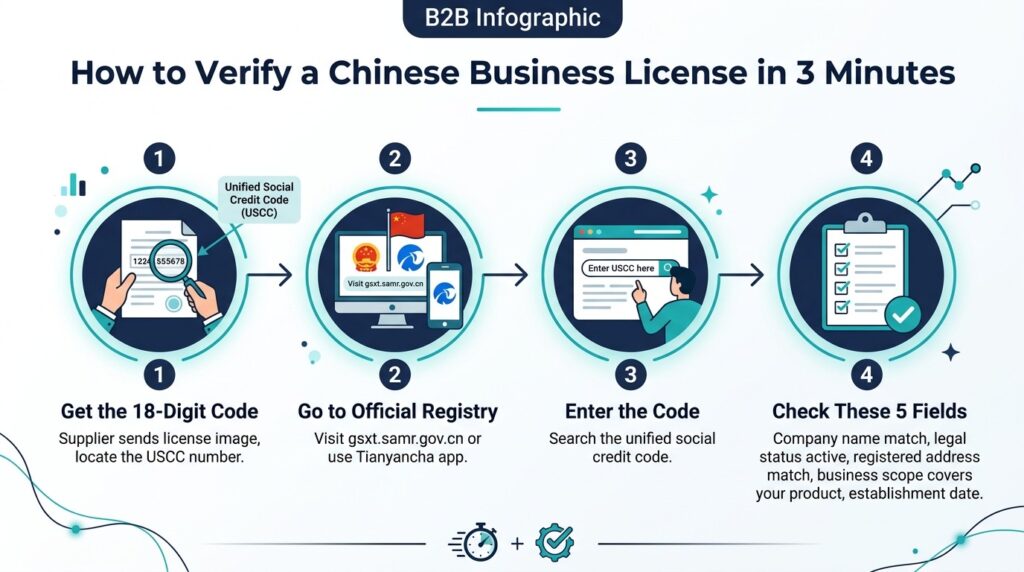
Come verificare la licenza in 3 minuti
Fase 1: Richiedere la licenza e individuare l’USCC
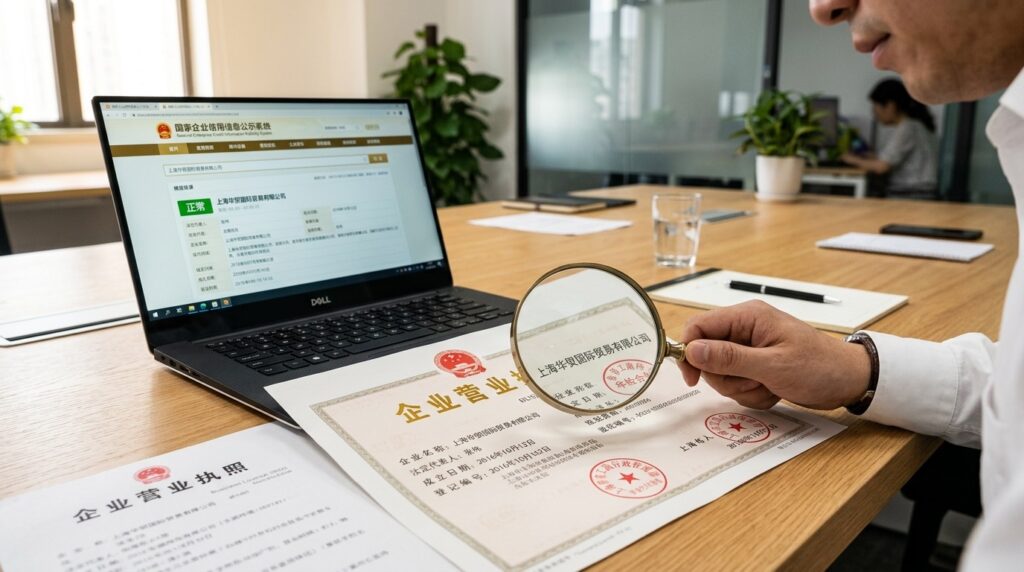
Ask your supplier to send a clear photo or scan of their business license (营业执照). The USCC — the 18-character code — is prominently displayed, usually near the top of the document.
Fase 2: Accedi al Registro Nazionale Ufficiale
Due opzioni, entrambe gratuite:
Option A — SAMR National Database (government, most authoritative):
Visita gsxt.samr.gov.cn — the National Enterprise Credit Information Publicity System. The interface is in Chinese but functional with Google Translate.
Option B — Tianyancha (企查查 / 天眼查, more user-friendly):
Tianyancha (tianyancha.com) e Qichacha (qcc.com) sono piattaforme di business intelligence del settore privato che raccolgono dati SAMR. Sono più intuitive da consultare e forniscono ulteriori informazioni di contesto, tra cui dati relativi a contenziosi, rapporti di investimento e cronologia delle modifiche.
Fase 3: Inserire l'USCC e verificare i risultati
Cerca il codice di 18 cifre. Se la società è registrata correttamente, verrà visualizzata una pagina dei risultati con i dettagli della registrazione.
Fase 4: Verifica questi 5 campi confrontandoli con la licenza
| Cosa controllare | Bandiera verde | Bandiera rossa |
|---|---|---|
| Nome dell'azienda | Corrisponde esattamente | Diverso da quello utilizzato dal fornitore |
| Stato della registrazione | 存续/正常 (Active) | 吊销 (Revoked) / 注销 (Cancelled) |
| Rappresentante legale | Conforme alla licenza | Una persona diversa di nome |
| Sede legale | Corrisponde ad altri documenti | Discrepanza rispetto all'indirizzo dello stabilimento |
| Ambito di attività | Copre la tua categoria di prodotti | Categoria di prodotto non presente |
Confronto tra 5 strumenti di verifica
| Strumento | Costo | Profondità | Ideale per |
|---|---|---|---|
| gsxt.samr.gov.cn | Gratis | Dati di registrazione di base | Verifica ufficiale rapida |
| Tianyancha (天眼查) | Versione base gratuita / Versione completa a pagamento | Registrazione + contenzioso + azionisti | La maggior parte degli acquirenti |
| Qichacha (企查查) | Versione base gratuita / Versione completa a pagamento | Simile a Tianyancha | Alternativa a quanto sopra |
| ImportYeti | Gratis | Cronologia delle importazioni e delle esportazioni degli Stati Uniti | Verifica incrociata delle richieste di esportazione |
| Ciao | A pagamento | Dati dettagliati sul commercio mondiale | Due diligence di alto valore |
Per la maggior parte degli acquirenti che devono prendere decisioni di approvvigionamento standard, il piano gratuito di Tianyancha, insieme al database SAMR, copre tutte le esigenze. ImportYeti aggiunge l’utile funzione di verificare se l’azienda abbia effettivamente un storico di esportazioni verso gli Stati Uniti a conferma di quanto dichiarato.
Come riconoscere una licenza commerciale falsa o alterata
Not all business license fraud involves completely fabricated documents. Some fraudsters alter legitimate licenses — changing a company name, modifying the USCC, or substituting a different entity’s details onto a real document format.
Segnali che indicano una possibile alterazione del documento:
- Incoerenze nei caratteri: I documenti del governo cinese utilizzano caratteri tipografici e spaziature tra i caratteri standardizzati. Il testo modificato presenta spesso lievi differenze in termini di dimensione, spessore o spaziatura rispetto al testo originale circostante.
- L'USCC non è matematicamente valido: The 18th character is a check digit derived from the first 17. Online USCC validators can verify whether the code is internally consistent — a code that fails validation is either mistyped or fabricated.
- Il database restituisce informazioni diverse: L'indicatore più attendibile. Se l'USCC restituisce un'azienda valida ma la ragione sociale non corrisponde a quella riportata sulla licenza, il documento è stato alterato.
- Discrepanza nel nome dell'autorità di registrazione: La sede operativa indicata sul timbro deve corrispondere geograficamente alla sede legale della società. Una società di Shenzhen con un timbro recante la sede operativa di Hangzhou costituisce un’incongruenza evidente.
- La data di costituzione sembra essere stata modificata: Look for signs of image editing around the date — pixel artifacts, color inconsistencies, or character spacing that doesn’t match the surrounding text.
Suggerimento: Richiedi la licenza nel suo formato originale (una foto scattata di persona o una copia certificata digitalmente dal sistema SAMR) anziché un PDF scansionato. I PDF possono essere modificati; le foto originali sono più difficili da alterare in modo credibile.
Cosa può e cosa non può rivelarti un controllo della patente
La verifica della licenza commerciale ti permette di sapere:
– ✅ The company is legally registered in China
– ✅ They are the entity they claim to be
– ✅ Their registration is currently active
– ✅ Their authorized business scope is consistent with what they’re selling you
La verifica della licenza commerciale serve a non ti dico:
– ❌ Whether the company is financially healthy
– ❌ Whether they have actual manufacturing capabilities
– ❌ Whether previous customers have been satisfied
– ❌ Whether their quality output is reliable
Think of license verification as clearing the minimum threshold — a necessary but not sufficient step in supplier vetting. A genuine, legally registered company can still produce poor-quality goods, miss deadlines, or fail on communication. The processo completo di verifica dei fornitori va ben oltre.
Altre letture → 11 segnali di allarme relativi alle truffe nell'approvvigionamento dalla Cina che ogni importatore deve conoscere
Il controllo di 3 minuti che cambia tutto
La verifica della licenza commerciale descritta in questa guida richiede circa tre minuti con Tianyancha. Non richiede alcuna conoscenza della lingua cinese, se non quella necessaria per copiare e incollare un numero di 18 cifre. È completamente gratuita.
Most buyers who’ve been defrauded by fake suppliers did not run this check. Not because they didn’t know it existed — but because the supplier seemed professional, the communication was smooth, and the price was good. The license verification is the step that would have taken 3 minutes and saved them everything they lost.
Add it to your standard supplier onboarding process. Not as an occasional step for suspicious-looking suppliers — as a routine one for every new supplier, every time.
If you’d like support running a thorough background check on a Chinese supplier — license verification, litigation history, export records, and local reputation — Il nostro team svolge questa attività nell'ambito di un incarico standard di approvvigionamento.
Next in the series → Ispezione pre-spedizione in Cina: cosa viene controllato e perché ti fa risparmiare migliaia
Information in this article reflects China’s business registration framework as of 2025–2026. SAMR database interface and Tianyancha features referenced are subject to change.