Most overseas buyers ask for a supplier’s business license but don’t know what they’re looking at when they get one.
The document arrives — official-looking, red stamps, Chinese characters — and the buyer files it away, satisfied that they’ve done their due diligence. What they’ve actually done is received a document without reading it.
This guide changes that. By the end, you’ll know what every field on a Chinese business license means, what to check, what red flags look like, and how to independently verify that the document you received is genuine — in about three minutes.
Why the Business License Matters for Overseas Buyers
China’s business registration system is administered by the State Administration for Market Regulation (SAMR, 国家市场监督管理总局). Every legally registered business entity in China — whether a factory, trading company, or individual business — holds a business license issued by their local SAMR bureau.
The license is the foundational legal document of a Chinese company. Without it, the entity cannot legally:
– Open a corporate bank account
– Sign legally binding contracts
– Obtain export certificates
– Issue formal invoices (fapiao)
A supplier without a valid, verifiable business license is either operating illegally or doesn’t exist as the entity they claim to be. Either situation is disqualifying.
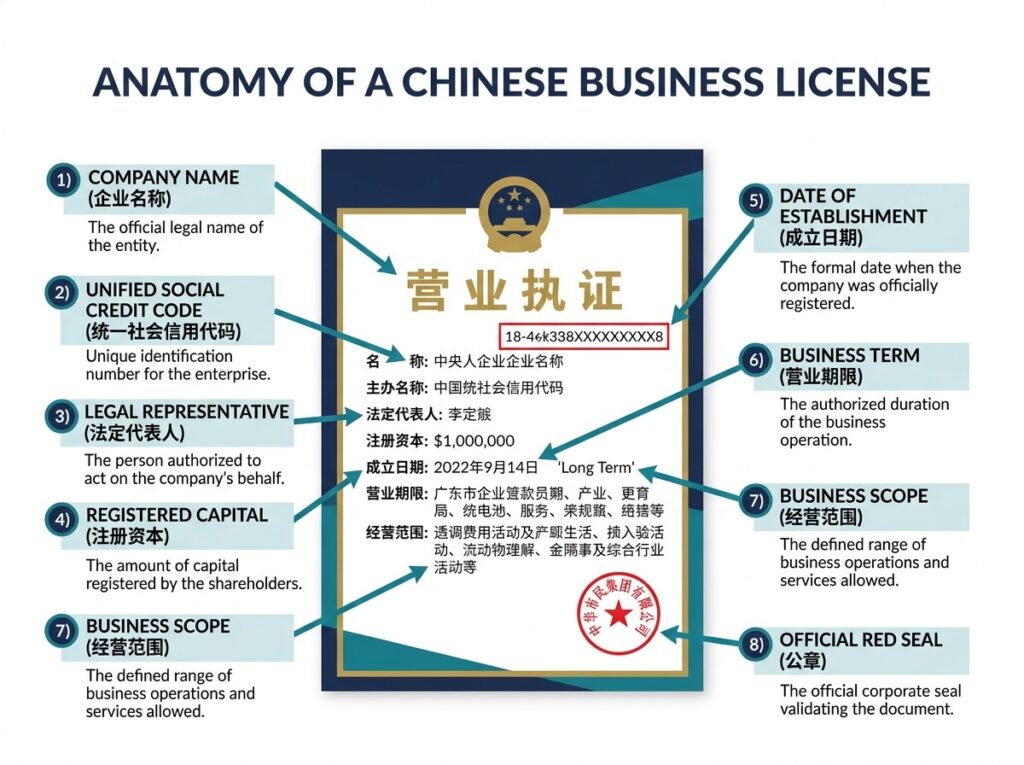
The 8 Fields on a Chinese Business License — Explained
Field 1: Company Name (企业名称 / Qǐyè Míngchēng)
The official registered legal name of the business entity. In China, company names follow a structured format:
[Region] + [Trade Name] + [Industry Descriptor] + [Entity Type]
Example: 广州华诚贸易有限公司 = Guangzhou (region) + Huacheng (trade name) + Trade (industry) + Limited Company (entity type)
What to check: Does the company name on the license exactly match the name used in all your correspondence and contracts? Any discrepancy — including simplified vs. traditional characters, or an abbreviated trade name — needs to be explained. A supplier trading as “Huacheng Electronics” whose license shows “Guangzhou Huacheng Trade Co., Ltd.” is operating under a trade name, which is normal — but verify the connection explicitly.
Field 2: Unified Social Credit Code (统一社会信用代码 / USCC)
This 18-character alphanumeric code is the most important field on the license. It’s China’s equivalent of a company registration number, tax ID, and organizational code — combined into one unique identifier.
The structure of the 18-digit USCC:
– Characters 1–2: Registration authority code
– Character 3: Type of entity (企业 = enterprise, 机关 = government, etc.)
– Characters 4–8: Administrative division code (province/city)
– Characters 9–17: Organization identifier (sequential registration number)
– Character 18: Check digit (mathematically derived, used to validate the others)
What to check: This is the number you enter into China’s official verification database. If the number returns no results, or returns results for a different company than the one you’re dealing with, the license is either fake or the company has been deregistered.
Field 3: Legal Representative (法定代表人 / Fǎdìng Dàibiǎorén)
The individual legally authorized to sign contracts and make binding commitments on behalf of the company. In Chinese law, only the legal representative (or someone holding an authorized power of attorney from them) can legally execute certain business transactions.
What to check: If you’re signing a purchase agreement or significant contract with a Chinese supplier, the signatory should be either the legal representative named here, or someone presenting a signed authorization document (授权委托书) from the legal representative. Agreements signed by other individuals without authorization have reduced legal enforceability.
Field 4: Registered Capital (注册资本 / Zhùcè Zīběn)
The amount of capital declared by the company’s shareholders at registration. Expressed in Chinese Yuan (RMB).
Important caveat: Since China’s 2014 company law reform, registered capital is a commitment to contribute, not verified paid-in capital. A company can legally register with RMB 10 million in registered capital without having actually deposited that amount. The figure is more meaningful as a relative indicator than an absolute one.
What to check: For large orders, registered capital should be proportional to the scale of business being represented. A factory claiming $5 million in annual exports with a registered capital of RMB 50,000 (~$7,000 USD) is an inconsistency worth questioning — though not automatically disqualifying, as many legitimate small factories have modest registered capital.
Field 5: Date of Establishment (成立日期 / Chénglì Rìqī)
The date the company was officially registered.
What to check: Does this match the company’s claimed history? A supplier claiming “20 years of manufacturing experience” with a license established in 2021 has a fundamental credibility problem. The establishment date also tells you roughly how stable and established the operation is — companies registered less than 2 years ago carry higher first-order risk than those with 5–10 year track records.
Field 6: Business Term (营业期限 / Yíngyè Qīxiàn)
The authorized duration of the business registration. Most companies register as “长期” (cháng qī — long-term/permanent), meaning no fixed expiry date. Some registrations have fixed terms.
What to check: If the business term shows an expiration date, verify that date is current. An expired business license means the company’s registration is no longer valid. Also look for any indication of suspension (吊销) or cancellation (注销) in the status field when you verify online.
Field 7: Business Scope (经营范围 / Jīngyíng Fànwéi)
The specific types of business activities the company is legally authorized to conduct. This field is often underappreciated by overseas buyers, but it’s commercially significant.
What to check: Does the business scope cover the product you’re buying? A company whose business scope lists “clothing and textile products” but is trying to sell you industrial machinery is operating outside their authorized scope — which may affect the legal standing of any contracts and export documentation.
For export-oriented suppliers, look for language related to “import and export” (进出口) in the scope. Companies without import/export authorization in their business scope typically need to export through a licensed freight forwarder — not a problem in itself, but worth knowing.
Field 8: Official Seal (公章 / Gōngzhāng)
The round red stamp applied by the issuing SAMR bureau. A valid license carries the official seal of the local market supervision bureau. In a digital license (increasingly common), this may appear as a verified digital signature rather than a physical stamp.
What to check: The seal should be clearly legible, correctly positioned, and match the issuing authority indicated elsewhere on the document. A blurred, poorly positioned, or absent seal on a physical license is unusual. In practice, verifying the seal authenticity requires cross-referencing with the database — which is exactly what the next step covers.
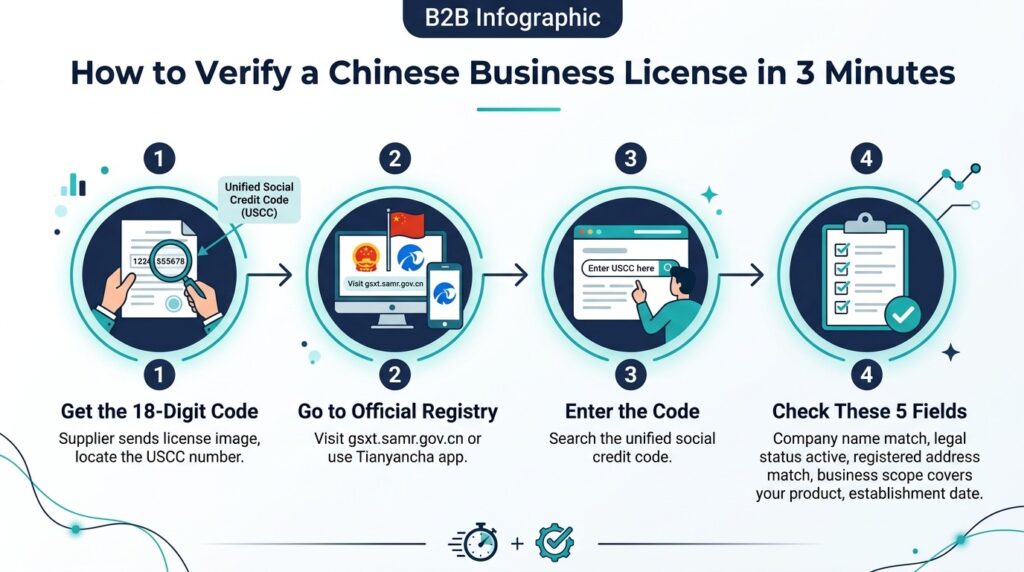
How to Verify the License in 3 Minutes
Step 1: Request the License and Locate the USCC
Ask your supplier to send a clear photo or scan of their business license (营业执照). The USCC — the 18-character code — is prominently displayed, usually near the top of the document.
Step 2: Go to the Official National Registry
Two options, both free:
Option A — SAMR National Database (government, most authoritative):
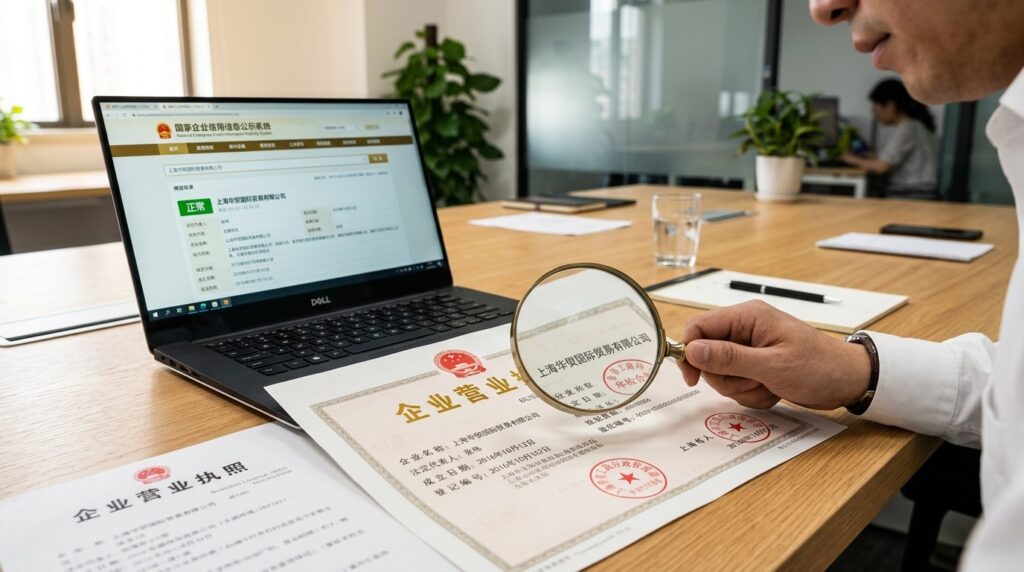
Visit gsxt.samr.gov.cn — the National Enterprise Credit Information Publicity System. The interface is in Chinese but functional with Google Translate.
Option B — Tianyancha (企查查 / 天眼查, more user-friendly):
Tianyancha (tianyancha.com) and Qichacha (qcc.com) are private-sector business intelligence platforms that aggregate SAMR data. They’re easier to navigate and provide additional context including litigation records, investment relationships, and change history.
Step 3: Enter the USCC and Review Results
Search the 18-digit code. A valid registered company will return a results page showing their registration details.
Step 4: Check These 5 Fields Against the License
| What to Check | Green Flag | Red Flag |
|---|---|---|
| Company name | Matches exactly | Different from what supplier uses |
| Registration status | 存续/正常 (Active) | 吊销 (Revoked) / 注销 (Cancelled) |
| Legal representative | Matches license | Different person named |
| Registered address | Matches other documents | Discrepancy with factory address |
| Business scope | Covers your product category | Product category absent |
5 Verification Tools Compared
| Tool | Cost | Depth | Best For |
|---|---|---|---|
| gsxt.samr.gov.cn | Free | Basic registration data | Quick official check |
| Tianyancha (天眼查) | Free basic / Paid full | Registration + litigation + shareholders | Most buyers |
| Qichacha (企查查) | Free basic / Paid full | Similar to Tianyancha | Alternative to above |
| ImportYeti | Free | US import/export history | Cross-referencing export claims |
| Panjiva | Paid | Detailed global trade data | High-value due diligence |
For most buyers on standard sourcing decisions, Tianyancha free tier plus the SAMR database covers everything needed. ImportYeti adds the useful dimension of verifying whether the company actually has US export history to match their claims.
How to Spot a Fake or Altered Business License
Not all business license fraud involves completely fabricated documents. Some fraudsters alter legitimate licenses — changing a company name, modifying the USCC, or substituting a different entity’s details onto a real document format.
Signs of potential document alteration:
- Font inconsistencies: Chinese government documents use standardized fonts and character spacing. Altered text often shows slight size, weight, or spacing differences from the surrounding original text.
- USCC doesn’t mathematically validate: The 18th character is a check digit derived from the first 17. Online USCC validators can verify whether the code is internally consistent — a code that fails validation is either mistyped or fabricated.
- Database returns different information: The most definitive indicator. If the USCC returns a valid company but the company name doesn’t match what’s on the license, the document has been altered.
- Registration authority name mismatch: The issuing bureau named on the seal should correspond geographically to the company’s registered address. A Shenzhen company with a Hangzhou bureau seal is an immediate inconsistency.
- Establishment date appears altered: Look for signs of image editing around the date — pixel artifacts, color inconsistencies, or character spacing that doesn’t match the surrounding text.
Tip: Request the license in its original format (a photo taken in person, or a digitally certified copy from the SAMR system) rather than a scanned PDF. PDFs can be edited; original photos are harder to convincingly alter.
What a License Check Can and Can’t Tell You
A business license verification tells you:
– ✅ The company is legally registered in China
– ✅ They are the entity they claim to be
– ✅ Their registration is currently active
– ✅ Their authorized business scope is consistent with what they’re selling you
A business license check does not tell you:
– ❌ Whether the company is financially healthy
– ❌ Whether they have actual manufacturing capabilities
– ❌ Whether previous customers have been satisfied
– ❌ Whether their quality output is reliable
Think of license verification as clearing the minimum threshold — a necessary but not sufficient step in supplier vetting. A genuine, legally registered company can still produce poor-quality goods, miss deadlines, or fail on communication. The complete supplier verification process goes several steps further.
Related reading → 11 China Sourcing Scam Red Flags Every Importer Must Know
The 3-Minute Check That Changes Everything
The business license verification described in this guide takes approximately three minutes with Tianyancha. It requires no Chinese language skills beyond being able to copy and paste an 18-digit number. It costs nothing.
Most buyers who’ve been defrauded by fake suppliers did not run this check. Not because they didn’t know it existed — but because the supplier seemed professional, the communication was smooth, and the price was good. The license verification is the step that would have taken 3 minutes and saved them everything they lost.
Add it to your standard supplier onboarding process. Not as an occasional step for suspicious-looking suppliers — as a routine one for every new supplier, every time.
If you’d like support running a thorough background check on a Chinese supplier — license verification, litigation history, export records, and local reputation — our team does this as part of standard sourcing engagement.
Next in the series → Pre-Shipment Inspection in China: What Gets Checked and Why It Saves You Thousands
Information in this article reflects China’s business registration framework as of 2025–2026. SAMR database interface and Tianyancha features referenced are subject to change.