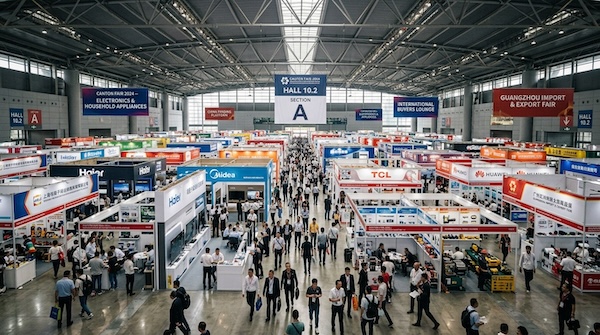
The China Import and Export Fair — universally called the Canton Fair — has been running since 1957. Its scale is genuinely difficult to describe: 25,000+ exhibitors occupying 1.18 million square meters of exhibition space across the China Import and Export Fair Complex in Guangzhou’s Pazhou district. April and October, every year. It is the largest trade fair in the world by any metric.
For first-time international buyers, that scale is both the appeal and the problem. Without preparation, a buyer can spend six days walking an exhibition the size of a small city, collecting business cards from 300 suppliers, and return home with nothing actionable. With preparation, the same six days can establish 8–12 genuine supplier relationships that form the foundation of a product sourcing operation.
This guide is for the second type of buyer.
Canton Fair Structure: Three Phases, Three Product Universes
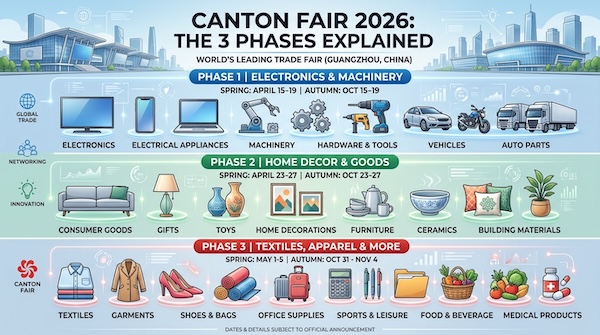
The Canton Fair runs across three phases per session (April and October), each covering different product categories and running for approximately six days with overlap. You do not need all three phases — identify which one covers your products and focus entirely on that.
Phase 1 (Days 1–6)
Electronics and household electrical appliances, lighting equipment, vehicles and spare parts, machinery, hardware, building materials, chemical products
Phase 2 (Days 5–10)
Consumer goods: daily products, gifts, decorations, toys, sporting goods, recreation products, food
Phase 3 (Days 9–14)
Textiles and garments, shoes, office supplies, cases and bags, healthcare products, medical devices
The practical implication: If you’re sourcing electronics, come for Phase 1. Consumer goods, come for Phase 2. Clothing and textiles, Phase 3. Many buyers combine adjacent phases — Phase 1 and 2 overlap on days 5–6; Phase 2 and 3 overlap on days 9–10. If you’re sourcing across categories, a 10-day trip covering two phases is manageable. Three phases in one trip is exhausting and rarely productive.
Registration and Logistics: What to Do Before You Arrive
Registration
International buyers register at cantonfair.net — the official platform. Registration is free for international buyers; you’ll need your passport details and business information. Pre-registration gives you a buyer badge that enables entry. Walk-in registration is possible but slower; pre-register at least 2 weeks in advance.
Chinese Visa: If attending in person, ensure your Chinese tourist or business visa is valid. For many nationalities, China’s visa-on-arrival and 72/144-hour transit visa programs apply — confirm eligibility for your passport before booking flights.
Accommodation
The Pazhou exhibition complex is in Haizhu District. Hotels within 2km of the complex fill up months in advance for Canton Fair dates, at 3–5x normal Guangzhou rates. Book accommodation at least 3 months before the fair, preferably 4–5 months for April (the higher-demand session). Budget $150–400/night near the venue; more economical options in Tianhe or Haizhu Districts with 20-minute metro access.
Practical Logistics
- The Pazhou Complex is accessible via Guangzhou Metro Line 8 (Pazhou station and Xingang East station)
- Each session uses all exhibition halls; your buyer badge indicates which halls are on your entry authorization
- The complex provides a free shuttle between zones; walking between distant halls can take 30+ minutes
Pre-Fair Supplier Research: The Week Before
Walking the Canton Fair without a pre-researched shortlist is the single biggest mistake first-time buyers make.
Use the Canton Fair online platform:
cantonfair.net allows you to search exhibitors by product category, company name, and product keyword before the fair opens. Browse exhibitor profiles, shortlist companies, and book meeting appointments in advance. Exhibitors with pre-scheduled meetings give you priority attention — they’re expecting you rather than treating you as one of thousands of walk-in visitors.
Research Alibaba in parallel:
Identify suppliers you’ve already been communicating with on Alibaba who are exhibiting at the fair. The Canton Fair is an efficient way to meet and evaluate suppliers you’ve already been negotiating with online — in-person relationship establishment after digital communication is significantly more productive than cold booth walks.
Build a prioritized list:
Aim for 15–20 shortlisted exhibitors per day, sorted by priority. You won’t reach all of them — plan for 8–12 productive conversations per day in practice. Prioritize: companies with products matching your specific requirements, companies you’ve already had positive online communication with, and companies in specific hall/booth locations that allow efficient routing.
On the Floor: How to Work the Fair Effectively
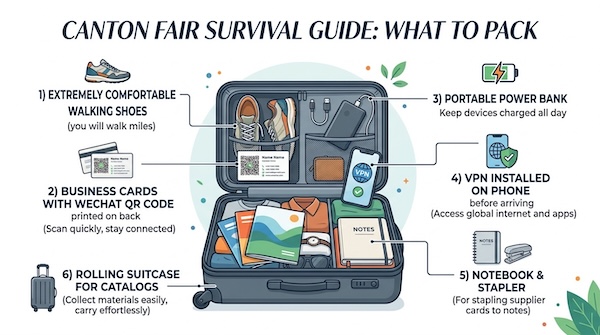
What to Bring
- Business cards: Minimum 200. Include your company name, contact information, website, and product categories you source. Print both English and Chinese if possible.
- A measuring tape and digital calipers: For evaluating product dimensions on-the-spot.
- A portable scale: For checking product weight (useful for shipping cost calculations).
- A notebook or tablet: For recording supplier details, booth numbers, and key product notes.
- Your product spec sheets: To communicate requirements clearly without relying on verbal description.
- A camera or good phone: Document every booth, every product that interests you, with the booth number visible in the shot.
Booth Conversations: What to Cover
At each shortlisted booth, cover these points in 15–20 minutes:
- Verify they manufacture the specific product you need — not just a similar category
- MOQ and price range for your target quantity
- Lead time for production and export
- Sample availability — can they send a sample, and at what cost?
- Export experience — which markets do they currently export to?
- Customization capability — logo, color, packaging, specification changes
- Certification documentation — what CE, FCC, or other certifications do they hold?
Collect a business card, note the booth number, and take a photo of the booth front and key products. Give them your business card and note any follow-up commitment you make.
How to Evaluate Booths Quickly
High-quality exhibitors: clear product displays with specifications visible, professional staff who ask about your requirements before quoting, documentation available for relevant certifications, samples physically present.
Lower-quality signals: generic “we make everything” catalog with no specialization, inability to answer technical questions about their products, aggressive pressure to place orders immediately, staff who cannot explain their production process.
Post-Fair Follow-Up: Where Most Buyers Fail
The Canton Fair contact list is only valuable if follow-up happens within 2 weeks. After that, exhibitor attention shifts, follow-up response rates drop, and the relationship momentum built on the floor dissipates.
Within 48 hours of returning:
– Organize your contacts by priority tier (A: genuine interest, B: possible follow-up, C: reference only)
– Send a brief follow-up email to all A-tier contacts: “Thank you for meeting at Canton Fair, I’m interested in [specific product], can you send me a quotation for [quantity] with [specifications]?”
Within 1 week:
– Follow up on sample requests
– Request formal quotations with specific product specifications attached
– Schedule video calls with top 3–5 candidates
Within 2 weeks:
– Make sample decisions — order samples from 2–3 top candidates, not just one
– Communicate your timeline for placing an order so suppliers understand the opportunity is real
Attending Remotely: The Online Canton Fair
Since 2020, the Canton Fair has operated a parallel online platform (cantonfair.net/online) with virtual booths, video product presentations, and digital meeting scheduling. The online platform is active year-round, not just during physical fair dates.
For buyers who can’t travel to Guangzhou, the online platform provides:
– Exhibitor browsing with video product demos
– Online meeting scheduling with exhibitors
– Sample request coordination
– RFQ (request for quotation) submission
The online experience is substantially less efficient than in-person — you can’t evaluate products physically, read body language, or build personal rapport as effectively. But for initial supplier shortlisting before an in-person visit, or for buyers with limited travel budgets, it’s a functional starting point.
Related reading → Guangzhou Wholesale Markets: A Buyer’s Map
Related reading → How to Verify a Chinese Supplier Before You Pay
Planning your first Canton Fair trip? Our team can help you prepare a targeted supplier shortlist, schedule pre-fair meetings, and accompany you on the floor as experienced sourcing support.