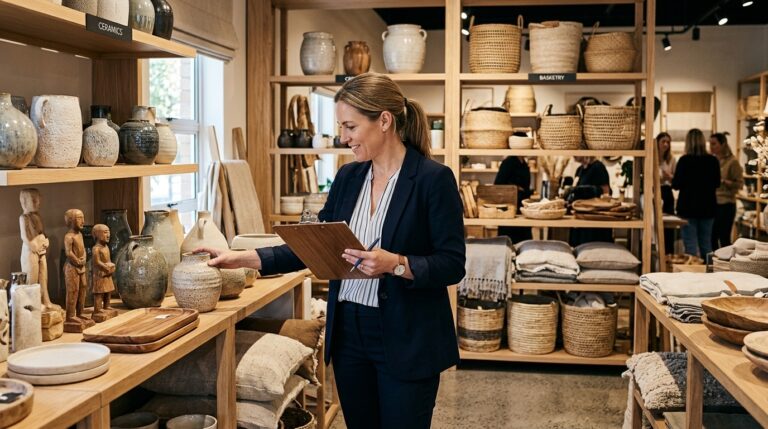
If Yiwu is the world’s wholesale market for small commodity products, Guangzhou holds that position for fabric, fashion, accessories, and home goods. The city hosts multiple distinct wholesale market clusters — each a city block or more of concentrated supply — that collectively represent one of the most comprehensive sourcing ecosystems in China.
For overseas buyers, Guangzhou offers something Alibaba doesn’t: immediate access to actual goods, real samples you can evaluate on the spot, and pricing from operators who serve the Chinese domestic market first. That pricing is consistently 20–40% below equivalent Alibaba listings in most categories.
This guide maps the key clusters, explains what each is best for, and shows you how to access Guangzhou wholesale pricing even if you’re not planning a trip.
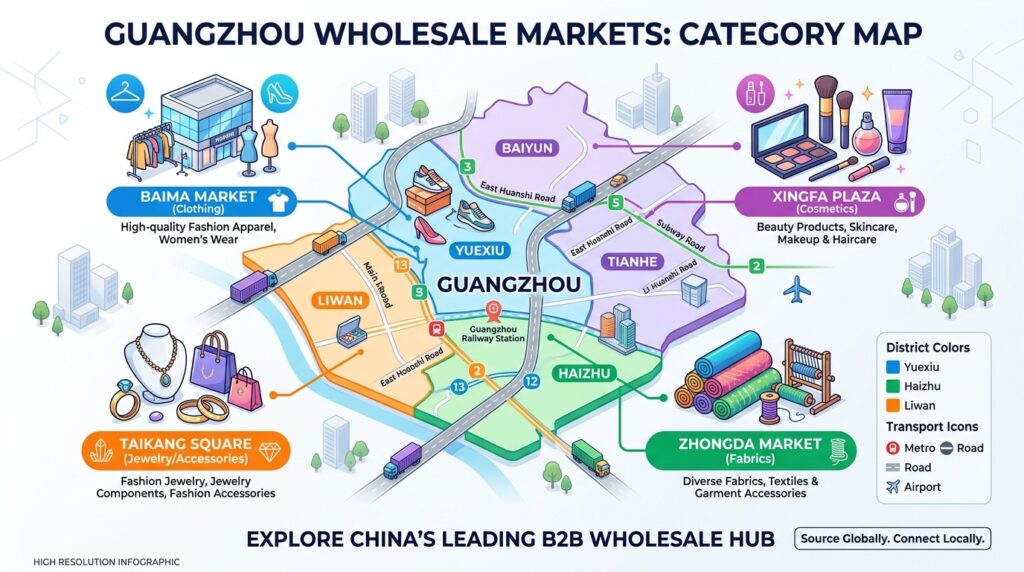
The Major Guangzhou Wholesale Market Clusters
1. Zhongda Fabric Market (中大布料市场)
Location: Around Zhongshan Dadao (中山大道), Haizhu District
Zhongda is China’s largest fabric wholesale market — a dense cluster of 10+ interconnected buildings holding approximately 10,000 stalls selling every category of textile material. It is the primary sourcing destination for garment manufacturers and designers across Asia.
What’s available:
– Woven fabrics (cotton, linen, polyester, blends)
– Knit fabrics (jersey, interlock, rib, fleece)
– Specialty fabrics (silk, velvet, technical performance fabrics)
– Lace, embroidered fabric, printed fabric
– Lining, interfacing, interlining
– Functional fabrics (waterproof, UV-protective, stretch)
Who shops here: Chinese garment factories, fashion designers, clothing brand buyers, custom apparel makers. Overseas buyers typically come with a local agent who knows the buildings.
MOQ reality: Most Zhongda stalls sell by the bolt — minimum purchase is often 50–100 meters per fabric type. Some sellers will cut smaller amounts for sample/development purposes at a premium price per meter.
2. Baiyun World Leather Trade Center (白云世界皮革贸易中心)
Location: Baiyun District
The largest leather and accessories wholesale hub in China. Buildings are organized by product type:
– Leather and PU leather by quality and thickness
– Zippers (YKK and domestic, every specification)
– Buttons, snaps, buckles, rivets
– Thread, elastic, webbing, straps
– Lining materials
– Bag hardware and accessories
Best for: Buyers making bags, shoes, belts, leather goods, or any garment requiring hardware and trim sourcing. If you need zippers, buttons, or bag hardware, this is where Chinese manufacturers come to stock up.
3. Guangzhou International Fashion Show City (广州国际轻纺城)
Location: Near Haizhu Square, across from Zhongda
Finished fashion wholesale — clothing, accessories, and fast-fashion items sourced from Guangzhou’s surrounding manufacturing base. This is where Hong Kong buyers and Southeast Asian wholesale traders stock up on finished garments.
What’s available:
– Women’s fast fashion (blouses, dresses, knitwear)
– Casual menswear
– Accessories (bags, belts, scarves, jewelry)
– Sportswear and athleisure
Typical MOQ: As low as 3–5 pieces per style for finished garments. This is one of the few wholesale contexts in China where very small quantities are genuinely accessible without a trading company intermediary.
4. Foshan Furniture Market (佛山家具市场)
Location: Foshan City (30 minutes from Guangzhou by metro)
Foshan is China’s furniture manufacturing capital. The wholesale market cluster spans several districts:
– Shunde (顺德): Upholstered furniture, sofas, bedroom furniture
– Lecong (乐从): Largest furniture wholesale market in Asia
– Longjiang (龙江): Solid wood furniture, panel furniture
For overseas buyers sourcing furniture and home furnishings, Foshan is more relevant than Guangzhou proper. The scale is similar to Guangzhou’s textile markets — thousands of showrooms, every style and price point.
5. Canton Fair Venue (广交会展馆)
Location: Pazhou, Haizhu District
The Canton Fair (China Import and Export Fair) runs twice annually — April and October — across three phases covering different product categories. The venue is permanent and hosts additional trade events throughout the year.
Even outside Canton Fair dates, the Pazhou area has permanent exhibition halls where some suppliers maintain showrooms. For buyers timing trips around the fair, our Canton Fair sourcing guide covers preparation strategy.
How to Navigate Guangzhou Without Speaking Mandarin
Use a local guide or agent:
Most overseas buyers in Guangzhou’s wholesale markets use a local guide — either a professional sourcing agent or a guide hired for the day (¥500–800/day). This matters more in Guangzhou than in Yiwu: Guangzhou markets are more complex, more specialized, and sellers are less accustomed to non-Chinese-speaking buyers than in international markets like Canton Fair.
Translation tools:
WeChat’s real-time translation function works reasonably well for basic price negotiation and product specification discussions. Google Translate camera mode helps read product labels and building directories.
Payment:
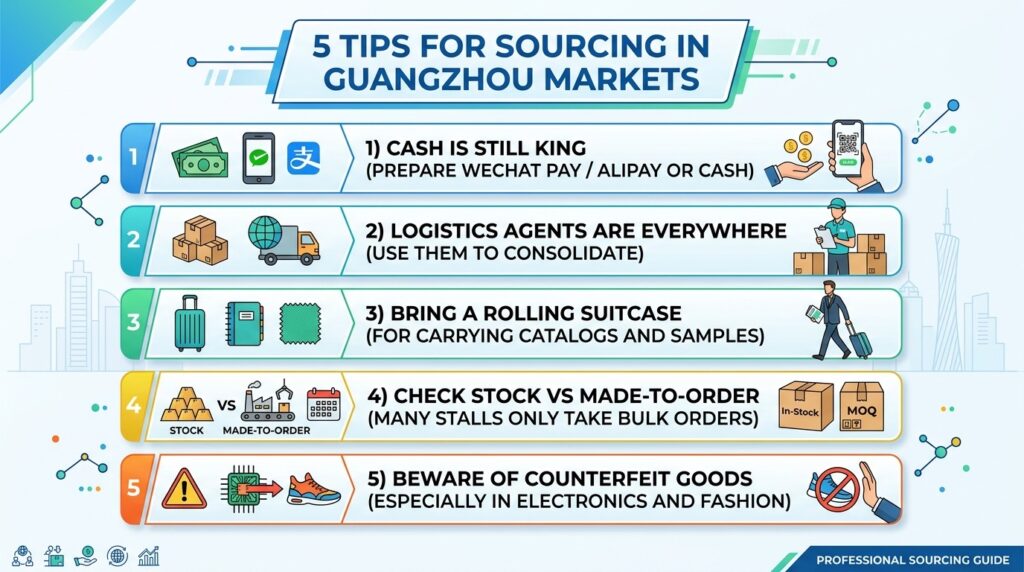
Most Guangzhou wholesale vendors accept WeChat Pay and Alipay — this requires a Chinese bank-linked account. For international buyers, cash (RMB, obtained from ATMs using international cards) is universally accepted. Credit cards are rarely accepted in wholesale markets.
Accessing Guangzhou Pricing Without Traveling
If you can’t make the trip, three routes provide access to Guangzhou wholesale pricing:
1. Guangzhou-based sourcing agent:
An agent physically based in Guangzhou (not Shenzhen or Yiwu) with relationships in the relevant market clusters. They purchase on your behalf, consolidate, quality-check, and ship. This is the most effective remote access method for textile and fashion sourcing.
2. 1688.com:
Many Guangzhou wholesale vendors also list on 1688. Search by city (广州) alongside your product category keyword. See our 1688 buying guide for how to navigate the platform as an overseas buyer.
3. Alibaba with Guangzhou filter:
Search for suppliers with 广东省广州市 (Guangdong Province, Guangzhou City) in their company address. These are actual Guangzhou-based operators who export internationally via Alibaba’s platform — prices higher than wholesale market rates, but with trade assurance protection.
Practical Tips for In-Person Visits
Best visiting days: Tuesday–Friday. Mondays are slow (restocking); weekends see more domestic retail buyers, higher prices.
Carry a sample book: Bring physical color swatches, material samples, or product photos of what you’re looking for. This communicates your requirements faster than any translation app.
Photograph everything: Mark stall numbers on photos (many buildings use a grid numbering system). You’ll visit 50+ stalls in a day; you won’t remember which fabric came from which stall without documentation.
Negotiate, but reasonably: First-quoted prices are typically 15–30% above the final settlement price for new buyers. Regular customers and high-volume buyers get progressively better pricing. Don’t expect extreme negotiation results on your first visit.
Factor in consolidation logistics: Goods from multiple market clusters need to be consolidated and shipped. Either your agent handles this, or you’ll need to arrange delivery of all purchases to a local logistics company for container consolidation.
Need help sourcing from Guangzhou wholesale markets with an experienced local agent? Our team has active coverage across Guangzhou, Foshan, and the Pearl River Delta region.
Related reading → How to Source Clothing from China: Sizing, Labels and Common Pitfalls