An Australian importer wired 100% payment to a new Guangdong supplier before production. The supplier confirmed production was underway, then went quiet. By the time it became clear that no goods were coming, the money was unrecoverable — wire transfers to China are not reversible without the receiving bank’s cooperation, and the supplier had no incentive to cooperate.
A European importer paid 30% deposit and 70% against bill of lading. The goods shipped, but on arrival, 40% of units had a visible defect. Because the importer had already paid the balance against shipping documents, they had no leverage for a refund. The factory claimed the defect occurred in transit.
Two different payment approaches. Two different failure modes. Neither buyer understood what their payment terms actually protected them against.
This guide covers every common payment method used in China trade, what risk each one transfers to which party, and how experienced importers structure payment terms to maintain leverage throughout the order cycle.
The Core Principle: Payment Timing = Leverage
Before comparing specific payment methods, understand the underlying logic:
Every payment you make before receiving conforming goods is a lever you’ve given up. The factory’s incentive to produce correctly, to respond to quality concerns, and to address problems is directly correlated with how much money they haven’t yet received from you.
100% prepayment → you have zero leverage after payment.
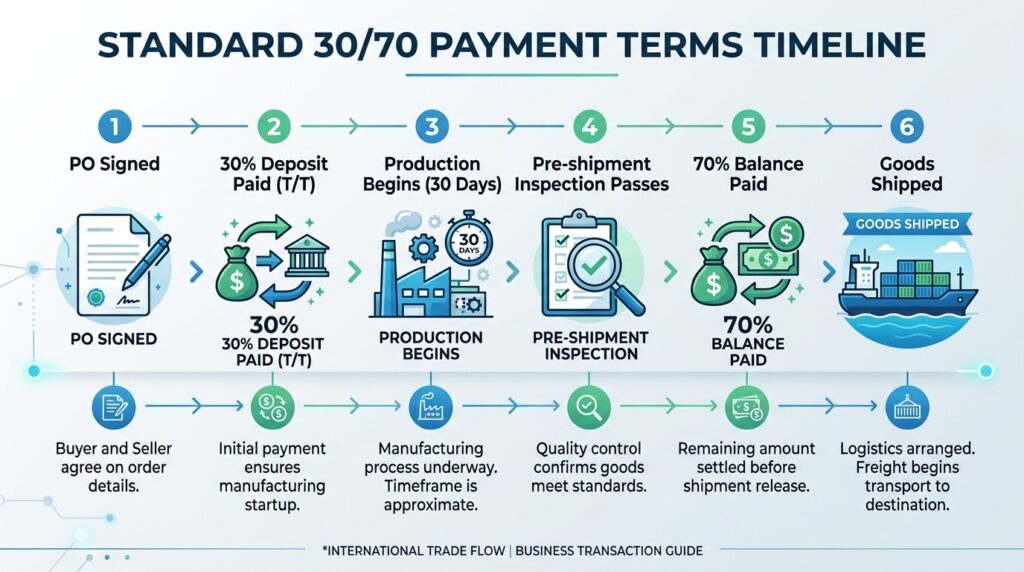
30% deposit / 70% against B/L → you have 70% leverage until goods ship.
30% deposit / 70% against inspection approval → you have 70% leverage until goods pass your inspection.
The ideal payment structure from a buyer’s perspective maintains maximum leverage at every stage until you have confirmed, conforming goods in transit. The challenge is that many factories — especially smaller ones with limited working capital — require significant upfront payment to cover raw material costs. Negotiating the right structure requires understanding both your risk and theirs.
Payment Method 1: T/T Wire Transfer (Telegraphic Transfer)
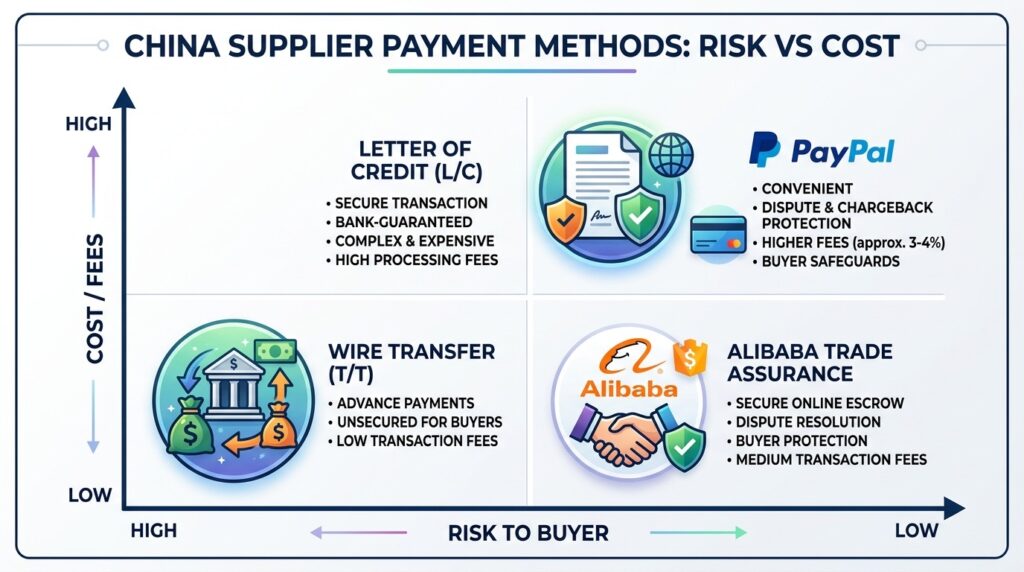
T/T is the most common payment method in China trade. Money moves directly from your bank to the supplier’s bank account via SWIFT transfer.
Standard structures:
30/70: 30% deposit upfront, 70% balance before or after shipment. The most common structure for established supplier relationships.
30/70 against inspection: 30% deposit, 70% after a third-party inspector confirms goods meet specification. This is the buyer-protective version — you maintain 70% leverage until quality is confirmed.
50/50: 50% deposit, 50% against B/L. Common for first orders with new suppliers where both parties are building trust.
100% upfront: Standard for very small orders (samples, trial quantities) or suppliers with strong platform verification. Never appropriate for large production orders with a new supplier.
What T/T protects you against: Nothing inherently — T/T is just a payment mechanism, not a protection mechanism. The protection comes from the timing of payments and what conditions trigger each payment.
What T/T doesn’t protect you against: Fraud, disappearing suppliers, or quality problems after full payment has been made.
Key rule: Never pay the balance before you have either: (a) a third-party inspection report confirming goods meet specification, or (b) at minimum, the bill of lading confirming goods have shipped. Paying 70% balance “to help the factory ship” before you have documentation of shipment is how large losses happen.
Payment Method 2: Letter of Credit (L/C)
A Letter of Credit is a bank-issued payment instrument where the buyer’s bank commits to pay the seller’s bank upon presentation of specified shipping and compliance documents.
How it works:
1. Buyer applies to their bank for an L/C, specifying the documents required for payment (commercial invoice, bill of lading, packing list, certificate of origin, inspection certificate, etc.)
2. Buyer’s bank issues the L/C to the seller’s bank
3. Seller ships goods and presents the required documents to their bank
4. Banks verify documents match L/C terms; if they match, payment releases automatically
What L/C protects you against:
– The seller gets paid only when they present the documents you specified. If an inspection certificate is required but goods fail inspection, the factory can’t present a passing certificate and can’t get paid.
– Significant protection against non-shipment — the factory must present a bill of lading proving goods shipped.
What L/C doesn’t protect you against:
– Document fraud — sophisticated fraudsters can falsify shipping documents. L/Cs verify documents, not physical goods.
– Goods that don’t match specification but were shipped with conforming documents — without an inspection requirement in the L/C, the factory can ship non-conforming goods and still collect payment.
Practical limitations:
L/Cs are expensive to establish ($300–800 in bank fees), require significant paperwork, take 1–3 weeks to establish, and many smaller Chinese factories are unfamiliar with or unwilling to accept L/C terms. They’re most appropriate for large orders ($50,000+) with established counterparties.
Payment Method 3: Alibaba Trade Assurance
Trade Assurance is Alibaba’s built-in payment and dispute protection system. Payments flow through Alibaba rather than directly to the supplier.
How it works:
– You pay into an Alibaba Trade Assurance escrow-like system via credit card, bank transfer, or other supported methods
– Alibaba releases payment to the supplier after order completion
– If there’s a dispute about quality or non-delivery, Alibaba’s dispute resolution team reviews evidence from both parties and may refund some or all of your payment
What Trade Assurance protects you against:
– Payment redirect fraud — since payment goes to Alibaba, not the supplier directly, man-in-the-middle bank account fraud doesn’t apply
– Basic quality disputes — if goods deviate significantly from what was agreed and documented in the Trade Assurance order
– Non-shipment — if the supplier simply doesn’t ship
What Trade Assurance doesn’t protect you against:
– Subtle quality issues that are hard to document as a clear deviation
– Disputes where your specification wasn’t clearly uploaded to the Trade Assurance order
– Non-Alibaba suppliers (only applies within the Alibaba ecosystem)
The practical reality of Trade Assurance disputes: Resolution takes 2–6 weeks. Alibaba tends toward compromise outcomes rather than full refunds — partial refunds of 30–70% are common in quality disputes. Trade Assurance is better than nothing but is not a substitute for proper quality control.
Payment Method 4: PayPal / Credit Card
Some Chinese suppliers accept PayPal or credit card payment, particularly smaller trading companies and suppliers on platforms like DHgate.
What it protects you against:
– Chargeback rights on credit cards are the strongest buyer protection in international trade — you can dispute a transaction with your card issuer if goods weren’t delivered or were significantly not as described, and the card network enforces the chargeback without requiring the seller’s cooperation.
– PayPal buyer protection applies to PayPal-processed transactions with similar dispute rights.
What it doesn’t protect you against:
– Higher transaction fees (2.5–5% on international transactions) that suppliers factor into their price
– Most larger Chinese factories don’t accept PayPal or credit card due to these fees and account restrictions — this method is mainly available for small-value transactions
Practical use: Good for sample purchases ($50–500) where the buyer protection value outweighs the fee cost. Not realistic for production order quantities.
Payment Risk Comparison
| Method | Buyer Risk | Seller Risk | Best For |
|---|---|---|---|
| 100% T/T upfront | Very High | Very Low | Samples only |
| 30/70 T/T (vs. B/L) | Medium | Medium | Established suppliers |
| 30/70 T/T (vs. inspection) | Low-Medium | Medium-High | First orders, high-value |
| Letter of Credit | Low (with inspection clause) | Low | Large orders $50K+ |
| Trade Assurance | Low-Medium | Medium | New Alibaba suppliers |
| Credit card / PayPal | Low | Medium | Samples, small orders |
Negotiating Payment Terms: What Actually Works
For a first order with a new supplier:
Request 30% deposit / 70% against third-party inspection approval. Explain that this is your standard terms for first orders; once the relationship is established, you’ll move to 30/70 against B/L.
Most legitimate factories accept 30/70 — the 30% deposit covers their raw material costs. Reluctance to accept any payment structure that maintains buyer leverage until quality is confirmed is a red flag.
For a supplier requiring more upfront:
Suppliers with limited working capital often push for 50/50 or even higher deposits. Counter-offer: 30/70 against B/L with the 70% wired within 3 days of receiving the B/L copy. This gives the factory certainty they’ll be paid quickly after shipment while maintaining your shipment-confirmation leverage.
For an established relationship (3+ successful orders):
30/70 against B/L is standard. Some buyers move to net-30 or net-45 payment against invoice with established suppliers — though this requires significant trust and is more common in large-buyer situations.
One rule with no exceptions:
Any change to payment bank account details must be verified by phone call to the supplier’s established number — not to a number provided in the email requesting the change. Man-in-the-middle bank account fraud specifically targets trusted supplier relationships. The call takes 90 seconds and has saved importers hundreds of thousands of dollars.
Related reading → How to Write a Purchase Order for Chinese Suppliers
Related reading → 7 China Sourcing Scam Stories — And What Each Victim Learned
Questions about payment structure for a specific China sourcing transaction? Our sourcing advisors can recommend the right payment approach for your order size and supplier relationship.