7 China Sourcing Scam Stories — And What Each Victim Learned
Seven real China sourcing fraud cases — each a different scam type, a different dollar amount, and a lesson experienced importers now apply to every order.
The numbers vary. The product categories change. The countries of the buyers are different in every case. But the structure of China sourcing fraud stories is remarkably consistent: a supplier who seemed legitimate, a payment that was made, and then a problem that turned out to be unfixable.
These are seven of those stories. They’re composites drawn from real reported cases — details changed to protect privacy, financial figures approximate. Each one involves a different type of fraud and a different gap in the buyer’s process. Each one ends with a lesson that costs nothing to apply going forward.
Story 1: The Phantom Factory — $28,000 Lost
The Setup:
A UK-based online retailer found a ceramic cookware manufacturer through a Google search. The website was excellent — high-quality product photos, a detailed “About Us” page describing 12 years in the industry, testimonials. The email responses were prompt and professional.
What Happened:
The buyer placed a 1,200-unit order for ceramic pots and paid a 30% deposit of $8,400. Three weeks later, they received a message saying production was delayed due to “equipment maintenance.” Two weeks after that, the email address stopped responding. The website went offline. The phone number connected to a non-working Chinese mobile.
A business license check — run after the fact — showed the 18-digit USCC code on the license image they’d been sent corresponded to a food distribution company in Henan province, not a cookware manufacturer in Guangdong.
Total Loss: $8,400 deposit (unrecoverable).
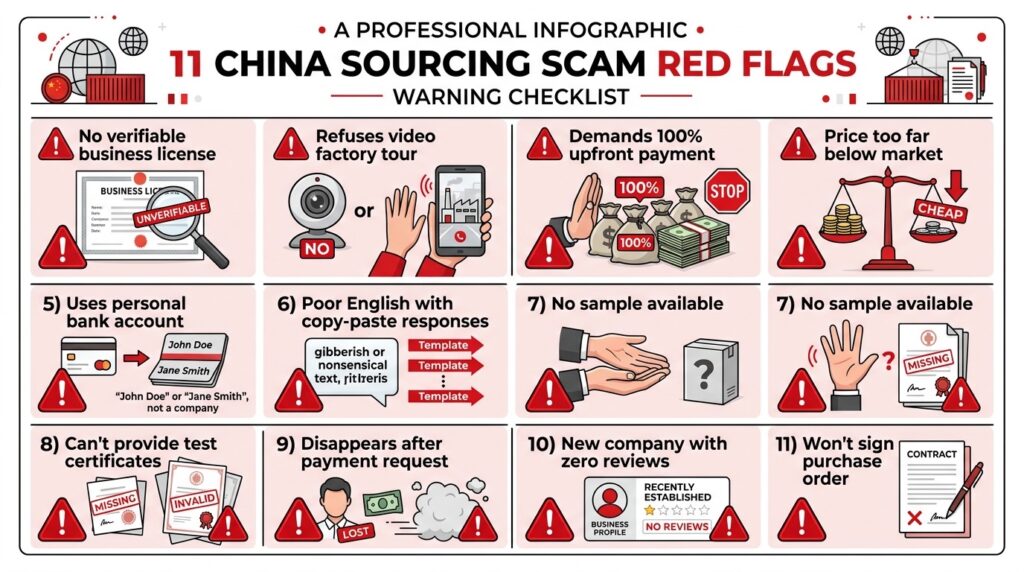
THE LESSON: Verify the business license before any payment. The 18-digit USCC code is publicly searchable at gsxt.samr.gov.cn in three minutes. A code that returns the wrong company type, the wrong province, or no result at all is a hard stop — not a reason to ask the supplier for clarification.
Story 2: The Quality Bait-and-Switch — $47,000 Absorbed
The Setup:
A US Amazon seller sourced silicone baking mats from a Guangdong supplier they’d used once before for a small test order. The initial 200-unit sample order had been excellent — consistent thickness, proper food-grade certification documentation, clean printing.
What Happened:
The follow-up 5,000-unit bulk order arrived 11 weeks later. Within the first week of Amazon FBA receiving, 23% of units were flagged for a quality defect: the logo printing was bleeding into the silicone surface under heat, creating a transfer that contaminated food surfaces. The defect was traced to a different silicone base compound used in the bulk run — a domestic-grade material substituted for the food-grade compound used in the sample.
The factory acknowledged “some variation” and offered a 7% discount on the next order. There was no pre-shipment inspection on the bulk run.
Total Loss: $10,810 in unusable inventory (23% of $47,000 order value), plus Amazon returns processing costs, plus one negative review cycle.
THE LESSON: A good sample doesn’t guarantee a good bulk order. Material substitution is the most common and hardest-to-detect quality fraud because it passes visual inspection. The fix is a pre-shipment inspection with a specific brief that includes material verification — not just cosmetic and functional checks. See our pre-shipment inspection guide for what to include in the brief.
Story 3: The Payment Redirect — $78,000 Diverted
The Setup:
A German furniture importer had a two-year relationship with a Guangzhou factory producing upholstered seating. Payments were always made via wire transfer to the same HSBC Hong Kong account.
What Happened:
Three months into a new order cycle, the importer received an email from what appeared to be their regular supplier contact — same email address, same name, same signature — explaining that the company was restructuring their banking to a new account at a different Hong Kong bank. The email provided new account details and asked the buyer to use these for the forthcoming balance payment of $78,000.
The importer didn’t call to verify. The payment was made. The real factory never received it.
A forensic email analysis later showed the supplier’s account had been compromised six weeks earlier. The “payment redirect” email had been sent from the real address but by the attacker who’d been monitoring email traffic and waiting for a large payment to intercept.
Total Loss: $78,000 (partial recovery of $11,200 attempted via wire recall 96 hours after payment — largely too late).
THE LESSON: Any change to payment bank details must be confirmed by phone — calling the supplier’s verified, previously established contact number, not a number in the email requesting the change. This rule has no exceptions. Man-in-the-middle payment fraud is specifically designed to exploit long-established trust in email communication. The call takes 90 seconds.
Story 4: The Disappeared Deposit — $12,500 Gone
The Setup:
An Australian homeware brand found a rattan furniture manufacturer on Made-in-China.com. The company had been registered on the platform for three years, had positive reviews, and quoted competitive prices on a custom outdoor furniture collection.
What Happened:
After two weeks of sample approval discussions (samples were sent and were genuinely good), the buyer placed a production order for 400 units and paid a 50% deposit of $12,500. Production confirmation was sent two days later with an estimated completion date 45 days out.
At day 40, the buyer sent a production progress inquiry. No response. At day 45, the buyer called the number on the business license. A different person answered — a private individual who said they’d never heard of the furniture company. The Made-in-China.com listing went offline within 48 hours of the buyer’s support ticket to the platform.
Total Loss: $12,500 (full deposit, irrecoverable — Made-in-China’s dispute process found insufficient evidence of platform rule violations as the transaction had been conducted off-platform via WeChat).
THE LESSON: Conduct all business through the platform’s official messaging system, not WeChat or WhatsApp. Platform-based messaging creates a documented record that enables dispute resolution. Off-platform communication is private and gives you no case when the platform’s dispute team reviews what happened. Also: positive platform reviews and multi-year registration are necessary but not sufficient — combine them with business license verification and a video call.
Story 5: The Sample Scam — $3,200 and 14 Weeks
The Setup:
A Canadian health and wellness brand was developing a custom supplement container — a specific shape, specific lid mechanism, BPA-free plastic. They found a plastics manufacturer in Zhejiang claiming OEM capabilities and requested a custom sample.
What Happened:
The supplier quoted $800 for tooling fees and three custom samples. The buyer paid. Samples arrived at week six — well-made, matching the spec. The buyer placed a 3,000-unit production order and paid a 40% deposit.
At week 12, the supplier said production was “60% complete” and requested the 60% balance before shipping “to cover material costs.” The buyer — feeling the samples had proven quality — paid. At week 14, the supplier became unresponsive. No goods were ever shipped.
A reverse image search of the sample product photos later found identical images on five different supplier websites — the “custom sample” had been a stock product with the buyer’s label applied.
THE LESSON: Custom tooling should produce a verifiable paper trail — mold invoices, production photos, factory QC records. If a supplier can’t provide mid-production photos showing your specific product on the line, be skeptical of “60% complete” status updates. Never pay the balance before goods have been physically inspected and verified at the factory. Consider this a universal rule with no exceptions.
Story 6: The Packaging Substitution — $19,000 Absorbed
The Setup:
A US e-commerce brand selling personal care products sourced custom-printed packaging boxes from a Shanghai packaging manufacturer. The approved sample: a specific uncoated kraft paper with a particular tactile finish that was central to the brand’s premium positioning.
What Happened:
The production order (10,000 units, $19,000) arrived on schedule. Unboxing revealed that the boxes had been printed on standard coated paper, not the specified kraft stock. The surface finish was glossy rather than matte-textured. The dimensions were correct. The printing was correct. The paper was not.
The factory’s position: “The artwork specifications didn’t specify paper type — we used a comparable alternative.” Review of the purchase order revealed no explicit paper specification had been included. The buyer had assumed the sample paper would be matched.
Total Loss: $19,000 in packaging that couldn’t be used for launch without compromising brand positioning, plus reprinting costs.
THE LESSON: Approved samples must be accompanied by written specifications — paper type, weight, surface treatment, finish, dimension tolerances. “Make it like the sample” is not a specification. Anything that matters must be written down with measurable parameters. The factory will manufacture to what’s on paper; what’s in your head doesn’t count.
Story 7: The Certification Forgery — $120,000 and a Market Exit
The Setup:
A UK electrical accessories importer sourced a range of smart home devices — switches, dimmers, smart plugs — from a Shenzhen electronics manufacturer. The supplier provided CE certification documents and test reports from what appeared to be an accredited testing laboratory.
What Happened:
Eighteen months after market entry, a UK trading standards investigation prompted by a consumer complaint found that the CE marks on the products were self-declared rather than third-party certified, and that the test reports had been falsified — the laboratory named on the reports confirmed they had never tested the specific products. Several units had exhibited overheating under load testing.
The importer faced a product recall, regulatory fines, and a permanent exit from the electrical accessories category. The supplier had by then reregistered under a new entity name.
Total Loss: Estimated £95,000+ in recall costs, fines, inventory write-off, and legal fees. Market reputation: permanently damaged in the category.
THE LESSON: For regulated products (electrical, children’s items, medical, food contact), never accept supplier-provided test reports at face value. Contact the named testing laboratory directly and ask them to confirm the certificate number and test date. Third-party certification by an accredited body (SGS, TÜV, Intertek, Bureau Veritas) means the certifier’s own reputation is attached to the document. Self-declared certificates mean nothing. This verification takes one email and one day.
The Pattern Across All 7 Stories
These stories involve different product categories, different countries, different dollar amounts. But every one of them had at least one gap in the buyer’s process that was identifiable in advance:
Story
Fraud Type
Preventable With
1. Phantom Factory
Identity fraud
Business license verification
2. Bait and Switch
Material substitution
Pre-shipment inspection with material brief
3. Payment Redirect
Man-in-the-middle
Phone confirmation of any payment detail change
4. Disappeared Deposit
Ghost supplier
On-platform communication + video verification
5. Sample Scam
Advance payment fraud
Never pay balance without inspection
6. Packaging Substitution
Spec gap exploitation
Written specifications on every material element
7. Certification Forgery
Document fraud
Direct laboratory confirmation of test reports
None of these protections requires special expertise or expensive tools. Each one costs less than an hour to apply. The cost of not applying them is visible in the numbers above.
These stories are composites drawn from documented fraud cases across importer communities, industry reports, and sourcing professional case studies. Identifying details have been altered. Financial figures are approximate.
Q: Can money be recovered after China sourcing fraud?#+
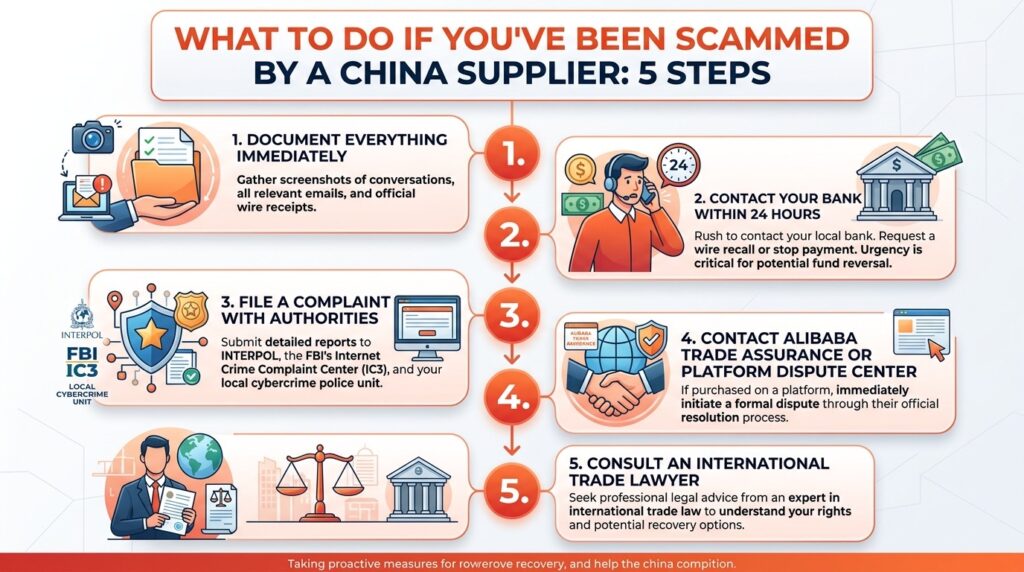
A: Recovery is possible but uncommon after 72 hours. Wire recalls initiated within 24–48 hours have the highest success rate — contact your bank immediately, provide all transaction details, and request an urgent wire recall. For amounts above $10,000, consult a lawyer familiar with international commercial fraud. Alibaba Trade Assurance provides meaningful recourse for transactions conducted within that system; transactions outside it have very limited platform protection.
Q: Are certain product categories higher risk for fraud?#+
A: Electronics, children's products, and health/beauty categories have the highest incidence of certification fraud and material substitution, primarily because compliance certification creates pressure to cut corners. Generic commodity goods (packaging, textiles, basic hardware) see more identity fraud and disappearing deposit scams targeting first-time buyers who haven't established the verification habit.
Q: Does Alibaba Trade Assurance prevent all these scenarios?#+
A: Trade Assurance provides meaningful protection for payment redirect fraud (payments go to Alibaba, not the supplier directly) and quality disputes (subject to resolution process). It doesn't protect you from bait-and-switch material substitution that passes inspection, certification forgery that your QC didn't catch, or packaging specification gaps that arise from poorly written purchase orders. Think of it as one layer of protection, not a complete system.
Q: Is China sourcing fraud more common than sourcing from other countries?#+
A: China accounts for the largest volume of international sourcing, so it naturally accounts for the largest absolute number of fraud cases. The per-transaction fraud rate is not higher than other developing manufacturing regions. The difference is that China's sourcing ecosystem is sophisticated enough that fraudulent operators are skilled at mimicking legitimate business practices — which is why the verification steps described in these cases matter more, not less.
A: Contact the testing laboratory named on the report directly — use contact details from the laboratory's own website, not those provided by the supplier. Give them the certificate number, product name, and test date. They can confirm in writing whether they issued the report for that product. This takes one email and typically one business day.
Q: What's the fastest single thing I can do to reduce fraud risk?#+
A: Run the business license check first. It takes three minutes, costs nothing, and eliminates the largest category of first-contact fraud — the phantom factory. If the USCC code doesn't match the company you're talking to, the rest of the verification process is irrelevant. Start there every time.
We use cookies to improve your experience on our site and analyse traffic. By clicking Accept, you agree to our use of cookies as described in our Privacy Policy.