No import category is more heavily regulated than children’s products. The regulatory rationale is clear: children are the most vulnerable consumer population, cannot make informed risk assessments, and often interact with products in ways that expose risks adults wouldn’t encounter. The compliance requirements reflect this.
For China importers, the children’s category presents a specific challenge: China is the world’s largest producer of toys, children’s clothing, and baby products — and also the source of some of the most prominent product safety incidents that prompted the regulatory frameworks now in place. The standards exist because of real harms that occurred with real products from real Chinese factories.
This guide covers what compliance is required for children’s products in the US, EU, and UK markets, what it costs, and what happens when importers skip it.
Defining “Children’s Products”
The definition matters for compliance purposes:
US (CPSIA): A product designed or intended primarily for use by children 12 years old and under. “Designed or intended” is interpreted broadly — if a product has a character, color scheme, or marketing that appeals to children, it may be covered even without explicit age labeling.
EU (Toy Safety Directive): Products designed or intended for use in play by children under 14 years.
UK (Toys (Safety) Regulations 2011): Products intended for use in play by children under 14 years.
For children’s clothing specifically: US children’s sleepwear regulations apply to sizes 9 months through 14 years. EU REACH restrictions on hazardous substances in textiles apply regardless of age.
US Compliance: CPSIA and CPSC Requirements
The Consumer Product Safety Improvement Act (CPSIA, 2008, updated multiple times since) is the primary US federal law governing children’s product safety. It is administered by the CPSC (Consumer Product Safety Commission).
Lead Content Limits
Substrate (paint/surface coating): Maximum 90 ppm (parts per million) lead in surface coating. This applies to all children’s products.
Total lead content in substrate materials: Maximum 100 ppm for most children’s products. This is a total lead limit on the accessible substrate — not just the surface coating.
Why this matters for China sourcing: Lead in paint and substrate materials was the cause of major Chinese toy recalls (Mattel/Fischer-Price recalls in 2007 that prompted CPSIA). Many Chinese factories have updated their processes, but lead testing must be verified by independent third-party testing — factory declarations are not sufficient.
Children’s Products Certificate (CPC)
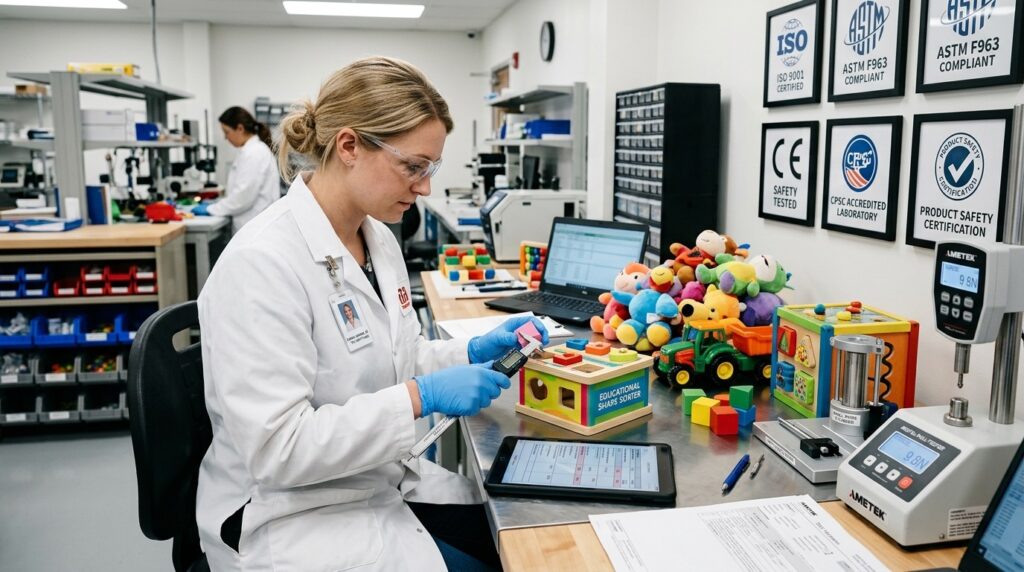
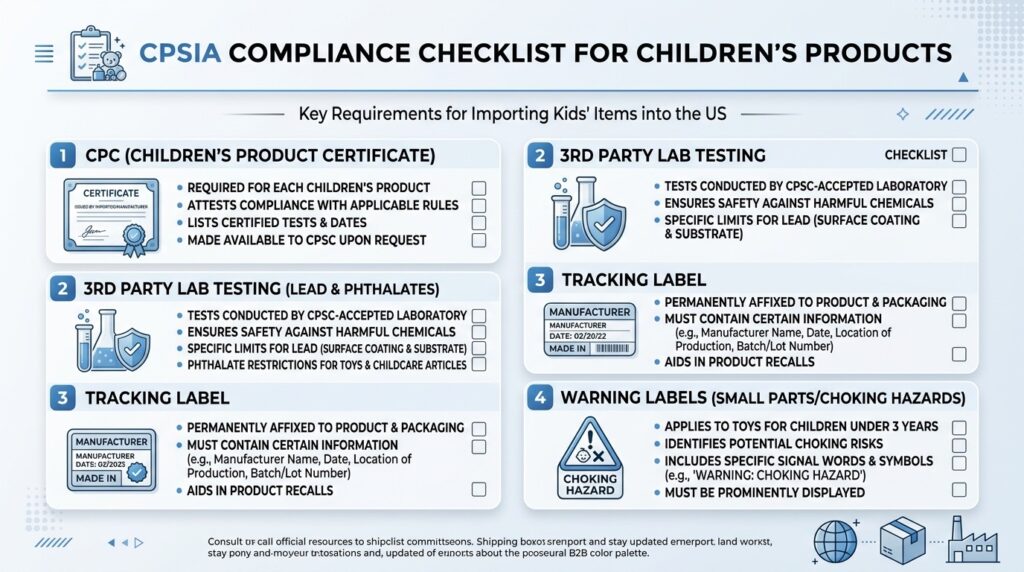
All children’s products sold in the US must have a Children’s Product Certificate (CPC) — a document certifying that the product complies with all applicable CPSC rules, based on testing at a CPSC-accepted third-party laboratory.
The CPC must include:
– Product identification
– Name and contact information of the importer or domestic manufacturer
– Identification of the applicable CPSC regulations and standards
– The accredited third-party laboratory that performed the testing
– Date(s) and place(s) of product testing
– Contact information for the manufacturer of the product
The brand (importer) generates the CPC — the factory provides test reports from accredited labs that support the CPC. The importer signs it and is legally responsible for its accuracy.
CPSC-accepted labs: A searchable list is at cpsc.gov/Business–Manufacturing/Testing-Certification/Accredited-Testing-Labs. Using a lab not on this list produces invalid test results.
Toy Safety: ASTM F963
Children’s toys must comply with ASTM F963 — Standard Consumer Safety Specification for Toy Safety. This covers:
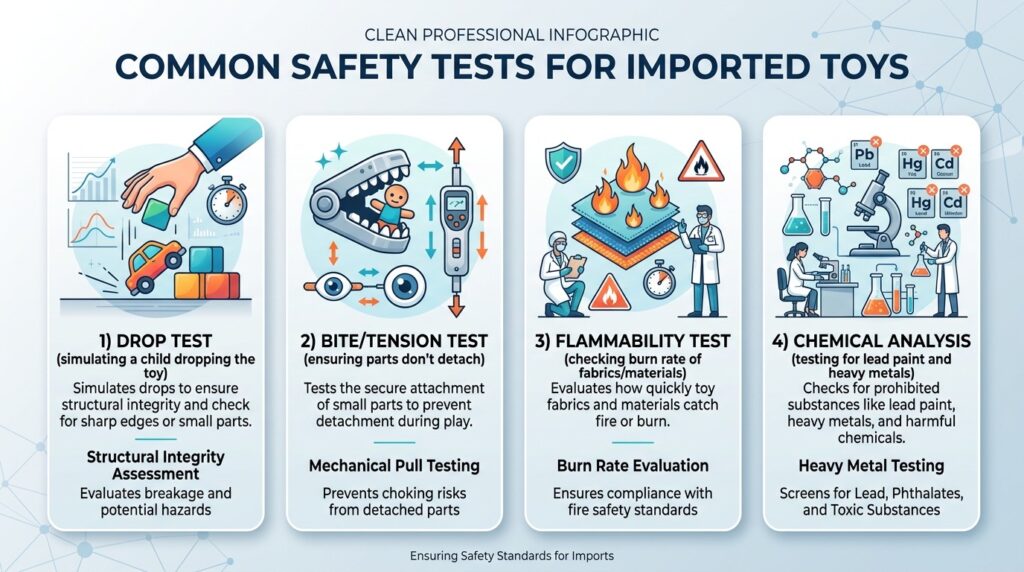
– Mechanical and physical hazards (sharp edges, points, small parts)
– Flammability
– Chemical requirements (specific substance limits)
– Electrical requirements (for battery-operated toys)
– Sound-producing toys (noise level limits)
– Projectile toys
– Toy chests (lid support requirements)
ASTM F963 compliance must be verified by testing at a CPSC-accepted lab with current scope for F963.
Small Parts and Choking Hazards
Products intended for children under 3 must not have small parts. Any toy or children’s product with components small enough to fit in a CPSC small parts cylinder (approximately 3.17cm diameter × 5.72cm depth) requires a choking hazard warning if intended for children under 3, and must pass small parts testing.
Chinese factories often don’t understand the specificity of the small parts test — the cylinder dimensions are precise, and parts testing must be done at the right force and conditions.
Children’s Clothing: Flammability
Children’s sleepwear (sizes 9 months–14 years) must either:
– Comply with 16 CFR Part 1615/1616 flammability standards (tested and certified), OR
– Be made of tight-fitting garments that meet specific size and fit requirements (exemption)
Most Chinese garment factories producing children’s sleepwear understand this requirement for export to the US, but compliance verification is still the importer’s responsibility.
EU Compliance: Toy Safety Directive and REACH
Toy Safety Directive 2009/48/EC
Toys sold in the EU must:
– Bear CE marking
– Comply with essential safety requirements (mechanical, chemical, electrical, flammability, hygiene)
– Have technical documentation available
– Have an EU Declaration of Conformity
For toys with specific risks (projectiles, toys with heating functions, toys for children under 36 months), testing by an EU Notified Body (third-party) is required. For other toys, self-declaration with documented testing is permitted.
Chemical requirements under the Toy Directive:
– Specific migration limits for heavy metals in accessible materials
– Restrictions on aromatic amines, carcinogenic/mutagenic/reprotoxic (CMR) substances
– Nitrosamines limits in rubber and latex toys
REACH Regulation
The EU REACH regulation restricts approximately 2,000 substances in all products, including toys and children’s products. Key restrictions for children’s products:
– Phthalates in PVC (limit: 0.1% by weight in toys and childcare articles)
– Bisphenol A in polycarbonate baby bottles (banned)
– Azo dyes in textiles (specific amines restricted)
REACH compliance requires either substance testing or supply chain documentation demonstrating that restricted substances are not present above threshold levels.
UK Compliance (Post-Brexit)
Post-Brexit, the UK has its own toys safety regulations (Toys (Safety) Regulations 2011, as amended) with UKCA marking requirements replacing CE for Great Britain.
UKCA compliance is broadly aligned with EU Toy Safety Directive requirements but requires:
– UKCA marking instead of CE on toys sold in Great Britain
– UK Responsible Person listed in documentation (EU address not sufficient)
For Northern Ireland, CE marking continues to apply.
What Testing Costs and How Long It Takes
| Test | Estimated Cost | Timeline |
|---|---|---|
| CPSIA lead content (surface + substrate) | $200–400 | 5–10 business days |
| ASTM F963 full toy safety | $1,500–4,000 | 10–20 business days |
| EN 71 (EU toy safety) | €1,500–3,500 | 10–20 business days |
| REACH/phthalates screening | $300–600 | 5–10 business days |
| Children’s apparel flammability | $300–600 | 5–10 business days |
For a children’s toy targeting both US and EU markets, budget $4,000–8,000 for a comprehensive compliance test stack. This is a fixed cost that spreads over the production run — at 2,000 units, it adds $2–4/unit to your landed cost.
Common Compliance Failures in China-Sourced Children’s Products
Factory-provided test reports that are out of scope: A factory may have an ASTM F963 test report from 2022 for a slightly different product. That report doesn’t cover your product variant or current production. Test reports must be product-specific and current.
Incorrect age-grade labeling: A product intended for children over 3 that includes small parts doesn’t require age warning — but if the product is marketed in imagery or packaging in ways that suggest appeal to children under 3, CPSC may consider it designed for that age group. Age grading must be accurate and defensible.
Lead in decoration elements: Small decorative elements (painted eyes on stuffed animals, metallic decorations on clothing) frequently fail lead testing. These components are often sourced by the factory from separate suppliers and may not have been included in the factory’s own QC testing.
Missing CPC on import: CBP (US Customs) increasingly requests CPC documentation at import. Goods without supporting documentation may be held or refused entry.
Related reading → Why Electronics from China Fail Compliance
Related reading → Pre-Shipment Inspection in China: What Gets Checked
Sourcing children’s products from China? Our team coordinates CPSC-accepted lab testing and CPC documentation for children’s product importers.