A UK importer of wireless smart plugs received a shipment of 4,000 units from a Shenzhen factory in March. Each unit displayed a CE mark. The supplier had provided a CE test report from a company called “European Quality Testing Center Ltd” — a professional-looking document with official-seeming stamps.
By September, Trading Standards issued a recall notice. The products had been found to contain live parts accessible without tools — a basic Low Voltage Directive safety failure. The test report was traced to a non-accredited “testing company” based in Guangdong that generates compliance-looking documents for a fee of approximately ¥800 per product.
The importer faced a full product recall, destruction of 4,000 units, £23,000 in regulatory fines, and civil liability for any consumer incidents. The products had been on sale for six months.
This happens more than the industry publicly acknowledges. This guide explains why, how to identify genuine compliance, and what the import process should look like for electronics.

Why Chinese Electronics Frequently Have Compliance Problems
Understanding the cause helps identify the solution.
The market structure creates compliance pressure:
Chinese electronics factories compete primarily on price. Genuine compliance certification — using an accredited lab, running actual product testing, maintaining documentation — costs $3,000–15,000 per product variant depending on what’s required. For a factory selling a product at $8.50/unit, that certification cost is material.
The shortcut is well-established: self-declare CE compliance (allowed for some product categories under EU rules, but requires genuine conformity assessment), use the CE mark from a similar product on a different product, or use a document service that produces realistic-looking test reports.
The enforcement environment is uneven:
Market surveillance authorities in the EU, UK, and US don’t test every imported product. The probability of any individual shipment being tested for compliance is low — which means the expected cost of non-compliance, weighted by probability of detection, is often lower than the cost of genuine compliance. This is a structural incentive problem.
The buyer bears the consequences:
When non-compliant products reach consumers and cause harm, or when market surveillance tests a product and finds failures, the responsible party is the entity that placed the product on the market — which is the importer, not the factory. Chinese factories are shielded from EU/UK/US regulatory consequences by jurisdiction. The importer is not.
The Most Common Compliance Failure Modes
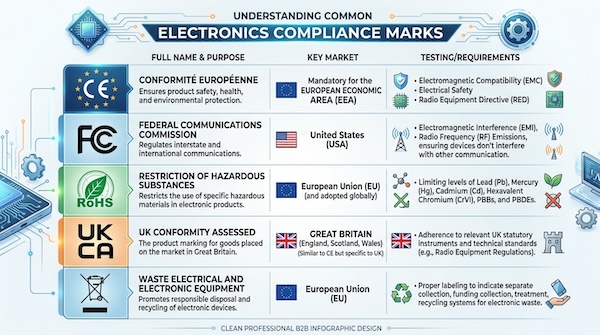
1. CE Self-Declaration Without Conformity Assessment
The CE marking system allows manufacturers to self-declare compliance with relevant EU Directives for certain product categories — but only after conducting a genuine conformity assessment, which requires either internal technical documentation demonstrating compliance with applicable harmonised standards, or third-party testing by a Notified Body (for higher-risk products).
What many Chinese suppliers do: apply the CE mark without conducting any conformity assessment, simply because CE marks are required to sell in the EU and the enforcement risk of non-compliance is low for any individual shipment.
How to identify: Ask for the Declaration of Conformity (DoC) — a legally required document for CE products that must list the specific EU Directives and harmonised standards the product complies with, plus the responsible person’s signature. If they can’t provide it, there’s no compliant CE marking. If it lists the wrong Directives or generic/inapplicable standards, it’s likely fabricated.
2. FCC ID Copying or Misrepresentation
FCC Part 15 authorization for US wireless devices requires either Certification (third-party testing by an accredited FCC Test Lab) or Declaration of Conformity (with documented test results). Each FCC ID is specific to one product from one applicant.
Common fraud pattern: A Shenzhen supplier applies an FCC ID from a legitimately authorized product (often a similar product from a different company) to their non-authorized product. The ID looks valid when searched in the FCC database — because it is valid for the product it was issued to, just not this product.
How to verify: Search the FCC ID at fcc.gov/oet/ea/fccid. The listing will show the grantee company name and the product photos/description. If the product name doesn’t match what you’re importing, or the grantee is a company unrelated to your supplier, the FCC ID is being misappropriated.
3. RoHS Declaration Without Testing
RoHS restricts 10 hazardous substances in electrical and electronic equipment sold in the EU. A supplier “RoHS compliant” declaration requires testing for restricted substances (lead, mercury, cadmium, hexavalent chromium, PBB, PBDE, and four additional phthalates added in 2019).
What frequently happens: Suppliers provide RoHS “compliance” without any actual substance testing — simply declaring compliance because it’s what buyers request.
How to verify: Request the RoHS test report from an accredited lab, not just a declaration. The report should list test results for each restricted substance category and the detection method used. A lab name you can verify (SGS, Intertek, Bureau Veritas, TÜV, UL, QIMA) and a certificate number you can look up is the standard.
4. UKCA Mark Confusion (Post-Brexit)
Since January 2021, products sold in Great Britain require UKCA marking instead of (or in addition to) CE. Many Chinese suppliers are not aware of or don’t maintain UKCA documentation because their primary EU customers still use CE.
For UK-market electronics, confirm UKCA documentation specifically — CE documentation alone is not sufficient for GB market sales.
How to Verify Compliance Before Import
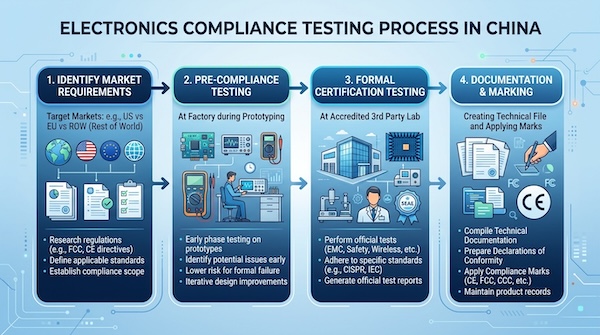
Step 1: Identify Which Certifications Apply
Different product types require different certifications. A wireless Bluetooth speaker sold in the US requires FCC Part 15 authorization. Sold in the EU, it requires CE under the Radio Equipment Directive (RED), Low Voltage Directive (LVD), and WEEE/RoHS compliance. Sold in the UK, add UKCA.
Map your product’s regulatory requirements before contacting suppliers. The FCC Equipment Authorization database, the EU’s NANDO database for Notified Bodies, and your country’s market surveillance authority websites are reference points.
Step 2: Request Specific Documentation, Not General Claims
Don’t ask “do your products have CE certification?” The answer will always be yes. Ask for:
– The Declaration of Conformity (DoC) with specific Directive numbers
– The test report from the accredited lab, including the lab’s ILAC accreditation status
– The FCC Grantee ID and product description matching your product
– The certificate number for any third-party certification (CE Notified Body, UL listing, etc.)
Step 3: Verify the Lab’s Accreditation
Testing labs must be accredited by a recognized accreditation body. In the US, the relevant accreditation bodies are A2LA and NVLAP. In the EU, each country has a national accreditation body (DAkkS in Germany, UKAS in UK, COFRAC in France). The ILAC (International Laboratory Accreditation Cooperation) maintains a global directory.
Go to the accreditation body’s website — not the lab’s website — and verify that the lab holds current accreditation for the relevant test scope. Accreditation is scope-specific: a lab may be accredited for EMC testing but not product safety testing.
Step 4: Verify the Specific Certificate, Not Just the Lab
Even if the lab is legitimate, verify that the certificate number covers your specific product. Call or email the lab directly with the certificate number. Legitimate labs will confirm whether they issued a specific certificate for a specific product.
Step 5: Independent Pre-Import Testing
For any significant order of regulated electronics, arrange independent compliance testing on production samples before your full shipment arrives. Submit samples to an accredited third-party lab yourself — don’t use the supplier’s samples or the supplier’s lab selection.
Cost: $300–1,500 per product depending on the test scope. Timeline: 5–20 business days. This is your practical protection against sophisticated document fraud that passes document verification but fails actual testing.
What to Do When Goods Arrive Non-Compliant
If you discover compliance issues after your shipment arrives:
Option 1 — Stop before customs clearance if possible:
If you discover the problem while goods are in port or a customs bonded warehouse, consult a customs broker about your options. Re-export to origin or destruction at port are typically less costly than dealing with products after they’ve entered commerce.
Option 2 — Don’t list for sale while investigating:
For goods already in your warehouse, don’t list them for sale while you’re investigating the compliance status. Placing non-compliant products on the market creates regulatory liability from the date of sale. Goods sitting in a warehouse are a financial problem; goods sold to consumers are a regulatory and legal problem.
Option 3 — Commission independent testing:
Submit samples from the shipment to an accredited lab. Get written test results. This establishes what you actually have — some products may partially comply (failing specific tests but passing others), which affects your options.
Option 4 — Return or renegotiate:
If the factory misrepresented compliance, you have grounds for a return, rework, or price compensation claim. Your evidence is the compliance-related purchase order terms and the independent test failure. Document everything in writing.
Related reading → Pre-Shipment Inspection in China: What Gets Checked
Related reading → Shenzhen Electronics Sourcing: An Insider’s Guide
Need help verifying compliance documentation for specific Chinese electronics products? Our team includes compliance specialists who verify certifications before your shipment departs China.