When the first iPhone launched in 2007, Apple’s supply chain ran almost entirely through Shenzhen and the surrounding Pearl River Delta. That wasn’t a coincidence, and the dynamic hasn’t fundamentally changed. Shenzhen remains the world’s most concentrated electronics manufacturing ecosystem — a city where component suppliers, PCB manufacturers, product designers, assemblers, and certification labs exist within 30 minutes of each other.
For overseas buyers, that density creates an opportunity that doesn’t exist anywhere else on earth: the ability to source finished electronics products, custom components, or fully designed prototypes from a supply chain cluster compact enough that a skilled agent can visit five different vendors in a single afternoon.
This guide explains how Shenzhen’s electronics ecosystem works, where to source different types of products, and what’s different about electronics sourcing compared to commodity goods.
The Shenzhen Electronics Ecosystem: A Map
Shenzhen’s electronics supply chain isn’t uniformly distributed across the city. Understanding the geographic clusters helps both in-person visitors and buyers briefing a local agent.
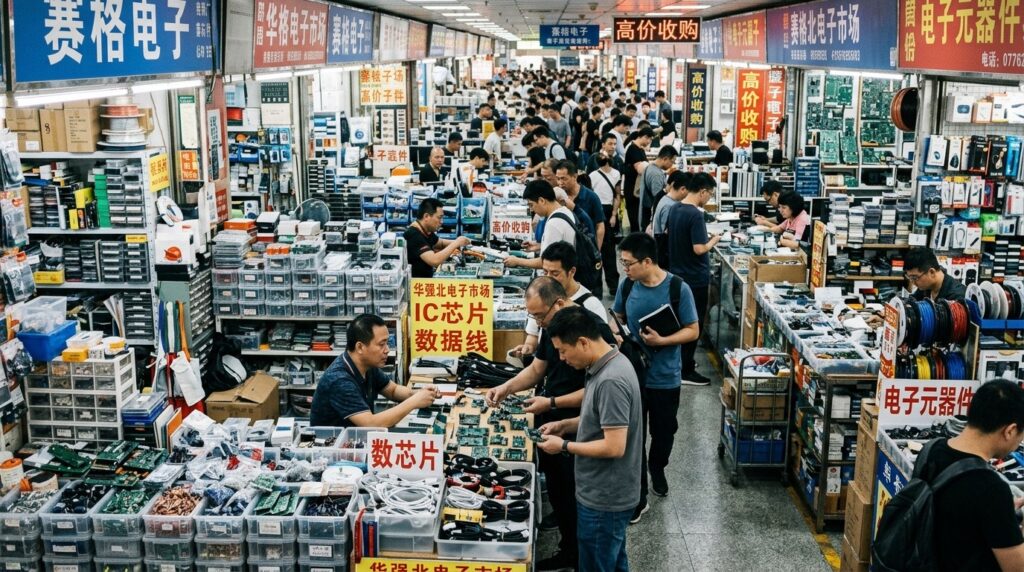
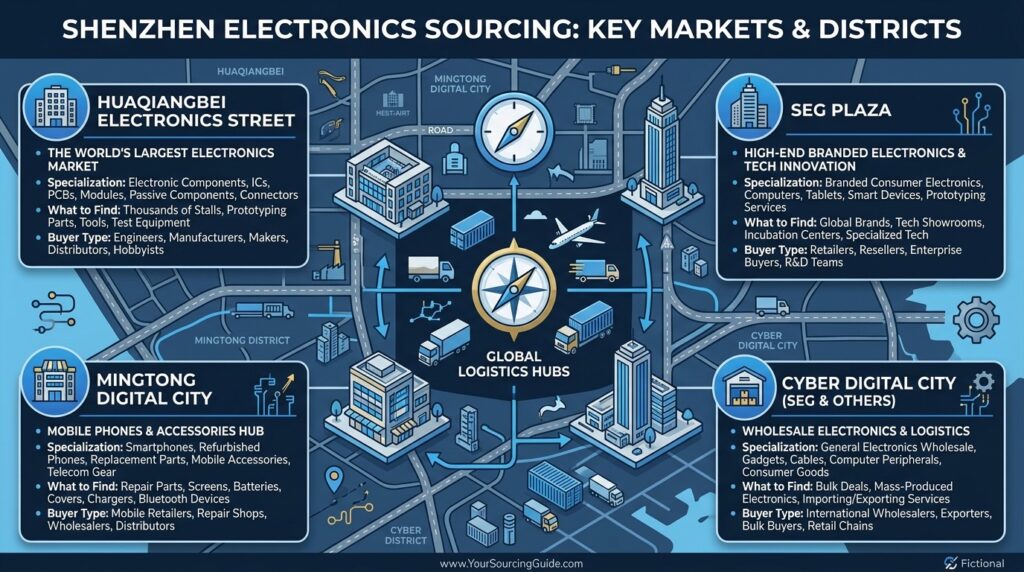
Huaqiangbei (华强北) — Components and Finished Products Market
Huaqiangbei is the world’s largest electronics components market district — a dense grid of eight to ten interconnected multi-story buildings spanning approximately 1 square kilometer in Futian District. It’s where you can buy:
- IC chips and electronic components (floor by floor, by component type)
- Consumer electronics: phones, tablets, earbuds, smart devices
- Cables, connectors, power adapters, charging equipment
- LED lighting and display components
- PCBs and development boards
- Counterfeit and gray-market goods alongside legitimate products (see the note on counterfeits below)
Huaqiangbei is relevant for: component sourcing, market pricing research, prototype hardware, and high-volume finished product sourcing through vetted traders.
Longhua and Guanlan — Contract Manufacturing Zone
This is where the large-scale assembly operations are — including Foxconn’s primary Shenzhen campus. The factories in Longhua and Guanlan handle mass production assembly for global brands. Smaller OEM/ODM manufacturers cluster in the same area.
For overseas buyers, this zone is relevant for: finished product manufacturing (rather than component sourcing), OEM brand licensing, and ODM product development with a factory that’s already tooled for consumer electronics.
Bao’an — Hardware Manufacturing Belt
Bao’an District is home to manufacturers of electronic hardware: enclosures, PCBs, switches, power components. Many of the factories visible on Alibaba with addresses in Shenzhen or “Guangdong” are physically located in Bao’an.
Dongguan (Adjacent City) — Mid-Tier Manufacturing
While not technically Shenzhen, Dongguan is 45 minutes away and part of the same ecosystem. It’s the primary location for consumer electronics factories that have moved production costs down from Shenzhen proper — same supply chain access, lower land and labor costs.
What to Source from Shenzhen (And What Not To)
Strong Categories
Consumer electronics (finished goods): Smart home devices, Bluetooth audio, wireless earbuds, portable chargers, LED lighting, surveillance cameras, health monitoring devices. Shenzhen factories have tooling, certifications, and production scale for these categories at price points unreachable elsewhere.
Electronic components: ICs, sensors, modules, development boards (Arduino, ESP32, Raspberry Pi accessories), connectors, passive components. Huaqiangbei prices for components are the global reference point for many parts.
Custom electronics / ODM: If you have a product concept that requires electronics development — a connected device, a smart product, a consumer gadget — Shenzhen has the highest concentration of ODM houses (original design manufacturers) that can take a brief from concept to production-ready product.
PCB manufacturing and assembly: Shenzhen has a dense cluster of PCB fabricators (JLCPCB, PCBWay, and dozens of others) capable of prototype quantities (5–50 boards) to mass production runs (100,000+ boards). Lead times for simple PCBs run 24–72 hours for prototypes.
Categories Where Shenzhen Has Limitations
Products with complex mechanical components: While Shenzhen excels at electronics, mechanical assembly quality (precise machined parts, complex injection molding) is often better sourced from Dongguan, Zhejiang, or Jiangsu manufacturers with different industrial specializations.
Low-cost commodity electronics that don’t need customization: For finished standard products (USB hubs, phone cables, basic LED bulbs), Yiwu or 1688-based trading companies often have competitive pricing with lower MOQs than Shenzhen factories require.
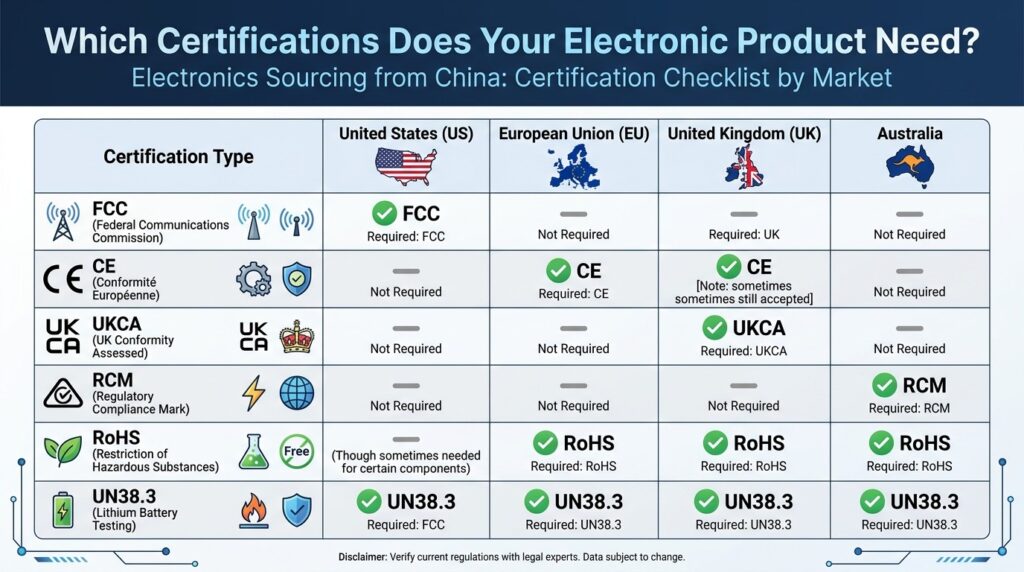
The Compliance Problem with Shenzhen Electronics
This is the most important section for buyers who intend to sell in regulated markets (US, EU, UK, Australia, Canada).
Shenzhen’s electronics market is stratified:
Tier 1 — Export-certified manufacturers: These factories have invested in genuine CE, FCC, RoHS, and REACH certification for their products. Test reports are from accredited third-party labs (SGS, TÜV, UL, Intertek). These products can be legally imported and sold in regulated markets. Price: higher. Access: requires relationships, typically through qualified agents or direct factory visits.
Tier 2 — Self-declared or partially certified: Factories that have done some internal testing and apply CE or FCC marks based on their own assessment, or who have older certification that doesn’t cover current product variants. This is the most dangerous tier — the products look certified but aren’t. Regulatory action risk: high.
Tier 3 — Uncertified or counterfeit-marked: Products carrying fake certification marks, fabricated test reports, or no certification at all. Found throughout Huaqiangbei and online. Significant in categories like chargers, power adapters, and children’s electronics where compliance is most relevant.
The buyer’s job is to know which tier they’re dealing with. For any product intended for regulated market retail, the process is:
- Request the specific certification (CE, FCC ID, etc.) with certificate number
- Verify the certificate directly with the issuing lab or authority
- Confirm the certificate covers your exact product model (not a similar one)
- Arrange independent lab testing before first commercial import
For products not intended for regulated retail (used internally, OEM components, prototype quantities), the tier matters less. For consumer products going to Amazon, retail stores, or e-commerce platforms that conduct compliance checks — it matters enormously.
How to Source Electronics from Shenzhen Without Visiting
Use a Shenzhen-Based Electronics Sourcing Agent
A sourcing agent with established presence in Shenzhen’s electronics ecosystem is valuable in a way that general sourcing agents aren’t. They know:
– Which buildings in Huaqiangbei stock genuine certified products vs. gray-market goods
– Which ODM houses have legitimate export track records
– Which component vendors have verifiable supply chains
– How to navigate certification documentation requests without being fobbed off
For electronics sourcing, specialization matters. An agent who sources furniture and electronics with equal fluency probably doesn’t have the technical depth for either.
Request Factory-Level Communication
For finished electronics products, insist on direct communication with the factory’s compliance or technical department — not just the sales team. A compliance person at a legitimate factory can answer questions about which lab performed their testing, what the certificate number is, and what product models are covered.
A factory that routes all technical questions through a salesperson who answers with vague reassurance (“our products all pass CE”) without being able to provide specific documentation is a factory to be cautious about.
Use Alibaba International with Verified Certification Filters
Alibaba’s search allows filtering for suppliers with specific certifications (CE, FCC, ISO). This filter shows suppliers who’ve uploaded certification documentation to Alibaba — not an absolute guarantee, but a meaningful filter versus suppliers who have no documentation at all.
Combine this with direct verification of the certificates provided.
Visiting Huaqiangbei: A Practical Guide for First-Timers
If you’re visiting in person:
Logistics: Huaqiangbei is easily accessible from central Shenzhen via Metro Line 1 (Huaqianglu station). The main shopping buildings run along Huaqiang North Road — look for SEG Electronics Market (赛格电子市场), Huaqiangbei Kexin Electronics Market, and the surrounding blocks.
What to expect: Different floors of each building are specialized for different component types. The ground floors typically have finished consumer products; upper floors have components. Prices are displayed but negotiable, especially for larger quantities.
Language: Most stall operators have basic English sufficient for numbers and product names. For technical specification discussions or serious negotiation, bring a Mandarin speaker or hire a local guide for the day (~¥500–800).
Counterfeits: They exist in abundance at Huaqiangbei, particularly for branded components (major IC brands) and consumer devices. For components, source from established distributors (Arrow, Avnet, Mouser have Chinese operations) when counterfeit risk is a concern for your product. For consumer devices, verify with the brand directly.
Information in this article reflects the Shenzhen electronics ecosystem as of 2025–2026. Specific factory recommendations are excluded as the landscape changes; work with current-reference agents for up-to-date supplier introductions.
Need help sourcing specific electronics products from Shenzhen? Our team has sourcing specialists with active Shenzhen factory relationships.
Related reading → China Quality Control: The Complete 2026 Guide for Importers