A client came to us two years ago with a straightforward problem. She had ordered 3,000 units of a silicone kitchen tool from a supplier she found on Alibaba. The samples were flawless. The price was right. The factory had 47 verified reviews. Then the shipment arrived — and about 600 pieces had a defect in the seal that made them unusable.
Getting a partial refund took four months of emails, one WeChat argument that required a translator, and a lot of patience she didn’t have.
Her question afterward: “Would a sourcing agent have caught this?”
The honest answer: quite possibly, yes. Here’s what you need to know about how China sourcing agents work — and how to find one that’s actually worth their fee.

What Is a China Sourcing Agent? (And What They’re Not)
A sourcing agent is a person or company based in China who acts on your behalf during the procurement process. They find suppliers, negotiate prices, manage quality checks, and coordinate shipping — all from inside the country where your goods are made.
That last part matters more than most buyers realize. When something goes sideways in the supply chain, having someone physically present — who speaks the language, knows the local business culture, and can walk into a factory unannounced — makes a concrete difference.
What sourcing agents are not:
– They’re not the same as trading companies, who buy and resell goods and have their own profit margin built into the price
– They’re not freight forwarders (though many agents offer logistics coordination as an add-on)
– They’re not a guarantee of perfection — no agent can eliminate all risk, and any one who tells you otherwise is overselling
Internal link → China Sourcing Agent vs. Trading Company: How to Tell the Difference
What Does a China Sourcing Agent Actually Do?
The scope of what agents handle varies significantly depending on who you hire and how much you pay. But across the board, a full-service sourcing agent typically covers these core functions:
Supplier Identification and Shortlisting
Before you ever receive a quote, your agent is filtering out the noise. They’ll search across Alibaba, 1688, factory directories, and their own network — often a network built over years of doing business in a specific region or industry. A Yiwu-based agent, for example, will have contacts that simply don’t appear on any platform.
The shortlist you get should include: verified business license status, factory vs. trading company classification, production capacity, and export history.
Price Negotiation
This is where being local pays off in dollars. Chinese factories routinely quote higher prices to foreign buyers — not out of bad faith, but because it’s an expected starting point in the negotiation culture. An experienced agent negotiates in Mandarin, knows what a realistic factory floor price looks like, and can often push back in ways a foreign buyer via email cannot.
In our experience, a skilled negotiator typically reduces the initial quote by 8–15% on mid-to-large orders. On a $50,000 order, that’s $4,000–7,500 saved before the agent even touches the quality side.
Sample Procurement and Evaluation
Your agent handles the back-and-forth of requesting, paying for, and forwarding product samples to you. More importantly, a good agent evaluates those samples locally before shipping them — catching obvious defects, checking packaging integrity, and flagging anything that doesn’t match the agreed spec sheet.
Production Monitoring
On larger orders, agents can conduct or coordinate factory visits during production to check that:
– Raw materials match what was agreed
– Production lines are using the correct specs
– Worker output is being quality-checked internally
This mid-production check is often skipped by buyers working alone, and it’s where many defect problems originate.
Pre-Shipment Inspection
Before goods are loaded onto a container, a final inspection confirms that the batch matches the approved sample. Inspectors check appearance, functionality, labeling, and packing. The standard method is AQL (Acceptable Quality Limit) sampling — we cover this in full in our product inspection guide.
Shipping Coordination
Most agents don’t run their own freight — but they manage the relationship with your freight forwarder, handle export documents, and flag any issues with customs paperwork before they become your problem.
How Much Does a China Sourcing Agent Cost?
This is the question that causes the most confusion — mostly because agents don’t structure their fees the same way.
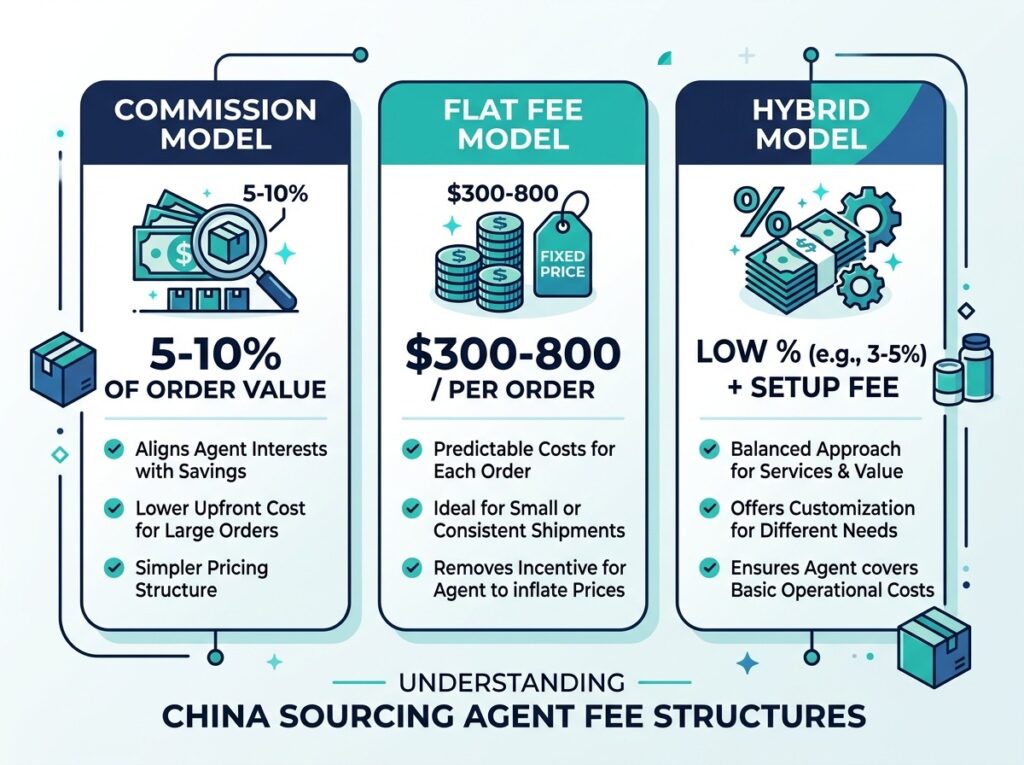
The Three Fee Models
1. Commission-Based (Most Common)
The agent charges a percentage of your total order value. Typical range: 5–10%.
On a $20,000 order at 7%, you’re paying $1,400. On a $100,000 order at the same rate, you’re paying $7,000. Commission models work well for large, irregular orders where you want the agent to have skin in the game — they’re motivated to negotiate down the supplier price, since their cut is calculated on the final figure.
Watch for: Some agents charge commission on the pre-negotiation price. Make sure the contract specifies whether their percentage applies to the quoted price or the final negotiated price.
2. Flat Fee Per Order
A fixed charge per sourcing engagement, typically $300–$800 per order for standard products. Some agents use tiered flat fees based on product complexity.
This model is more predictable for buyers who place frequent, consistent orders. You know what you’re paying upfront.
3. Hybrid Model
A lower commission (3–5%) combined with a setup or monthly retainer fee. Common among agencies serving clients with ongoing procurement needs.
What’s Typically Not Included
Even when you’re paying an agent, these costs usually sit separately:
– Inspection fees ($150–$300 per inspection visit)
– Sample shipping costs
– Factory audit fees (if required)
– Freight forwarding fees
Get a clear breakdown before you sign anything. Reputable agents provide itemized quotes.
The Honest Case for Using a Sourcing Agent
Here’s the unvarnished version: sourcing agents don’t make sense for every buyer.
If you’re ordering a one-time batch of $2,000 worth of goods from an established supplier with strong reviews and a clear product, the agent fee eats into margins without adding proportional value.
But if you’re:
– Placing orders over $10,000 with a new supplier
– Working with a factory for the first time on a custom or OEM product
– Importing goods with safety or compliance requirements (electronics, toys, cosmetics)
– Managing multiple suppliers across different categories
…then a good agent is almost certainly worth the 5–8% you’ll pay. The protection against defective shipments alone often covers the cost on a single order.
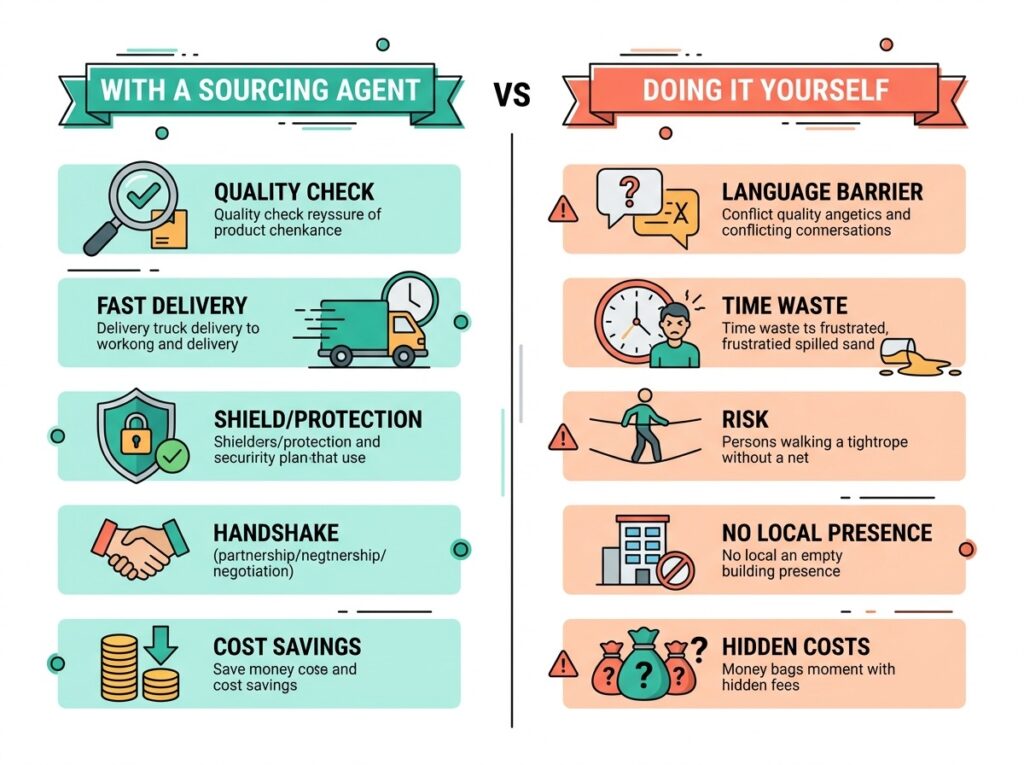
The calculation shifts further in your favor when you factor in time. Sourcing from China yourself — managing WeChat conversations across time zones, chasing down samples, writing inspection briefs — is a part-time job. An experienced agent does it faster, in the right language, from the right time zone.
Internal link → China Sourcing Agent vs. Doing It Yourself: A Brutally Honest Comparison
How to Work With Your Agent Once You’ve Hired One
Getting the relationship right from the start saves significant friction later.
Write a detailed product specification. Vague briefs produce vague results. Your spec should include: material requirements, dimensions and tolerances, color codes (Pantone if applicable), required certifications, and packaging specs.
Agree on inspection criteria upfront. What constitutes an acceptable defect rate? What happens if a batch fails inspection — is it re-inspected, rejected, or does the supplier repair and re-test? Get this into writing before production starts.
Establish a communication rhythm. Weekly updates during production is standard for most orders. If your agent goes more than five business days without proactive communication during an active order, that’s a flag worth raising.
Don’t bypass them. Some buyers start working directly with the factory after the agent facilitates the introduction, effectively cutting the agent out. Beyond the ethical issues, this destroys trust and often costs you the relationship entirely. If the direct relationship is what you want long-term, negotiate that arrangement openly from the start.
Internal link → Request a Sourcing Consultation
Summary: What to Take Away
A China sourcing agent is not a magic solution — but for most buyers importing regularly from Chinese factories, a well-chosen agent is the single highest-ROI investment you can make in your supply chain.
The key decisions:
1. Match the agent to your product category — don’t use a generalist for a specialized product
2. Understand the fee structure completely before signing anything
3. Test with a small order before scaling up
4. Put quality criteria in writing — verbal agreements don’t survive factory disputes
5. Expect transparency — on pricing, on factory contacts, on inspection results
If you’re ready to talk through your specific sourcing needs, reach out to our team — we’re happy to give you an honest assessment of whether and how we can help.
Further reading → How to Import Products from China: A Step-by-Step Process for First-Time Buyers