You’ve found a supplier on Alibaba who checks every box — good photos, fast replies, reasonable MOQ, and a price that looks competitive. There’s one thing you probably haven’t confirmed yet: are you actually talking to the people who make the product, or to a middleman who’s going to place your order with someone else?
This distinction matters more than most buyers realize. A trading company isn’t automatically a bad choice, and a factory isn’t automatically the right one. But knowing which you’re dealing with changes how you negotiate, what risks you’re exposed to, and what you can realistically expect on price, customization, and lead time.
This guide breaks down the real differences, gives you five concrete ways to identify which type of supplier you’re talking to, and explains which situations call for which approach.
What Is a Trading Company in China?
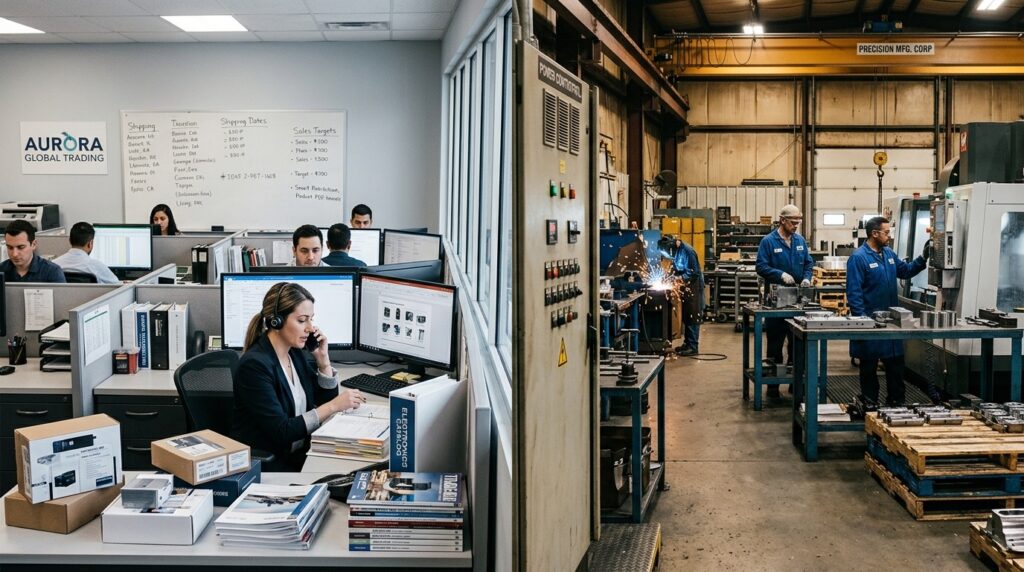
A trading company — sometimes called a “sourcing company” or “export company” — doesn’t manufacture anything itself. It buys finished goods from factories (often multiple factories across different product categories) and resells them to overseas buyers, typically with a markup of 10–30%.
Some trading companies are highly specialized, focusing on a single category like electronics or hardware. Others are broad, offering thousands of SKUs across completely unrelated categories. The latter is almost always a red flag: no single operation can genuinely quality-control 3,000 different product types.
Trading companies typically hold inventory or work on a made-to-order basis, placing your order with their supplier network after you’ve confirmed. They handle documentation, export procedures, and often provide English-speaking sales staff — which is precisely why many buyers gravitate toward them.
What Is a Factory (Manufacturer)?
A factory is the actual production facility. Workers, machines, raw materials, and production lines are all under one roof. When you place an order with a factory, you’re working directly with the people who will make your product.
In China’s manufacturing ecosystem, “factory” covers a wide spectrum. A small workshop in Guangdong might run 20 workers producing one product line with very limited customization. A mid-size manufacturer in Zhejiang might run 500 workers across three product categories with full OEM/ODM capabilities. A large facility in Jiangsu might supply global brands and have ISO certifications, in-house testing labs, and dedicated export departments.
The common thread: the factory controls the production process. That means you have direct leverage over quality, lead times, and product specifications — when you know how to use it.
The 7 Real Differences That Actually Matter
1. Price
This is the most obvious difference, but the gap is often misunderstood. Trading companies typically add 15–25% on top of factory price. For high-volume orders, that markup is significant — the difference between $4.20 and $5.00 per unit doesn’t sound dramatic until you’re ordering 50,000 pieces.
That said, some trading companies with strong supplier relationships and high-volume purchasing power can sometimes quote prices competitive with what a small factory would offer an unknown overseas buyer. Don’t assume factory always equals cheapest.
2. MOQ (Minimum Order Quantity)
Factories set their MOQ based on production economics — minimum batch sizes to justify setup costs, raw material procurement, and machine changeovers. For most manufactured goods, factory MOQs range from 500 to 5,000 units depending on complexity.
Trading companies often offer lower MOQs because they can aggregate orders from multiple buyers to meet the factory’s minimum. If you need 200 units of something with a factory MOQ of 1,000, a trading company might be your only realistic option.
3. Customization
Factories have direct control over tooling, molds, materials, and processes. If you want your logo engraved, a specific color mixed, a modified dimension, or a new component sourced — all of that is negotiable directly with the production team.
Trading companies need to relay customization requests to the factory, which introduces a telephone-game problem. Details get lost. Feasibility assessments get vague. Any customization costs get marked up. For complex OEM or ODM projects, this communication gap can cause serious problems.
4. Quality Control
A factory can let you station a third-party inspector on the production line, give you access to their QC department, or provide raw material and in-process inspection reports. You have direct visibility into what’s happening.
A trading company has no control over the factory’s QC processes. They can request inspection, but they can’t enforce it. Some trading companies hire their own QC staff and do a decent job; others simply repackage whatever the factory ships.
5. Lead Time
When you order from a factory, your production slot is scheduled based on their current capacity and order queue. Lead times are what they are, and the factory has direct control over them.
When you order through a trading company, there’s an extra step: they place your order with the factory, which may already have a queue. Add 3–7 days for the order relay process. For time-sensitive orders, this matters.
6. Communication
Many people assume factories are harder to communicate with than trading companies because of language barriers. That’s often true for smaller factories. But mid-size and larger factories increasingly have dedicated export sales teams with strong English speakers — sometimes better than what trading companies offer.
The real communication risk with trading companies is technical accuracy. When you ask about production capabilities, tolerances, material specs, or compliance certifications, a trading company salesperson may not actually know the answer.
7. Documentation and Compliance
Factories can provide first-party documentation: material certifications, test reports from their in-house labs, certificates of conformity, ISO certificates that apply to actual production. When you need compliance documentation for regulated markets (CE, FCC, REACH, RoHS), the factory is the source.
Trading companies can provide these documents too — but they’re passing along what the factory gave them. If there’s a compliance issue after import, tracing responsibility back to the actual producer becomes more complicated.
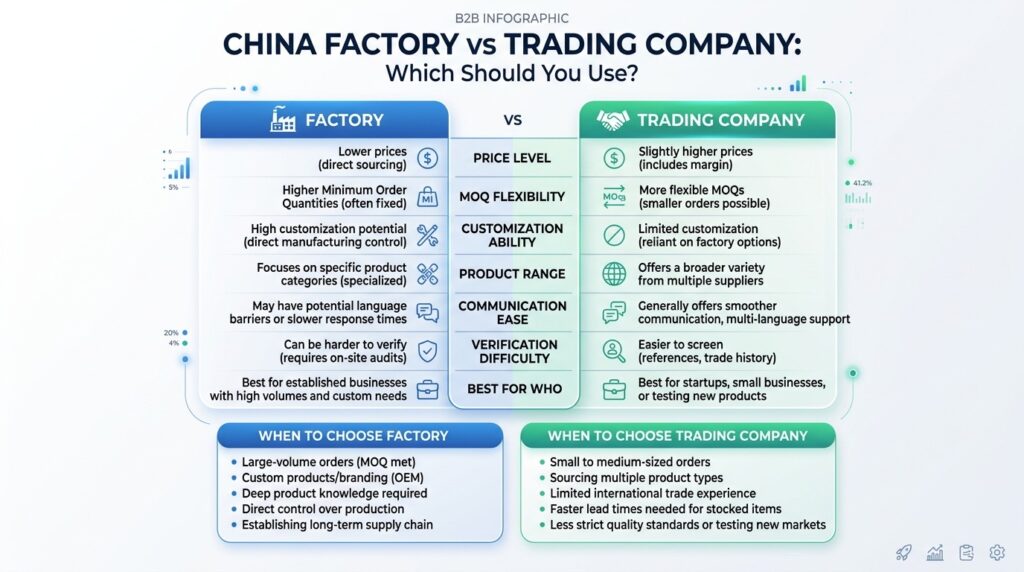
Head-to-Head Comparison Table
| Dimension | Trading Company | Factory |
|---|---|---|
| Price | 15–30% markup over factory cost | Direct manufacturing cost |
| MOQ | Often lower (can aggregate orders) | Higher (production minimums) |
| Customization | Limited, relayed through factory | Full OEM/ODM capabilities |
| Quality Control | Indirect; limited visibility | Direct access and control |
| Lead Time | Longer (add 3–7+ days for relay) | Based on actual production schedule |
| Communication | Fluent in English, weak technically | Technical depth, variable English |
| Documentation | Second-hand (from factory) | First-party, traceable |
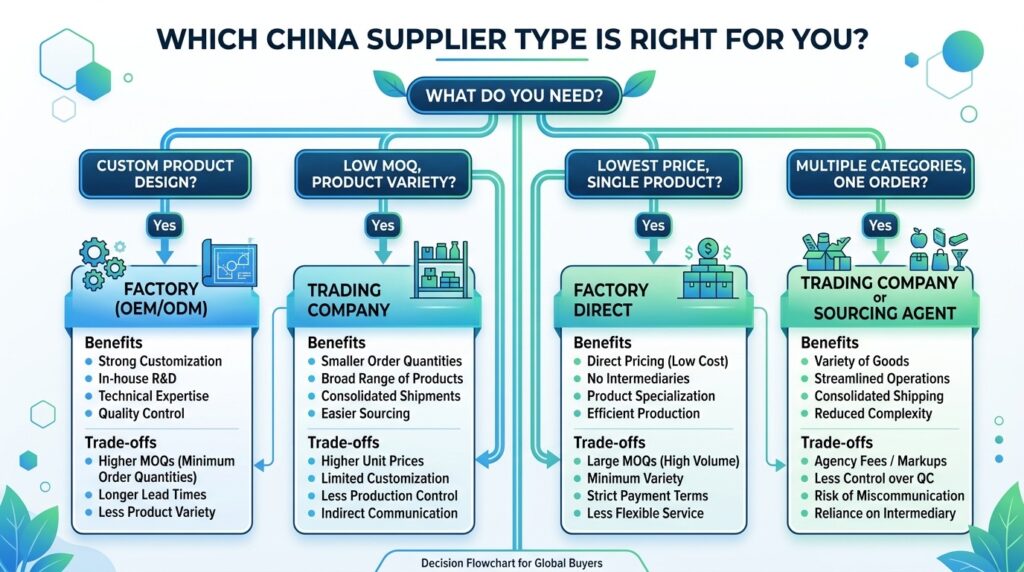
How to Tell Which You’re Actually Talking To (5 Methods)
Most suppliers on Alibaba present themselves ambiguously. Even if a listing says “manufacturer,” that word is used loosely. Here’s how to verify.
Method 1: Check the Business License
Ask for the supplier’s business license (营业执照). The registered business scope (经营范围) will show what activities the company is legally registered to conduct.
- If it includes 生产 (production) or 制造 (manufacturing): factory or manufacturing entity
- If it only lists 贸易 (trade) or 销售 (sales): trading company
Legitimate suppliers share this document readily. Reluctance is informative. Learn how to read and verify Chinese business licenses in our complete guide.
Method 2: Request a Factory Video Tour
Ask for a live video walkthrough of the production facility for your specific product category. A factory will almost always accommodate this — it’s a selling point. During the call, ask them to show you the production line, raw material storage, and QC station for your product.
A trading company will either decline, show generic footage, or arrange a visit to a facility that isn’t theirs. Pay attention to whether the people giving the tour actually understand what the equipment does.
Method 3: Look at Their Product Range
A factory is deeply specialized. Genuine manufacturers typically offer 20–80 variations within a tightly defined category and can discuss tooling costs, cycle times, and material trade-offs in detail.
If a supplier’s catalog spans plastic toys, industrial fans, kitchen appliances, and LED lighting — they’re almost certainly a trading company sourcing from multiple factories. When you ask technical questions about each category and get equally fluent answers, that pattern is a strong signal.
Method 4: Request a Sample with Unusual Specifications
Ask for a sample with a specific, slightly unusual specification — a particular Pantone color, a non-standard dimension, a specific material grade — and ask the supplier to explain the technical process involved.
A factory answers directly and can often get you a sample through their normal tooling process. A trading company needs to “check with the factory” — resulting in vague answers, longer timelines, and oddly rounded pricing.
Method 5: Cross-Reference on Chinese Platforms
Search the company name or address on 1688.com or use Chinese business intelligence tools like Tianyancha (天眼查) or Qichacha (企查查). Factories often appear on 1688 as domestic suppliers, where you can see their actual wholesale pricing and buyer base.
A business lookup will show registration type, registered capital, and business scope — a trading company with ¥300,000 in registered capital claiming to be a “major manufacturer” for a $5M product category is an inconsistency worth questioning.
When a Trading Company Makes Sense
Trading companies get unfairly maligned. For many sourcing situations, they’re the smarter choice.
You’re testing a new product category. If you want 300 units to test market demand, a factory probably won’t touch your order. A trading company will, and they’ll handle the logistics.
You need multiple products from different factories. Rather than managing four factory relationships, a trading company can be a single point of contact for a multi-SKU order. This consolidates logistics and reduces paperwork — at a cost.
You’re sourcing a straightforward, non-customized product. For commodity items with standard specs, the trading company’s markup may be worth the reduced hassle.
Your volumes don’t justify a factory relationship. Factories prioritize their largest customers. If you’re ordering $5,000/year, you’re not a priority. A trading company that consolidates orders from dozens of buyers like you gets better factory attention than you would alone.
When You Need to Go Direct to Factory
You’re customizing a product. Any OEM or ODM work — custom molds, branded packaging built into production, unique specifications — requires the factory. Trading companies can’t reliably manage complex customization.
You’re sourcing at scale. Once you’re ordering above $50,000–$100,000 annually from a single supplier category, the markup becomes a real cost. At that volume, factories will take you seriously.
You need compliance documentation. For regulated categories (electronics, children’s products, medical devices, food contact), you need factory-direct test reports traceable to actual production.
Quality control is critical. If you’re having a third-party inspector visit the facility, you need direct factory access. Meaningful inspection through an intermediary isn’t possible.
The Gray Zone: Some Trading Companies Own Factories
The China sourcing reality is messier than a clean binary. Some larger trading companies own partial stakes in factories or have exclusive supply agreements giving them near-factory levels of control. Some factories have set up separate trading entities to handle export business.
The key questions remain the same regardless: Can they provide first-party production documentation? Can you access the facility? Can they answer technical questions without constantly needing to “check with the factory”?
For a detailed approach to vetting any supplier type, see our guide on how to verify a Chinese supplier before you pay.
If you want help confirming whether a specific supplier is a factory or trading company — including business license verification and background checks — our team can run this for you as part of standard sourcing support.
Related reading → How to Verify a Chinese Supplier Before You Pay (7 Steps)