The sample stage is the most important point in any China sourcing relationship — and the one most buyers handle poorly.
Getting a sample is easy. Any factory will send you something. The harder question is: does that sample represent what you’ll receive in bulk production? The answer depends on how you requested the sample, what materials the factory used to make it, and how rigorously you evaluated it before approval.
This guide covers the full sample process: types of samples, how to request them correctly, what to evaluate, how to handle multiple supplier samples in parallel, and how to turn an approved sample into a production standard that protects you through every reorder.

The 4 Types of Samples You Need to Know
Not all samples serve the same purpose. Understanding what type you’re requesting — and what type the factory is sending — prevents one of the most common misalignments in sourcing.
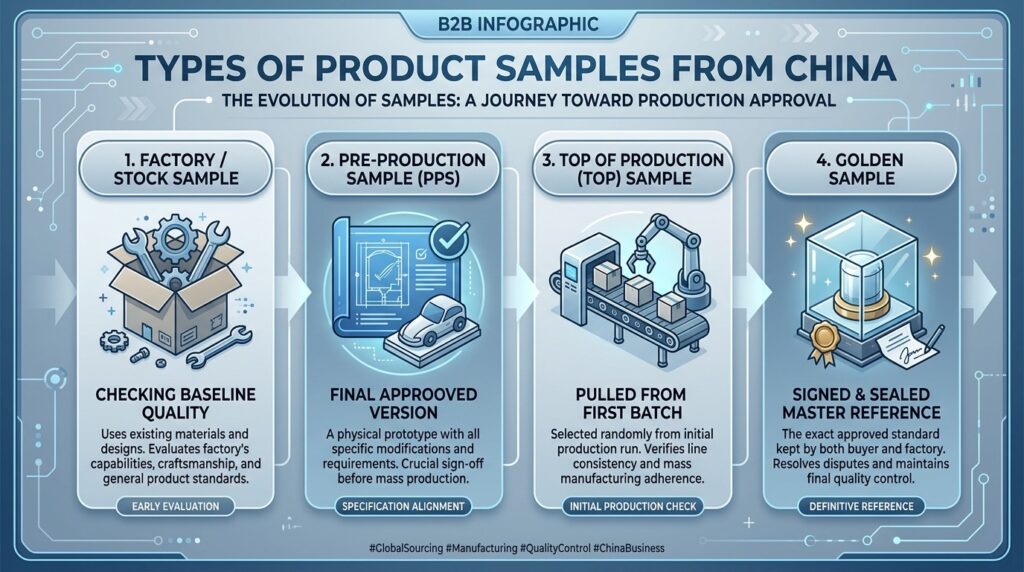
1. Existing Product Sample (Stock Sample / Showroom Sample)
The factory ships you a finished unit from their current production stock — typically the fastest and cheapest option.
Purpose: Verify that the factory makes a product in this category at an acceptable quality level. Understand baseline workmanship and materials.
What it doesn’t tell you: Whether they can make your version of the product, with your specifications, at the same quality.
Cost: Often free or low-cost ($10–30 + shipping). Factory is sending you something they already have.
When to use: Very early stage. You’re evaluating multiple factories for capability, not committing to a specific design.
2. Customized Sample (Pre-Production Sample / Proto Sample)
The factory makes a sample specifically to your design — your dimensions, your colors, your logo, your specifications — but using whatever materials are convenient for them.
Purpose: Confirm that the factory can interpret and execute your design correctly. Identify construction or design issues before production.
What it doesn’t tell you: Whether the bulk production will match, since materials may differ from what you ultimately specify.
Cost: $30–200 per sample depending on complexity. May include tooling costs for custom shapes (molds, cutting dies).
When to use: After you’ve selected a supplier and want to see your design realized. This is the design validation sample.
3. Pre-Production Sample (PPS / Counter Sample)
Made using the confirmed production materials — the actual fabric lot, the actual component batch, the actual hardware — that will be used in bulk production.
Purpose: This is the true quality validation sample. It should be indistinguishable from production units because it’s made from production-run materials.
What it tells you: With high confidence, whether bulk production will match specification.
Cost: $50–300 per sample. Higher cost reflects the use of production-run materials.
When to use: Mandatory before approving production on any significant order. This is the sample you approve in writing; it becomes the Golden Sample.
4. Reference Sample (Counter Sample)
You send the factory a sample of an existing product you want them to replicate or match. The factory produces a counter sample demonstrating how close they can get to your reference.
Purpose: Used when you don’t have a tech pack or design brief — you have a physical product and want something like it.
Cost: Typically $50–150. More complex for unique designs.
When to use: When your product concept is better communicated by a physical object than a written specification.
How to Request Samples Correctly
The quality of your sample is directly proportional to the quality of your request. Vague requests produce vague samples.
What to include in a sample request:
- Product specification — dimensions, materials, colors (Pantone or RAL references), weight, finish
- Reference images — multiple angles, close-up details, any features you want replicated exactly
- Your logo/branding — artwork files in the correct format (vector preferred) if you want branding on the sample
- Quantity — typically 2–3 samples (one for evaluation, one retained as master, one for QC company)
- Required timeline — when you need the sample by, and what project timeline depends on it
- Shipping preference — DHL/FedEx/UPS with your account number, or factory-arranged express at their cost
What not to say: “Can you send me a sample of your best quality product?” This produces a showroom sample chosen by the factory, not a sample of your product. Be specific about what you want.
What to Evaluate When the Sample Arrives
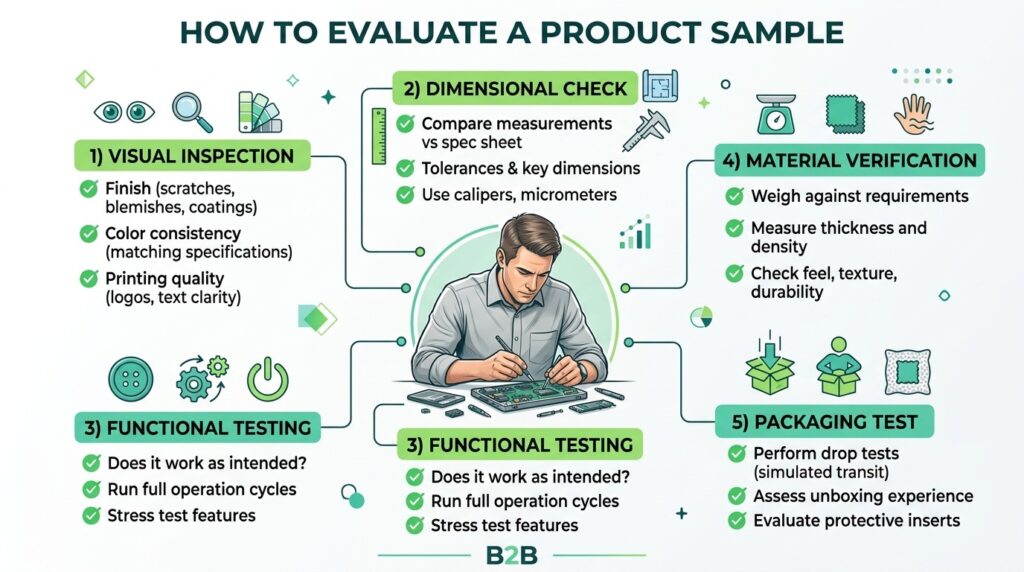
Systematic sample evaluation prevents approval of samples based on first impressions. Use a written evaluation checklist against your specification:
Dimensional Accuracy
Measure all critical dimensions against your spec sheet. Dimensional deviations that seem minor at sample stage are amplified across thousands of units. Acceptable tolerance is typically ±1–2% on most dimensions; tighter for precision-fit products.
Material Verification
Compare the sample material against your specification. For textiles: check weave, hand feel, and weight (use a postal scale and calculate GSM from a fabric cutting). For plastics: confirm rigidity, surface texture, color match to your Pantone reference. For metals: check thickness, finish quality, surface treatment uniformity.
If you can’t verify material composition visually (fiber content, plastic grade, metal alloy), note it on your evaluation form as “requires lab testing.”
Surface Finish and Appearance
Inspect under bright light at multiple angles. Look for: surface defects (pitting, bubbles, scratches), coating adhesion (use the fingernail test on painted surfaces — flaking indicates adhesion failure), color consistency across the whole piece, and sharpness of printed or engraved elements.
Function and Durability
Test every functional element: zippers run 20 cycles, buttons pressed repeatedly, hinges opened and closed, clasps fastened and released. For electrical products: test all functions, check connections, verify switch feel. Stress-test areas likely to experience wear in consumer use.
Branding and Labeling
Verify logo placement, logo size, font accuracy, and color match to your brand standard. Check that any required regulatory text (care instructions, safety warnings, compliance marks) is present and correctly formatted.
Packaging
If packaging was included in the sample, evaluate: structural integrity (carton compression test by hand), print quality on packaging artwork, and whether the packaging protects the product adequately for shipping.
Comparing Multiple Supplier Samples
For significant product decisions, request samples from 2–3 candidate factories simultaneously. Evaluate them side by side against the same specification.
How to structure the comparison:
Create a scoring matrix: rate each supplier’s sample on dimensions, material quality, workmanship, branding accuracy, and response to your specification brief. Score 1–5 on each. The highest total score isn’t automatically the winner — use the matrix to identify which supplier best addresses your priority criteria.
Price is one factor, not the only one. A supplier who scores 4.2 overall but quoted $0.40/unit cheaper than a 4.7-scoring supplier deserves consideration. A supplier who scored 2.8 and quoted the cheapest price deserves elimination.
The Golden Sample: Your Production Standard
When you approve a pre-production sample in writing, that approved sample becomes the Golden Sample — the physical production standard that all subsequent quality control is measured against.
How to manage the Golden Sample:
- Keep one copy in your possession, stored carefully (away from light and heat for textiles; in a protective case for hard goods)
- Send one copy to your QC inspector or inspection company with a clear label: “PRODUCTION REFERENCE SAMPLE — [Product name] — Approved [date]”
- Return one copy to the factory with your approval letter
The QC inspector uses the Golden Sample during pre-shipment inspection to compare bulk production units against the approved standard. This comparison catches deviations that a written spec alone might miss — surface texture, color depth, assembly feel — because those qualities are difficult to fully capture in written parameters.
Sample Red Flags to Watch For
The factory sends a sample without acknowledging your specification: They’re sending a stock sample, not responding to your requirements. Start over with a more specific brief.
The sample arrives suspiciously quickly: A genuinely custom sample for a complex product can’t be made in 2 days. Very fast turnaround on custom samples often means they’ve sent you an existing stock product with your label applied. Test it against every specification point.
The sample quality far exceeds your expected price point: Some factories produce excellent samples that their production line can’t replicate at scale. The sample is made by skilled craftspeople with care; production is made by workers with volume pressure. If a sample seems too good for the quoted price, ask specifically about the production process and request references from buyers who’ve placed bulk orders.
They refuse to provide a pre-production sample: Pre-production samples require production-run materials. A factory that refuses this step is either unable to produce at your required quality level or doesn’t want you to see production-quality output before you commit. Walk away.
Sample Costs: What to Budget
| Sample Type | Typical Cost | Shipping (Express) | Total First Sample |
|---|---|---|---|
| Stock sample | Free–$30 | $30–80 | $30–110 |
| Custom proto | $50–150 | $40–80 | $90–230 |
| Pre-production (PPS) | $80–300 | $40–80 | $120–380 |
| Competitor reference | $0 (you buy it retail) | N/A | $20–80 retail |
Budget for multiple rounds: Most products go through 2–3 sample rounds before approval. Budget $200–600 for the full sample process on a typical product before production approval.
Related guide → Pre-Shipment Inspection in China: What Gets Checked and Why It Saves You Thousands
Related guide → China Quality Control: The Complete 2026 Guide for Importers
Want help managing the sample and quality control process with a factory? Our sourcing team coordinates sample requests, evaluation, and pre-production approval for clients across product categories.