A US-based outdoor furniture brand placed a $65,000 order with a Fujian manufacturer they’d worked with for two years. No quality checks beyond a pre-shipment inspection were arranged — the relationship felt established, the factory’s track record was solid. When the container arrived, 18% of the chairs had a powder-coating adhesion failure: the coating peeled under standard UV exposure testing. The defect traced back to a raw material supplier change made three weeks into production.
The pre-shipment inspection had caught correct dimensions, acceptable finish, and proper packaging. It hadn’t caught the material substitution — because material verification wasn’t in the inspection brief.
The repair cost: $11,700. The delay: 11 weeks. The relationship with two major retail buyers: damaged.
This guide exists so you understand what a complete quality control program looks like — not just the inspection at the end, but the entire system that prevents that furniture story from happening to your business.
Why Quality Problems Happen: The Real Causes
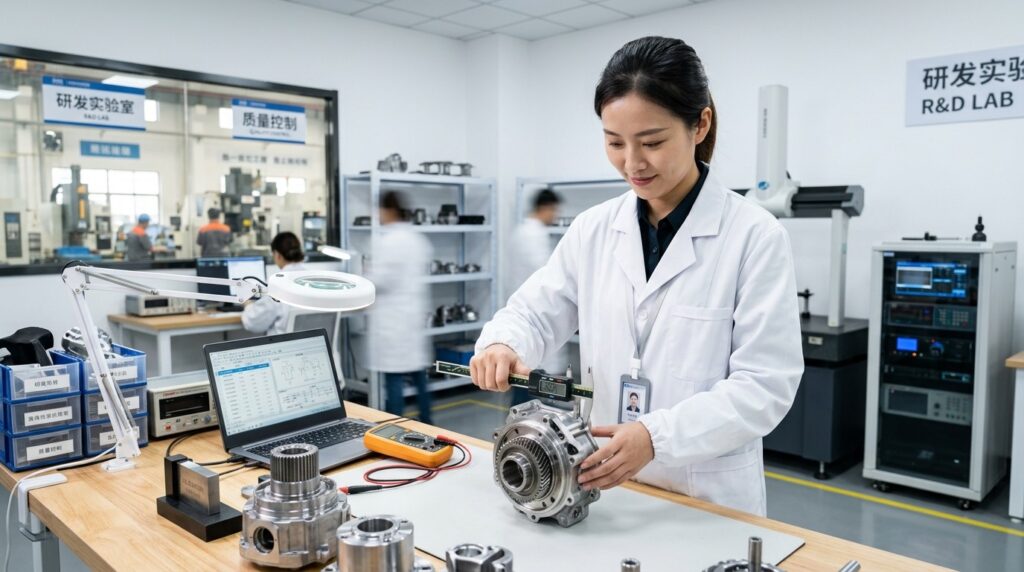
Most buyers blame quality failures on “bad factories.” That’s rarely the full story. In practice, quality problems in Chinese manufacturing come from four sources — and three of them are under your control:
1. Raw material substitution (most common)
Factories manage their own material supply chains. When their usual supplier raises prices, runs out of stock, or is replaced by their purchasing team, a substitute goes in. If your spec sheet doesn’t define materials precisely, the factory isn’t technically violating any agreement — they’re using “similar” materials.
2. Production workforce changes
Experienced line workers handle complex assembly tasks with lower defect rates. Turnover is high in Chinese manufacturing, particularly in Guangdong Province. An order handled by experienced workers in March may be handled by newer workers in August. Your order quality is a function of who is on the line, not just which factory you chose.
3. Production pressure and scheduling compression
When factories are at capacity or facing shipping deadlines, QC steps get shortened. Drying time gets reduced. Curing cycles get compressed. Assembly checks get skipped. This happens at legitimate factories with good intentions — not just at bad ones.
4. Specification gaps (the buyer’s responsibility)
If your spec sheet doesn’t define material grade, color tolerance, dimensional tolerance, and testing requirements — the factory fills in those gaps with whatever is expedient. Vague specifications produce vague outcomes.
Understanding these causes shapes the quality system you build. You’re not just catching defects at the end — you’re closing the gaps that allow defects to form in the first place.
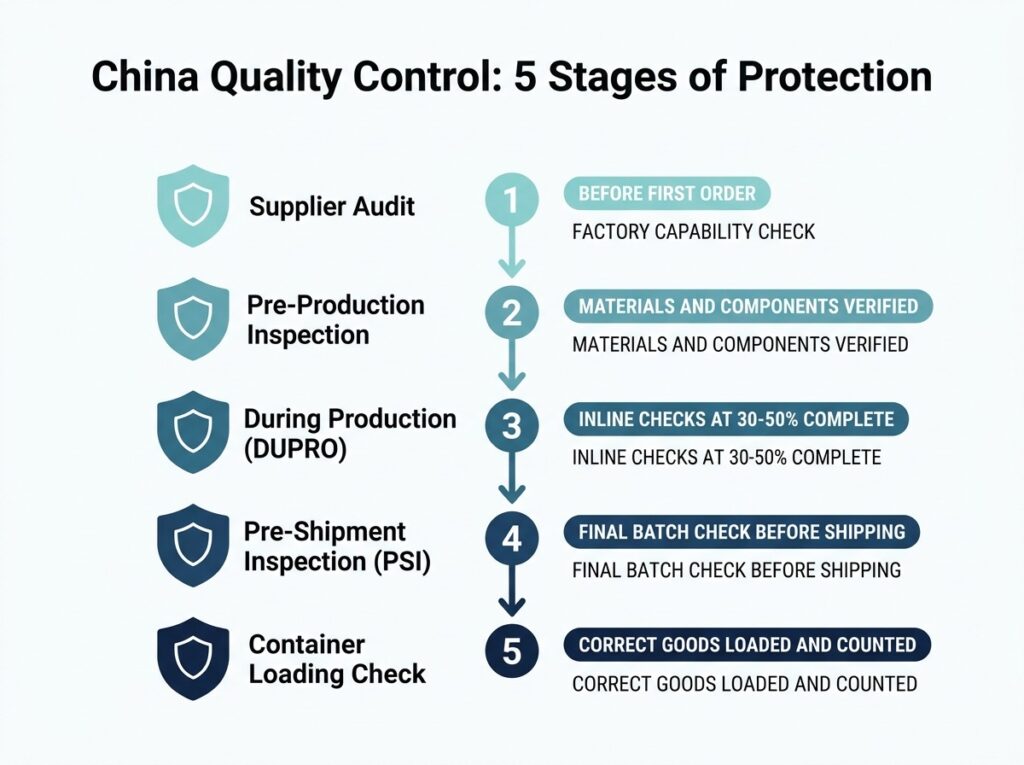
The 5-Stage Quality Control System
Stage 1: Supplier Audit — Before the First Order
A supplier audit is a structured assessment of a factory’s production capabilities, quality management systems, and operational processes — conducted before you place your first order.
What it covers:
– Factory size, equipment, and production capacity
– Quality control infrastructure (in-house QC team, testing equipment, ISO certification)
– Worker management and training systems
– Sub-contracting practices (does the factory do all production in-house?)
– Social compliance and labor practices
Audit types:
– Self-assessment questionnaire: Cheapest, least reliable. Factory fills in their own answers.
– Document review: You review certifications, licenses, and quality management documentation remotely.
– Third-party audit: An independent auditor (QIMA, SGS, Bureau Veritas) conducts an on-site assessment. This is the only format that provides verified information.
Cost: $200–$500 for a standard third-party audit.
When to use: Every new factory before a first meaningful order. For small trial orders ($1,000–$3,000), a full audit may not be cost-effective — substitute with thorough documentation review and a video call production floor tour.
Stage 2: Pre-Production Inspection (PPI) — Before Production Starts
A pre-production inspection verifies that the factory has the correct materials, components, and production setup before a single unit is produced.
What it checks:
– Raw materials and components match your approved specifications
– Production equipment is appropriate for your product requirements
– The factory’s internal QC process is understood and in place
– The production schedule is realistic given factory capacity
Why it matters:
The PPI is the only stage where you can catch material substitution before it affects your entire batch. Once production is 50% complete, rework is expensive and rescheduling is disruptive. Catching a material issue before production starts costs nothing beyond the inspection fee.
Cost: $150–$250 for a standard PPI.
Best for: First orders, custom products, products with precise material requirements (food contact, electronics, children’s items), orders where material cost represents a significant share of unit cost.
Stage 3: During Production Inspection (DUPRO) — Mid-Production
A DUPRO inspection (also called a During Production Inspection or DPI) takes place when 30–50% of your order is complete. The inspector examines finished units that have come off the production line and can still be reworked while production continues.
What it checks:
– First-off-the-line units against your approved sample
– Production defect rates at current pace (extrapolated to final batch)
– Workmanship quality on partially assembled units
– Packaging process if already underway
Why it matters:
A defect found at DUPRO affects 30–50% of your order. The same defect found at PSI affects 100% of your order. The earlier you catch a problem, the cheaper it is to fix.
Cost: $180–$280 for a standard DUPRO.
Best for: Large orders (2,000+ units), custom-designed products, orders where rework cost would be high, first orders with a new factory.
Stage 4: Pre-Shipment Inspection (PSI) — After Production, Before Shipment
The most commonly used inspection type. The PSI is a comprehensive final check conducted after 100% of production is complete but before goods are loaded for shipping.
For a detailed breakdown of PSI procedures, AQL standards, and inspection company selection, see our dedicated Pre-Shipment Inspection guide.
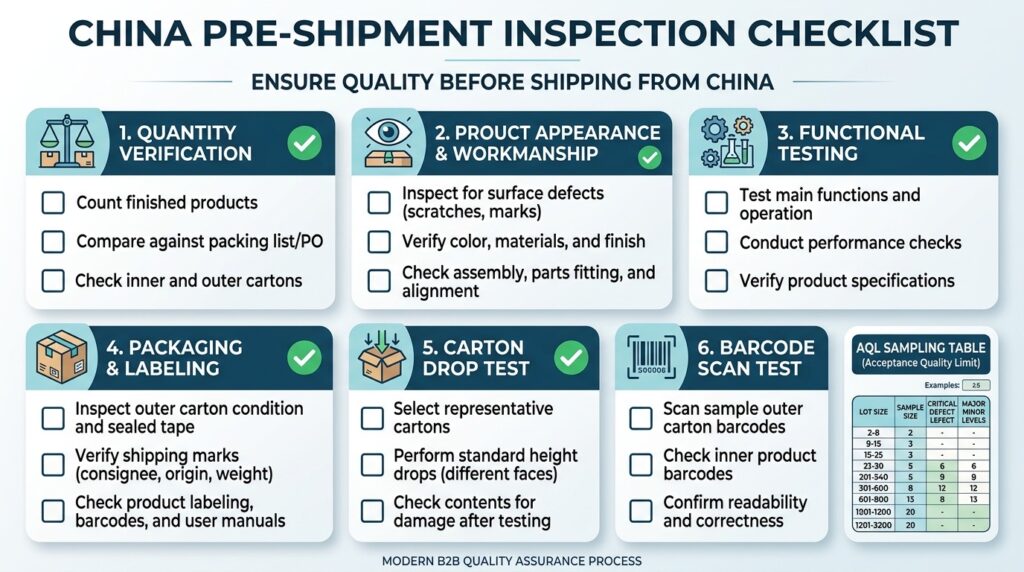
Key PSI elements:
– Quantity count against purchase order
– Visual and workmanship inspection (AQL sampling)
– Dimensional checks against specification
– Function testing
– Packaging and labeling review
– Carton drop test
Cost: $200–$320 for a standard one-day PSI.
Timing: Book 5–7 business days before intended shipment date.
Stage 5: Container Loading Supervision (CLS) — During Loading
A container loading check involves an inspector being present at the factory while goods are physically loaded into the shipping container.
What it verifies:
– The correct goods (matching the PSI-verified batch) are being loaded
– Quantity loaded matches the packing list
– Container condition is clean and structurally sound before loading
– Goods are properly secured and protected for transit
– Container seal number is recorded
Why it matters:
Substitution fraud — where approved goods are swapped for inferior goods during loading — does occur, particularly when payment has been fully released before shipment. Container loading supervision is the last physical checkpoint before your goods leave China.
Cost: $150–$220 for a standard CLS.
Best for: High-value shipments, first orders with new suppliers, orders where PSI revealed borderline results, any situation where you’re releasing full payment before receiving goods.
How to Write a Product Specification Sheet That Actually Works
The single most impactful thing a buyer can do for quality — before spending a dollar on inspections — is write a precise product specification sheet.
A useful spec sheet defines:
| Element | Vague (Useless) | Precise (Effective) |
|---|---|---|
| Material | “Stainless steel” | “SUS 304 stainless steel, 1.2mm thickness ±0.05mm” |
| Color | “Dark blue” | “Pantone 2767 C, ΔE tolerance ≤1.5” |
| Weight | “Approximately 250g” | “250g ±5g” |
| Function | “Must work correctly” | “Switch rated 10,000 cycles minimum; voltage range 100-240V” |
| Packaging | “Standard packaging” | “Individual poly bag + 6-unit inner box + 24-unit master carton, min 3-ply corrugated” |
The Golden Sample: Once you’ve approved a production sample that meets all specifications, photograph it comprehensively (all angles, details, measurements visible), label it, and store it. Send a copy to your inspection company. The Golden Sample becomes the physical standard against which all production units are compared — more reliable than written specifications alone because it captures qualities that words can’t fully describe (surface texture, color depth, assembly feel).
AQL Standards: Choosing the Right Level
AQL (Acceptable Quality Level) determines how many units are inspected and what defect rate triggers a rejection. The key AQL decisions are:
What defect level applies to your product?
| Product Type | Recommended Major AQL | Recommended Critical AQL |
|---|---|---|
| General consumer goods | 2.5 | 0 |
| Food contact / Children’s items | 1.5 | 0 |
| Electronics / Safety-critical | 1.0 | 0 |
| Low-cost commodity items | 4.0 | 0 |
Critical defects (safety hazards, fundamental failure) always carry AQL 0 — a single critical defect in the sample triggers rejection. Major defects (functional problems, high customer return risk) typically run at AQL 2.5 for general consumer goods. Minor defects (cosmetic issues unlikely to cause returns) often run at AQL 4.0.
Practical example: At AQL 2.5 for a 5,000-unit shipment, your inspector checks 200 units. If they find more than 14 major defects in those 200 units, the batch fails. The math works out to roughly a 7% defect rate triggering rejection — protecting your business from batches that would generate significant customer returns.
Quality Control Cost Planning
Build QC costs into your per-unit economics from the start:
| QC Stage | Cost | Per-Unit Impact (5,000 unit order) |
|---|---|---|
| Supplier Audit | $300 | $0.06 |
| Pre-Production Inspection | $200 | $0.04 |
| DUPRO | $230 | $0.046 |
| Pre-Shipment Inspection | $270 | $0.054 |
| Container Loading | $180 | $0.036 |
| Full 5-Stage Program | ~$1,180 | ~$0.24/unit |
On a product selling at $25 retail, $0.24 in QC cost represents less than 1% of retail price — a straightforward investment compared to the cost of a quality failure.
For smaller orders, you don’t need all five stages. A practical minimum:
– First order with any factory: Supplier audit + PSI
– Repeat order, product unchanged: PSI only
– Large or custom first order: PPI + DUPRO + PSI
– Very high-value or sensitive product: Full 5-stage program
When the Inspection Fails: What to Do Next
A failed inspection isn’t the end of the road — it’s information you now have, at a point when you can still act on it.
Assess the failure type:
Defects that can be reworked at the factory (preferred):
Surface defects, labeling errors, packaging issues, and some assembly problems can often be fixed at the factory. Request rework, set a clear deadline, and book a re-inspection (additional cost of $200–$300). Only release final payment after a passing re-inspection report.
Defects that require production rework:
Material failures, dimensional errors beyond tolerance, and functional failures often require partial or full reproduction. This is expensive (additional production costs, timeline delay) but the alternative — accepting defective goods — is typically worse.
Defects that are fundamental and unresolvable:
If the factory cannot or will not produce goods to your specification, you may need to terminate the order. Whether you can recover your deposit depends on your purchase agreement — another reason to have a clear written contract before production begins.
Negotiating a resolution:
– Document the defect clearly with photos and the inspection report
– Quantify the commercial impact (cost of returns, repackaging, disposal)
– Propose a specific resolution with a specific timeline
– Put the agreement in writing before releasing any remaining payment
Related guide → How to Verify a Chinese Supplier Before You Pay (7 Steps)
Choosing a Quality Control Partner
For most importers, the practical choice is between the major international inspection companies and their local alternatives:
| Company | Strengths | Best For |
|---|---|---|
| QIMA | Online booking, fast turnaround, transparent pricing | General use, first-time buyers |
| SGS | Global recognition, broad certification capability | When clients/platforms require SGS specifically |
| Bureau Veritas | Strong in compliance testing + inspection combined | Products needing regulatory certification |
| Intertek | Consumer goods expertise | Retail-destined products |
| Local Chinese agencies | Lower cost ($120–$180/day) | Experienced buyers on routine orders |
For first orders and high-value shipments, use an internationally accredited company. Their reports carry legal weight in dispute resolution and insurance claims that local agency reports typically don’t.
If you’re working with a China sourcing agent, they can often coordinate inspections on your behalf — including briefing inspectors on your specific requirements and following up on defect resolution with the factory directly.
Building Quality Into Your Supply Chain, Not Bolting It On
The buyers who consistently get good quality from China aren’t the ones who run the most inspections — they’re the ones who’ve built quality expectations into every stage of the supplier relationship.
This means:
– Precise specifications before production begins
– Clear communication about what constitutes a defect
– Inspections positioned at the right stages, not just at the end
– Payment terms that maintain leverage throughout production
– A documented response process for when (not if) issues arise
Quality control is not a cost center. In a business where customer returns, negative reviews, and supply disruptions carry real financial consequences, it’s the discipline that makes the difference between a sustainable China sourcing operation and an expensive learning curve.
If you’d like help designing a quality control program appropriate for your specific product category and order volumes, our sourcing team can advise based on direct experience in your category.
Quality control cost ranges in this article reflect 2025–2026 pricing from major international inspection companies operating in China. Specific pricing varies by location, product complexity, and inspection duration.