The Amazon FBA + China sourcing model attracted a lot of attention when it worked and a lot of criticism when it didn’t. The criticism is usually accurate: sellers who treated it as a simple arbitrage — find cheap product, ship to Amazon, collect money — faced margin compression, quality problems, and account suspensions they didn’t see coming.
The sellers who built sustainable businesses on this model understood that China sourcing for Amazon is a discipline, not a shortcut. It requires genuine product research, supplier evaluation, quality control, compliance documentation, and operational precision around Amazon’s specific fulfillment requirements.
This guide covers the full sequence: from product selection through supplier evaluation to your first successful FBA shipment, with the compliance and quality requirements that determine whether the second shipment happens.
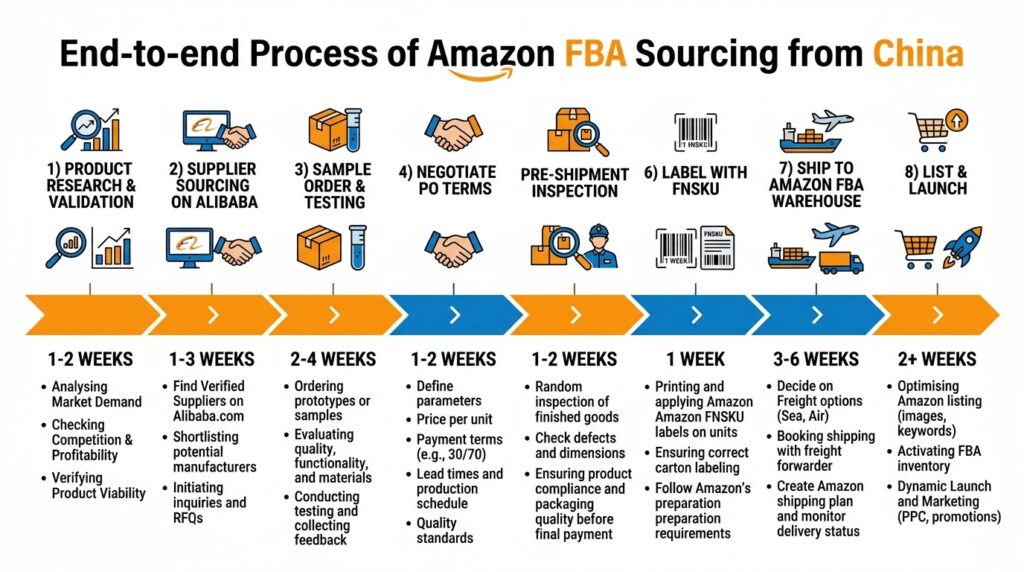
Step 1: Product Research That Actually Works
The most common Amazon FBA mistake happens before any supplier is contacted: choosing a product based on surface-level metrics (high sales rank, low competition) without understanding the structural dynamics of the category.
What you’re evaluating:
– Demand: Is there consistent, year-round demand, or is this seasonal? (Use Keepa or Jungle Scout historical data — 12+ months, not current snapshot)
– Competition: How many sellers are already serving this demand? Are the top 3 sellers dominant brands with thousands of reviews, or is the market fragmented?
– Margin viability: Can you source the product at a landed cost (including China production, shipping, duties, and FBA fees) that leaves ≥35% gross margin at a competitive price point?
– Differentiation opportunity: Is there a specific complaint pattern in reviews (fragile design, missing feature, poor packaging) that you can address with a better-spec product?
The margin math to run before contacting any supplier:
1. Target selling price (based on competitive analysis)
2. Minus Amazon FBA fee (use Amazon’s FBA fee calculator)
3. Minus Amazon referral fee (8–15% depending on category)
4. Minus estimated landed cost (production + freight + duties + prep)
5. Remaining = gross margin
If that number is below 30–35%, the product is not viable at your sourcing cost. Either find a lower-cost source or reconsider the product.
Step 2: Finding the Right Chinese Supplier
For Amazon FBA, not all Chinese suppliers are equal. You need a supplier who understands FBA requirements — or is willing to learn them — not just one who can make the product.
Where to find suppliers:
– Alibaba — primary platform for FBA sellers; Gold Supplier filter + trade assurance significantly reduces fraud risk
– Global Sources — stronger for electronics and tech products
– Canton Fair — for sellers willing to travel, the most efficient way to meet multiple vetted factories in 3 days
– 1688.com via agent — for experienced sellers, often 30–50% lower pricing than Alibaba-listed factories
What to evaluate in the supplier:
– FBA experience: Have they shipped to Amazon FBA warehouses before? Can they handle FNSKU labeling, carton label requirements, and poly bag requirements themselves or with your specifications?
– Production capacity: Can they scale with you if you reorder 3x the initial quantity?
– Sample quality: Order samples before committing to bulk. Pay the sample cost — free samples from unknown suppliers have a way of not reflecting production quality.
– Communication response time: If they take 72 hours to reply to a basic inquiry, that pattern continues through production questions and delivery delays.
MOQ negotiation:
For first FBA orders, you typically don’t want to over-commit. Negotiate initial quantities of 200–500 units for product validation. Be transparent with the supplier: “We’re testing market demand and will reorder at 3x quantity if the product performs.” Most legitimate factories prefer this to sellers who disappear after one order.
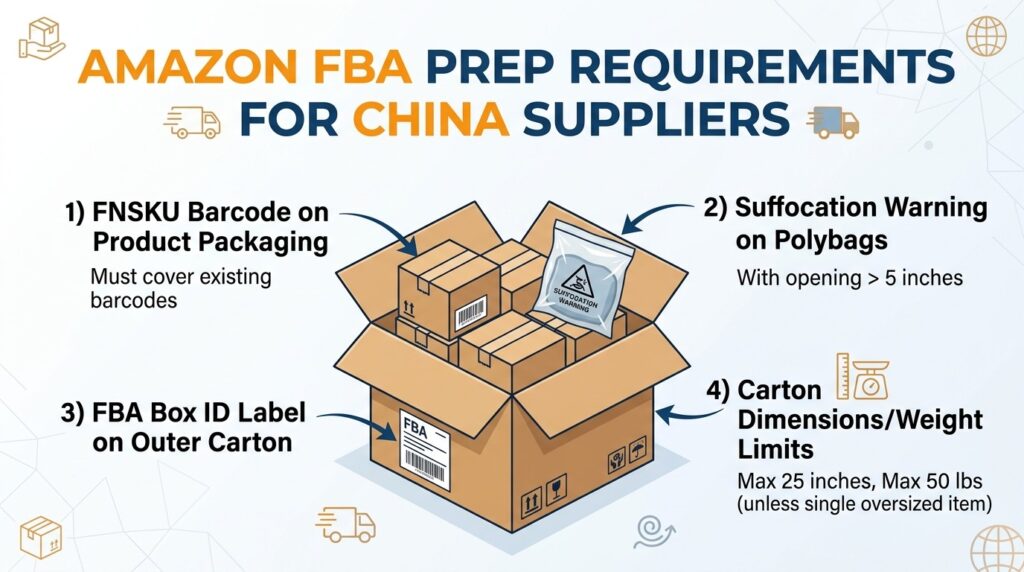
Step 3: FBA-Specific Packaging Requirements
This is where many China-sourced FBA shipments fail. Amazon’s packaging requirements are specific, enforced at the warehouse, and can result in unfulfillable shipments if not followed exactly.
FNSKU labels:
Every unit must have a scannable FNSKU barcode label — either printed by the manufacturer (provide the FNSKU label artwork) or applied at an FBA prep service. Each FNSKU corresponds to one specific product/variant in your Amazon catalog.
Poly bag requirements:
Any soft goods, multi-component products, or items that could scatter must be in a sealed poly bag with a suffocation warning printed on or attached. The warning text must be in the correct format specified by Amazon.
Carton weight and dimension limits:
Standard FBA cartons: max 50 lbs (23 kg). Max dimensions depend on product category, but standard cartons are limited. Oversized cartons are handled differently and incur different fees.
Carton labels:
Each shipping carton must have Amazon’s shipment ID label (generated in Seller Central when creating the shipment plan) plus shipper ID, destination FC, and PO number.
The practical solution: Provide your factory with Amazon’s packaging requirements in writing as part of your purchase order. For factories new to FBA, send sample FBA carton labels and unit labels to show exactly what’s required. For the first order, consider routing through a China-based FBA prep service to ensure everything is correct before it reaches Amazon.
Step 4: Compliance Requirements by Category
Amazon enforces specific compliance requirements at listing level and increasingly at shipment level. Getting suspended for compliance issues after your first order is a very expensive way to learn this.
Categories with mandatory compliance documentation:
| Category | Required Documentation |
|---|---|
| Electronics | FCC ID registration (US), CE (EU), UL listing where applicable |
| Children’s products | CPSC children’s product certificate, ASTM testing, CPSIA compliance |
| Supplements / consumables | FDA facility registration, product documentation |
| Toys | ASTM F963 (US), EN 71 (EU), age grading documentation |
| Personal care / cosmetics | FDA registration, INCI ingredient disclosure |
| Clothing (children’s) | CPSC, flammability testing |
For electronics sold on Amazon US, FCC ID registration is required for wireless products. You apply for the FCC ID — the factory cannot do this on your behalf. Budget 4–8 weeks for FCC testing and registration through an accredited lab.
For private label products in regulated categories, the brand (your brand) is the responsible party for compliance — not the Chinese factory. The factory can provide test reports; you are responsible for ensuring they are valid.
Step 5: Shipping China to Amazon FBA
Option A — Air Freight (3–7 days to destination):
Cost: $4–8/kg. Best for: first orders (validate before over-committing inventory), restocks when Amazon inventory is running low, lightweight high-value products where speed justifies cost.
Option B — Sea Freight LCL (25–40 days):
Cost: $80–160/CBM. Best for: established sellers with predictable reorder cycles, products where 30-day transit time is planned into inventory management, products too heavy for air to be economical.
Option C — Sea Freight FCL (25–35 days):
Cost: $1,500–3,500 for a 20ft container. Best for: high-volume sellers ordering full container quantities (typically 2,000+ units of a single product).
Option D — Express courier (DHL/FedEx/UPS, 3–5 days):
Cost: $8–15/kg. Best for: small initial orders (under 50kg), urgent restocks, samples.
The FBA timeline reality: Add 2–3 weeks for production completion, 1–3 weeks for inspection and export processing, plus transit time, plus Amazon FC receiving time (typically 2–7 business days after arrival). Plan your China-to-available-in-FBA timeline as 8–14 weeks for sea freight, 4–6 weeks for air.
Step 6: Working with a Sourcing Agent vs. Direct Factory
Direct factory advantages:
– Lower per-unit cost (no agent margin)
– Direct relationship for quality issues
– Faster communication on customization
Sourcing agent advantages for FBA sellers:
– Agent handles supplier vetting, negotiation, and QC on your behalf
– Can coordinate FBA labeling and prep in China (saving per-unit prep costs at a US prep center)
– Reduces the time you spend on supply chain management
– Useful when testing multiple products simultaneously across different categories
For new FBA sellers testing their first product, a China sourcing agent reduces operational complexity at a cost of 5–10% of order value — which typically pays for itself in avoided mistakes on the first order.
The 5 Most Common FBA + China Sourcing Mistakes
1. Skipping pre-shipment inspection on the first order.
Your first bulk order with any factory is the highest-risk order. The sample was good; the bulk may not be. A pre-shipment inspection ($250–320) is essential on all first orders regardless of factory credentials. See our pre-shipment inspection guide for what to include in the brief.
2. Under-specifying FBA packaging requirements.
A factory unfamiliar with FBA will package products correctly for their standard export — not necessarily for FBA compliance. Every FBA requirement must be written into the purchase order and verified at inspection.
3. Ordering too much inventory for a product that hasn’t been validated.
FBA long-term storage fees are real and significant. Validate demand with a 200–500 unit initial order before committing to 2,000+ units of a product that may not perform.
4. Ignoring compliance until after listing.
Amazon is increasingly proactive about compliance documentation requests. Having documentation ready from your first order cycle avoids account-level disruptions when Amazon requests it 6 months into your listing.
5. Using only price as a supplier selection criterion.
The cheapest factory is rarely the best FBA supplier. Reliability, FBA experience, quality consistency, and communication responsiveness matter more than a $0.30/unit difference in per-unit cost.
Shipping cost estimates and FBA fee references in this article reflect 2025–2026 conditions. Check Amazon’s current FBA fee schedule in Seller Central, as fees are updated periodically.
If you’re sourcing for Amazon FBA and want supplier vetting, FBA prep coordination, and quality control handled by an experienced China-side team, contact our sourcing specialists.
Related reading → How to Import Products from China: A First-Timer’s Step-by-Step Playbook