A US gift shop owner sourced 800 hand-painted ceramic mugs from a Jingdezhen supplier. The mugs looked beautiful. Three months after sale, a customer reported concern about a metallic aftertaste when drinking from the mug. The owner arranged independent lab testing. The leachable lead level in the glaze was four times the FDA limit for ceramic foodware.
The mugs were pulled from sale. The customer communication was uncomfortable. The replacement order took 12 weeks.
The supplier had a legitimate business, a real factory, and good production quality on workmanship. They had no food-contact safety testing because nobody had asked them to provide it.
Home décor sourcing from China is attractive — the category is broad, designs are creative, and prices are significantly lower than domestic sourcing. The specific risks, however, are different from other product categories: material compliance (heavy metals, formaldehyde, VOCs), environmental certification (wood species, FSC documentation), textile chemical standards, and flame retardancy requirements depending on the product type and destination market.
This guide breaks those risks down by subcategory and tells you what to check before you order.

China’s Home Décor Manufacturing Clusters
Different home décor subcategories are made in different regions:
| Subcategory | Primary Region | Key Cities |
|---|---|---|
| Ceramics and pottery | Jiangxi, Guangdong, Fujian | Jingdezhen, Chaozhou, Dehua |
| Wooden décor, furniture accessories | Zhejiang, Guangdong | Dongyang, Foshan |
| Woven/rattan/bamboo | Fujian, Zhejiang, Anhui | Quanzhou, Yongkang |
| Metal décor, iron art | Hebei, Guangdong | Langfang, Foshan |
| Candles and fragrance | Guangdong, Shandong | Guangzhou, Qingdao |
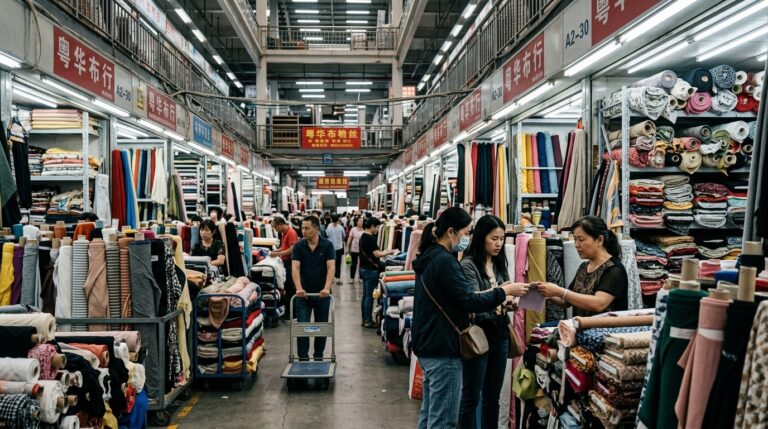
| Textiles (throws, cushions, rugs) | Zhejiang, Jiangsu | Keqiao, Nantong |
| Glass décor | Hebei, Shanghai | Hejian, Shanghai |
Knowing the production cluster helps when briefing a China sourcing agent — an agent with Fujian connections for rattan is more valuable than a general agent who needs to find a rattan factory from scratch.
Ceramics: The Lead and Cadmium Problem
Ceramic home décor — mugs, bowls, vases, plates, decorative objects — is one of China’s strongest export categories, and also one of its highest compliance risk categories for food-contact and food-adjacent items.
The risk: Decorative glazes containing lead or cadmium compounds produce more vivid colors and better adhesion than lead-free alternatives. Many Chinese ceramic factories use these glazes for decorative items that are not intended for food contact — but those items end up being used by consumers in ways the manufacturer didn’t anticipate (decorative mugs used for drinking, decorative bowls used for food serving).
What to check:
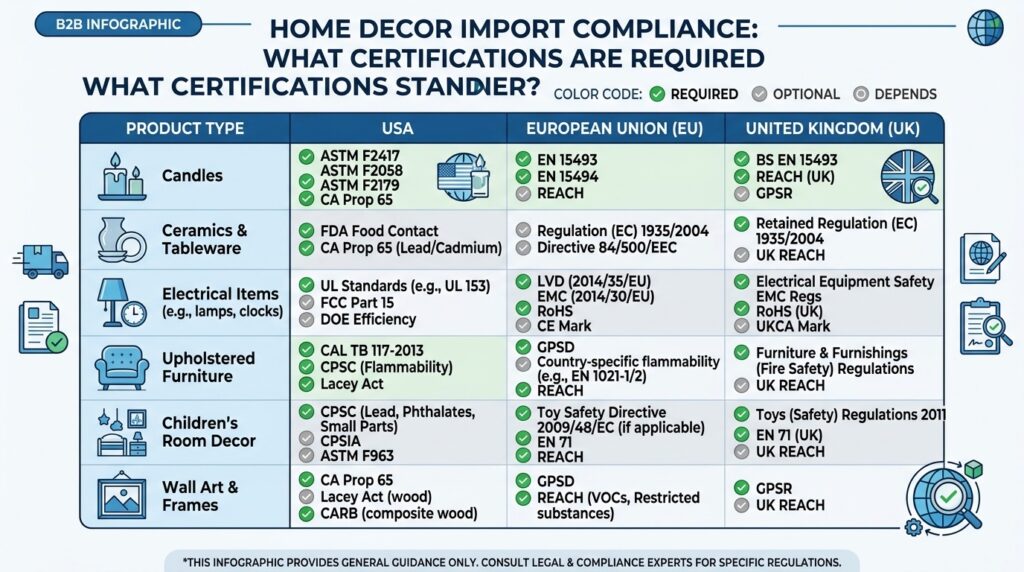
For food-contact ceramics (mugs, plates, bowls): Request lead and cadmium leachability test results per FDA CFR 21 Part 109 (US) or EU Directive 84/500/EEC (EU). Tests must be from an accredited third-party lab.
For purely decorative ceramics: Confirm with the factory in writing that the item is not food-contact safe and will be marketed as decorative only. This is a labeling and marketing decision; the compliance risk shifts to your market positioning.
For ceramics with children’s product marketing: CPSC requirements apply in the US — much stricter lead limits than adult ceramics.
Testing cost: Ceramic leachability testing runs $80–150 per sample at accredited labs (SGS, Intertek, Bureau Veritas).
Wood and Rattan: FSC, CITES, and Customs Inspection Risk
Wooden home décor and rattan/bamboo products carry two distinct compliance risks that most buyers don’t encounter until their goods are held at customs.
Risk 1 — Protected species (CITES):
Some wood species used in Chinese decorative products are protected under CITES (Convention on International Trade in Endangered Species). Rosewood (Dalbergia spp.) is the most common example — it’s widely used in Chinese decorative items but is CITES Appendix II listed, meaning import requires documentation and permits.
When goods containing CITES-listed species arrive without documentation, they are seized. The burden of proof falls on the importer.
What to do: For any wooden product, ask the supplier to confirm the wood species by scientific name. Cross-reference against CITES Appendix listings. If the species is listed, confirm that the supplier can provide CITES export permits.
Risk 2 — Illegal logging documentation (US Lacey Act / EU Timber Regulation):
The US Lacey Act and EU Timber Regulation require importers to conduct due diligence that their wood products don’t contain illegally harvested timber. FSC (Forest Stewardship Council) certification is the most widely recognized standard — it documents that the wood came from a responsibly managed forest.
For decorative wooden products sold in US retail or EU markets, request FSC chain-of-custody documentation or equivalent legal harvest documentation from your supplier. “We use sustainable wood” from a salesperson is not documentation.
Candles and Fragrance: Compliance Most Buyers Ignore
Candles are a high-growth home décor category with specific compliance requirements in most Western markets that almost no first-time buyer checks.
EU (CLP Regulation): Candles sold in the EU must have hazard labeling if the fragrance or material composition meets certain chemical thresholds. The fragrance compound must comply with IFRA (International Fragrance Association) guidelines. Documentation from the fragrance supplier must be available.
US: No federal mandatory candle regulation, but California Proposition 65 applies if selling to California. Fragrance compounds listed under Prop 65 require consumer warning labels if present above threshold levels.
UK (post-Brexit): Aligns broadly with EU CLP requirements for hazard labeling.
Practical approach: Request the Safety Data Sheet (SDS) for the fragrance used in production. A legitimate fragrance supplier provides this documentation. If the factory can’t provide an SDS, request that they source the fragrance from a supplier who can.
Also verify: wick composition. Wire-core wicks (sometimes containing lead) are banned in EU and prohibited under US EPA guidelines. Request confirmation that wicks are cotton or paper core only.
Textiles (Throws, Cushions, Rugs): Chemical and Flammability Compliance
Textile home décor carries two primary compliance risk areas:
Chemical content (REACH / OEKO-TEX):
EU REACH regulations restrict certain chemicals in textiles — azo dyes, heavy metals in dyes, formaldehyde. For EU market sales, request OEKO-TEX Standard 100 certification or REACH compliance test reports from the factory. OEKO-TEX certification is product-specific and verifiable on the OEKO-TEX database.
Flammability:
Upholstered products (cushions, pillows, throws with fillings) have specific flammability requirements in UK (BS 5852) and California (CA TB 117). For UK sales, flammability compliance is mandatory. For US sales, it depends on whether the product falls under California’s market reach.
For Chinese textile factories, OEKO-TEX certification is common among export-focused manufacturers — it’s a meaningful filter when searching for compliant suppliers on Alibaba.
Quality Risks Specific to Home Décor
Beyond compliance, home décor has quality risks that often don’t surface until the goods are in consumer hands:
Color consistency across batches: Ceramic glazes, fabric dyes, and wood stains all vary between production batches. For brand-sensitive products with consistent colorways, specify the exact color standard (Pantone for textiles, RAL for paints and coatings) and include color measurement testing (Delta-E tolerance) in your inspection brief.
Fragility in transit: Ceramics, glass, and thin metal decorative items require specific packaging specification — individual wrapping, adequate foam or paper padding, carton drop testing. Packaging specification must be included in your purchase order, not assumed.
Surface finish durability: Decorative finishes (painted surfaces, electroplating, lacquer coatings) on metal and wood décor items can chip, peel, or oxidize under use conditions. Request cross-hatch adhesion test results (ASTM D3359) for painted surfaces, and salt spray test results for outdoor-use metal items.
How to Find Home Décor Factories in China
Canton Fair (Guangzhou, April and October): Has a large home décor section covering ceramics, glass, wood, textiles, and gift products. The most efficient way to see a broad range of factories and compare in person.
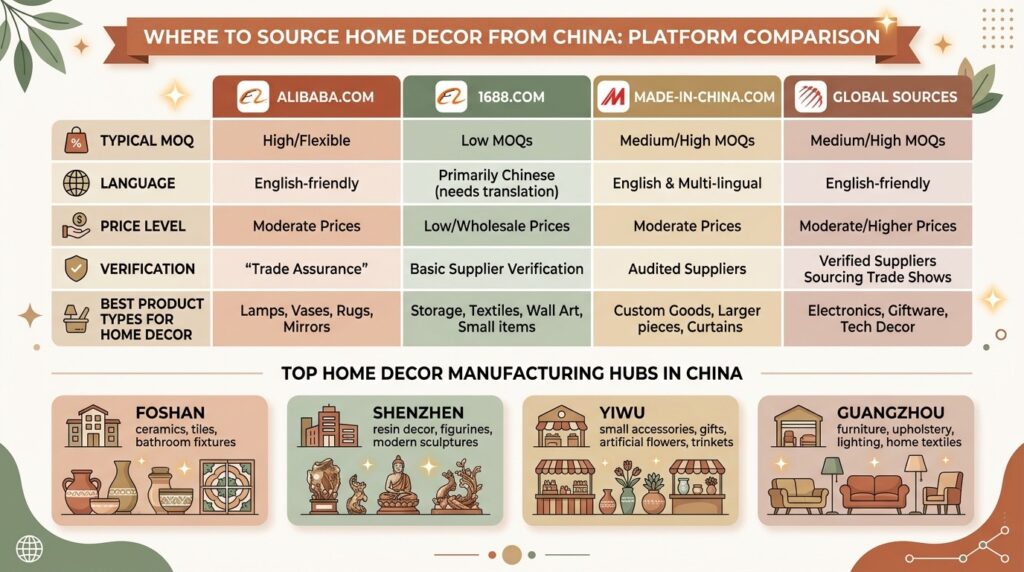
Alibaba with category-specific filters: Filter for “home décor” suppliers with relevant certifications (OEKO-TEX, FSC, SGS certified). Cross-reference with the geographic clusters above — a ceramic supplier in Jingdezhen with 10+ years on Alibaba and factory audit history is more reliable than an unverified trading company claiming to offer the full home décor range.
Global Sources Home: Runs annual events in Hong Kong with home décor manufacturer representation.
Need help sourcing specific home décor categories from China? Our team covers ceramic, wood, textile and candle sourcing with regional factory networks.
Related reading → China Quality Control: The Complete 2026 Guide