Here’s something that surprises most buyers the first time they see it: the exact same product, from the same factory, can be listed at three completely different prices on three different platforms.
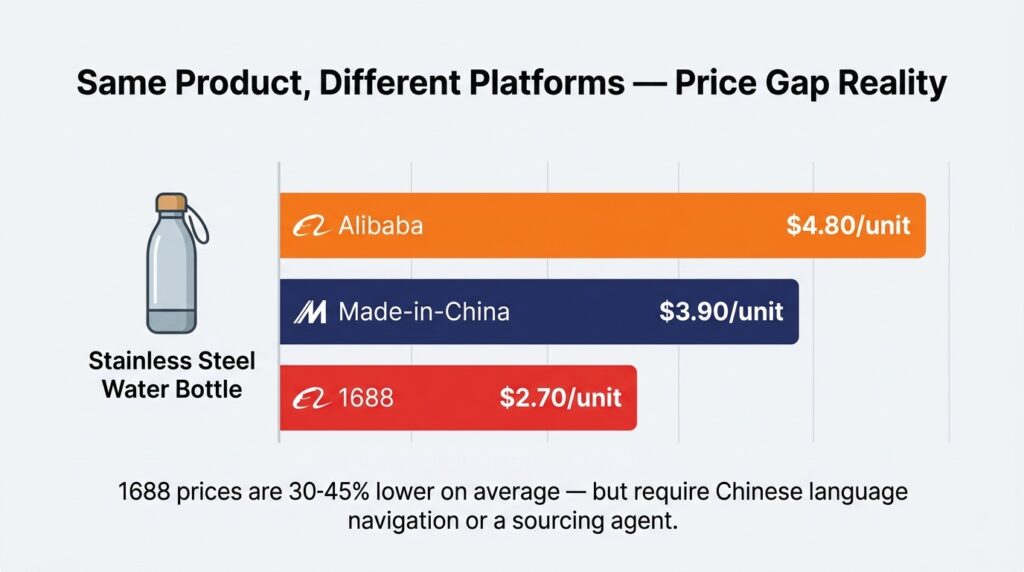
A stainless steel insulated water bottle — 500ml, double-wall, bulk packed. On Alibaba: $4.80 per unit. On Made-in-China.com: $3.90. On 1688: $2.70.
Same spec. Possibly the same manufacturer. The price gap is real, and it’s not a coincidence — it reflects the fundamental difference in who each platform is built for.
This article breaks down what those differences actually mean for buyers, and helps you decide which platform deserves your time based on where you are in your sourcing journey.
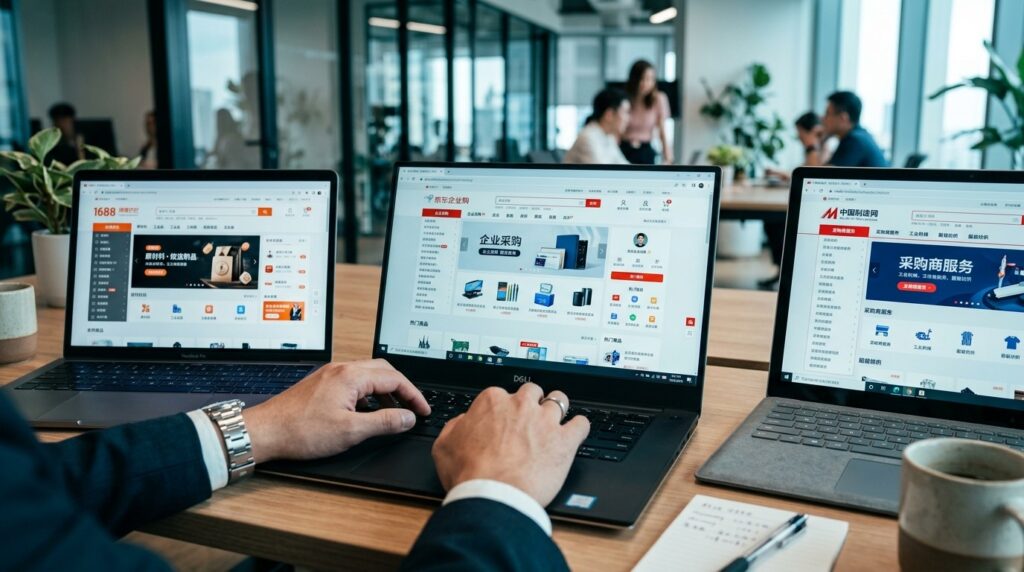
Why the Same Product Costs Different Amounts on Each Platform
Before comparing the platforms directly, it helps to understand why prices differ — because it’s not just about profit margins.
Alibaba is built for international trade. It has an English interface, buyer protection infrastructure, and dispute resolution in place. All of that costs something to maintain — and some of that cost flows through to the prices you see. A significant portion of Alibaba suppliers are also trading companies (middlemen), not factories. Their price includes a layer of markup.
1688.com is Alibaba’s domestic Chinese platform — the one factories use to sell to Chinese resellers. No English interface was built into the design, because none was needed. Prices reflect what a Chinese wholesale buyer would pay: factory-direct, no international overhead, no translation layer. This is why the numbers look so different.
Made-in-China.com sits between the two. It’s English-facing and targets international buyers, but leans toward verified manufacturers and industrial categories. Prices are typically lower than Alibaba but don’t reach the floor-level pricing of 1688.
Platform-by-Platform Breakdown
Alibaba.com — The International Default
What it is: The world’s largest B2B marketplace for international buyers. Launched in 1999, it now hosts over 200,000 suppliers across virtually every product category.
Who’s on it: A mix. About 40–50% of listings on Alibaba are trading companies — businesses that buy from factories and resell to international buyers with a markup. The remainder are actual manufacturers. The “Verified Manufacturer” badge helps, but isn’t definitive.
The price reality: You’re paying for convenience, English communication, and the Trade Assurance safety net. On mid-volume orders ($5,000–$30,000), Alibaba prices typically run 20–40% higher than what the same goods would cost through 1688 or a direct factory relationship. That gap narrows on very large orders where factories are willing to match aggressive pricing.
Trade Assurance — what it actually covers:
Trade Assurance is Alibaba’s buyer protection program. It covers you if:
– Goods aren’t shipped on time
– Goods don’t match the agreed specification
It does NOT cover subjective quality disputes (e.g., “the finish doesn’t look as good as the photos”) or situations where your spec wasn’t detailed enough. Think of it as basic financial protection, not a quality guarantee.
Best for:
– First-time importers who need English communication
– Buyers testing a new supplier relationship before moving to direct sourcing
– Orders where Trade Assurance provides meaningful risk coverage
– Products where finding suppliers on 1688 is genuinely difficult (niche or custom items)
Limitations:
– Higher base prices than factory-direct sourcing
– Significant trading company presence — you may not realize you’re not talking to a factory
– Supplier reviews can be gamed; don’t rely on star ratings alone
1688.com — The Factory Floor Price
What it is: China’s domestic wholesale platform, operated by the Alibaba Group. Built for Chinese buyers purchasing from Chinese factories. It is, without exaggeration, the closest most overseas buyers can get to factory-direct pricing without physically being in China.
Who’s on it: Overwhelmingly actual factories and domestic wholesalers. The supplier base skews toward manufacturers selling in volume, which is why MOQs can be surprisingly low on certain product categories — because they’re accustomed to serving small Chinese resellers, not just large export orders.
The price reality: Across the product categories we work with regularly — consumer goods, home products, electronics accessories, packaging materials — 1688 prices run 30–45% lower than equivalent Alibaba listings. On a $20,000 order, that’s a $6,000–$9,000 difference. That’s not a rounding error.
The language problem — and the workaround:
The entire platform is in Mandarin. There is no official English version, no built-in translation, and most suppliers on 1688 do not communicate in English. Google Translate helps with reading product listings but creates significant friction in negotiation and specification communication.
The practical solution: a China sourcing agent who operates on 1688 as part of their workflow. A good agent gives you 1688 pricing with Alibaba-level communication — and the agent fee (5–8%) still typically leaves you ahead on any order over $8,000–10,000.
Payment from overseas: 1688 was originally built for domestic payments (Alipay, WeChat Pay). International payment requires either working through an agent, using third-party services like Yicang or Supplyia, or having a Chinese bank account. This is another reason most overseas buyers access 1688 indirectly.
Best for:
– Experienced importers who know what they want and can communicate specs clearly (via an agent)
– High-volume repeat orders where even small per-unit savings compound significantly
– Buyers who have already validated a product on Alibaba and want to reduce COGS on repeat orders
– Accessing factory-direct MOQs that Alibaba suppliers won’t offer internationally
Limitations:
– No English interface — requires agent or translation workaround
– No buyer protection equivalent to Trade Assurance
– Quality varies — more than on Alibaba, because the platform serves domestic buyers who can inspect in person
– International payment requires a workaround
Made-in-China.com — The Industrial Middle Ground
What it is: A B2B sourcing platform launched in 1998, focused on connecting international buyers with Chinese manufacturers. It’s English-facing and has historically been strong in industrial, machinery, hardware, and B2B product categories.
Who’s on it: Mostly manufacturers and factories — Made-in-China.com’s positioning has always been more factory-centric than Alibaba’s. The platform has built a verification system that includes factory audits and inspection reports you can view before contacting a supplier.
The price reality: Prices typically sit between Alibaba and 1688. You’re getting closer to factory-direct pricing than Alibaba, with better verification infrastructure than 1688, but without 1688’s floor-level costs.
Where it genuinely outperforms Alibaba:
- Machinery and industrial equipment: Made-in-China.com has a significantly stronger supplier base in heavy equipment, CNC machinery, industrial components, and B2B manufacturing inputs. If you’re sourcing anything in this category, check here before defaulting to Alibaba.
- Factory audit transparency: Suppliers can display factory inspection reports directly on their profile — including third-party audits. This is information Alibaba doesn’t surface as consistently.
- Lower trading company ratio: The platform’s focus on manufacturers means you’re more likely to be talking directly to a factory.
Limitations:
– Smaller product selection than Alibaba in consumer goods and lifestyle categories
– Less developed buyer protection than Alibaba’s Trade Assurance
– Communication quality is mixed — English proficiency varies more than on Alibaba
– Less recognizable to consumers, which can affect trust if you’re referencing sourcing methods publicly
Head-to-Head Comparison: The Decision Table
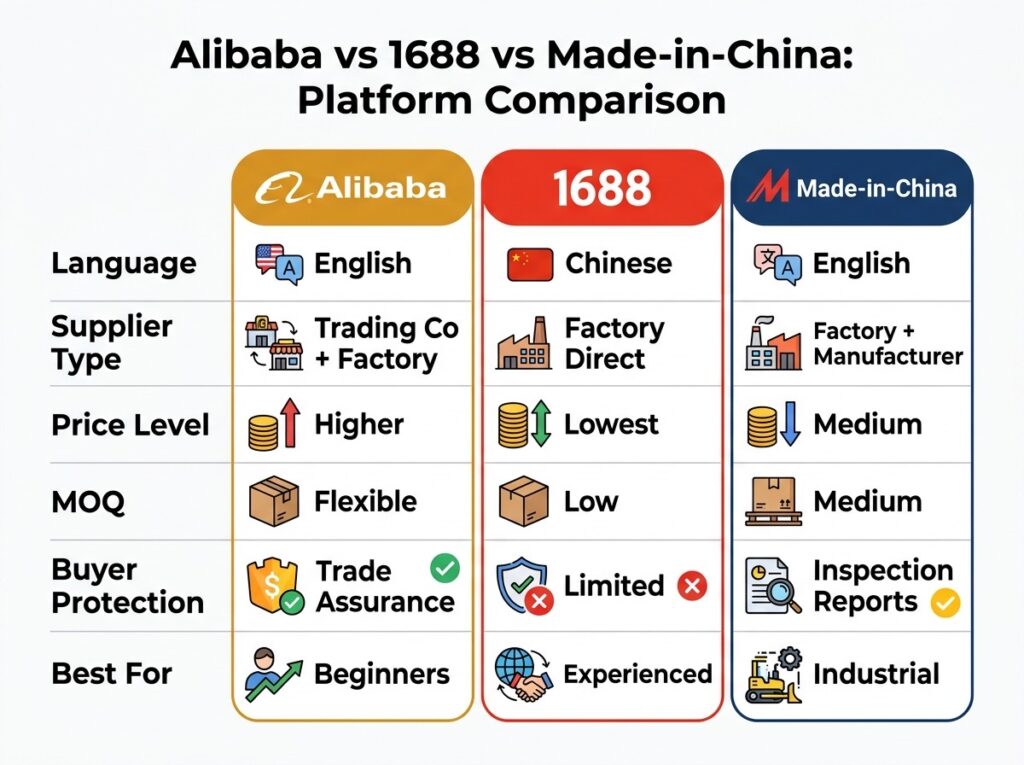
| Dimension | Alibaba | 1688 | Made-in-China |
|---|---|---|---|
| Interface Language | English | Chinese only | English |
| Dominant Supplier Type | Trading Co + Factory | Factory-direct | Factory + Manufacturer |
| Price Level | Higher (20–40% above 1688) | Lowest (floor pricing) | Medium |
| Typical MOQ | Flexible (often 50–200 units) | Low (sometimes 10–50 units) | Medium (100–500 units) |
| Buyer Protection | Trade Assurance ✅ | Limited ❌ | Inspection reports ⚠️ |
| Payment Method | International cards + wire | Alipay/WeChat (workaround needed) | Wire transfer |
| Best Product Categories | Consumer goods, all categories | All categories at lower price | Industrial, machinery, hardware |
| Best For | Beginners, testing suppliers | Experienced buyers, repeat orders | Industrial sourcing |
| English Communication | Good | Poor (agent required) | Variable |
| Verification Level | Verified Supplier badge | Minimal | Factory audit reports |
So Which Platform Should You Actually Use?
There’s no universal answer, but here’s a decision framework based on where you are:
If you’re placing your first order ever
Start with Alibaba. The English interface, Trade Assurance, and structured supplier profiles give you guardrails while you learn the process. Yes, you’ll pay more. Think of the premium as your tuition for learning how this works before the stakes get higher.
If you’ve already done 3–5 successful Alibaba orders
Move some of your sourcing to 1688 via an agent. You know your product well enough to write a proper spec. You know what good quality looks like. Now it’s time to reduce your cost base.
If you’re sourcing machinery, industrial equipment, or B2B manufacturing inputs
Made-in-China.com should be your primary platform. The supplier base for industrial categories is deeper and more manufacturer-focused than Alibaba, and the factory audit infrastructure gives you better pre-qualification tools.
If you’re running high-volume repeat orders
1688 is almost always the right answer — either directly with agent support, or through a hybrid approach where you use Alibaba for supplier discovery and 1688 for repeat purchasing from the same factory (many factories list on both platforms under different pricing).
The Hybrid Strategy: How Experienced Importers Actually Use These Platforms
Most experienced buyers don’t treat these platforms as mutually exclusive. A typical workflow looks like this:
Discovery phase: Search Alibaba to identify 8–12 candidate suppliers. Alibaba’s English interface makes initial screening fast. Request quotes, check Trade Assurance history, filter for Verified Manufacturers.
Verification phase: Cross-reference shortlisted suppliers on 1688. If the same factory appears on both platforms, compare pricing. The gap tells you how much trading company markup (if any) is built into the Alibaba quote.
Negotiation phase: Use the 1688 price as your benchmark when negotiating with Alibaba suppliers. “I can source this at [1688 price] through other channels” is a legitimate negotiating position that often prompts factories to sharpen their Alibaba pricing.
Repeat ordering phase: Once a supplier relationship is established, move purchasing to 1688 directly (via your agent) or negotiate Alibaba pricing down to match 1688 levels for high-volume repeat orders.
Related guide → How to Buy from 1688.com as an Overseas Buyer (No Chinese Required)
A Note on Global Sources and Other Platforms
Two platforms worth mentioning that didn’t make the main comparison:
Global Sources — Strong in electronics, consumer electronics, and mobile accessories. The supplier base skews toward manufacturers with significant export experience and higher product standards. Annual trade shows in Hong Kong are the best reason to engage with this platform. Prices are comparable to Alibaba, occasionally lower.
DHgate — Often confused with the B2B platforms above, DHgate is closer to a B2C wholesale platform with lower MOQs. Useful for very small trial orders but less appropriate for building a serious supply chain. Quality control is less consistent.
Neither replaces the three main platforms for most sourcing scenarios, but they’re worth bookmarking for specific use cases.
The Bottom Line
Alibaba is the safest starting point. Made-in-China is the right tool for industrial sourcing. 1688 is where the real factory prices live — but you need either language capability or a trusted agent to access them effectively.
The platform is just a door. What matters is who you find behind it, how carefully you verify them, and how clearly you define what you need before money changes hands.
If you’re ready to explore 1688 sourcing but don’t want to navigate the language barrier alone, our team can help — we source through both Alibaba and 1688 depending on what makes sense for each client’s product and order volume.
Next step → How to Verify a Chinese Supplier Before You Send Any Money
Prices referenced in this article are illustrative examples based on real market data from Q2 2026. Actual pricing varies by product category, specification, order volume, and supplier.