There’s a conversation that happens regularly between buyers and sourcing agents — and it goes badly in a predictable way.
The buyer asks: “What are your fees?” The agent says: “We charge 7% commission.” The buyer agrees. The order proceeds. Then the final invoice arrives, and it includes a sourcing fee, an inspection coordination fee, a sample forwarding fee, and a logistics handling charge — none of which were mentioned in the initial conversation.
This isn’t always bad faith. Sometimes it’s genuinely unclear communication between parties who have different assumptions about what “7% commission” covers. But the result is the same: a buyer who planned for one number and is now looking at another.
This guide exists to close that gap. By the end of it, you should be able to read any sourcing agent’s quote, identify what’s missing, and ask the right questions before you sign anything.

The Three Fee Models You’ll Actually Encounter
The China sourcing industry has no standardized pricing. Agents set their own fee structures, and the same service can be priced three completely different ways depending on who you’re talking to. Here are the models in use:
Model 1: Commission on Order Value (Most Common)
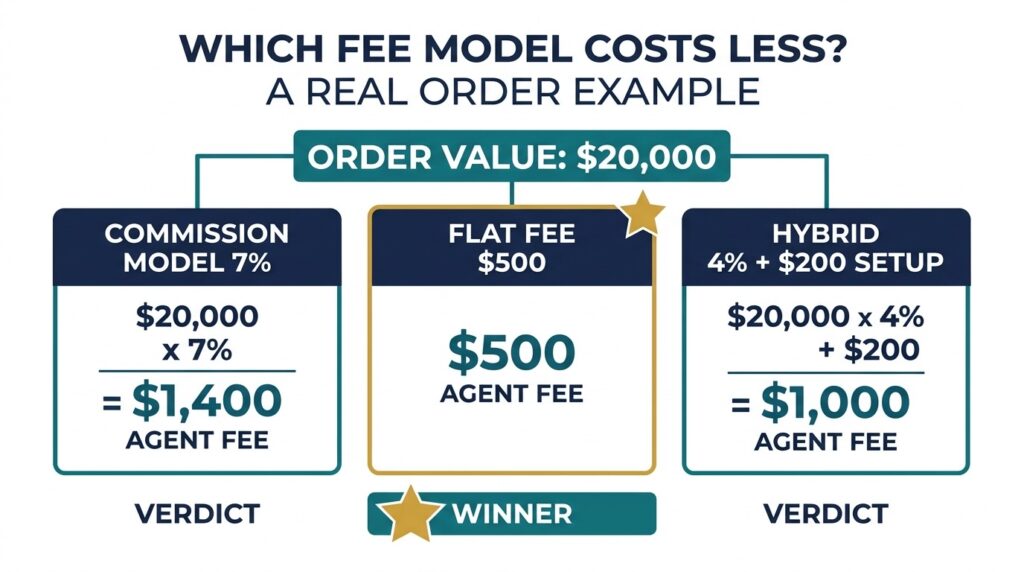
The agent charges a percentage of the total order value — typically 5–10%, with most established agents sitting in the 6–8% range.
How it’s calculated:
On a $30,000 order at 7%, the agent fee is $2,100. That figure is relatively straightforward — though the ambiguity comes in how “order value” is defined (pre-negotiation price? Post-negotiation? Including or excluding shipping?).
Why agents prefer this model:
Commission-based pricing aligns the agent’s incentive with yours, in theory. If they negotiate the factory price down, their fee drops proportionally — so there’s motivation to get you a better price. In practice, some agents negotiate to a floor and then stop, because further negotiation reduces their income. Watch for this.
When it works well for buyers:
Large, irregular orders where the service investment varies significantly. An agent who spends three weeks finding a custom OEM manufacturer deserves to be compensated for that time, and a commission model scales with the work required.
When it works against you:
Small, repeat orders of standardized products. On a $4,000 repeat order of packaging materials you’ve bought a dozen times, a 7% commission ($280) for minimal actual work is hard to justify. This is where flat fee models make more sense.
The Commission Baseline Problem
One specific issue with commission models: some agents apply their percentage to the quoted factory price, not the negotiated price. If the factory initially quotes $5.00 per unit and the agent negotiates it to $4.20, a commission on the original $5.00 means the agent is actually making more money by having a higher starting price on your invoice. Ask explicitly: does your commission apply to the final negotiated factory price?
Model 2: Flat Fee Per Order
A fixed charge per sourcing engagement, regardless of order value. Common ranges:
| Order Complexity | Typical Flat Fee |
|---|---|
| Simple, standard products | $200 – $400 |
| Mid-complexity (custom spec, 3–5 suppliers) | $400 – $800 |
| Complex (OEM, multiple rounds of sampling) | $800 – $1,500+ |
Why buyers sometimes prefer this model:
Cost certainty. You know what you’re paying before the order starts. For buyers managing tight margins on lower-value orders, a flat fee can be significantly cheaper than commission.
The critical limitation:
Flat fees don’t scale with your order size. On a $5,000 order, a $500 flat fee is 10% — more expensive than most commission rates. On a $50,000 order, the same $500 flat fee is 1% — an excellent deal. Flat fee pricing requires you to understand where the crossover point is for your specific order values.
Model 3: Hybrid (Base Fee + Lower Commission)
A structure that combines a smaller upfront fee with a reduced commission percentage. Common example: $200 setup fee + 4% commission.
How it works in practice:
The setup fee covers the agent’s initial sourcing work (supplier research, shortlisting, initial communication). The reduced commission covers ongoing order management. This model is more common with agencies serving clients who need ongoing support across multiple product categories.
Who it suits:
Buyers with a mix of order sizes — some smaller, some larger. The setup fee covers the agent’s time on smaller orders where a pure commission wouldn’t make the work worthwhile; the lower commission rate makes larger orders more affordable than the standard 7–8%.
What the Fee Doesn’t Cover: The Hidden Cost Layer
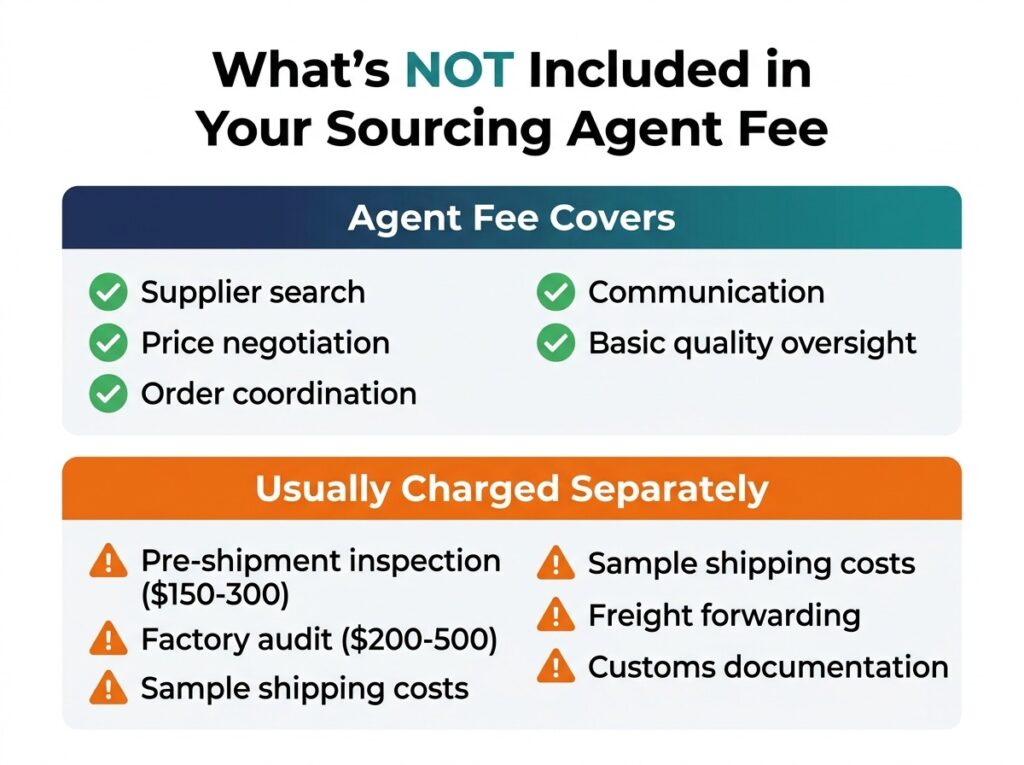
This is where most first-time buyers get caught out. The agent’s core fee — whether commission or flat — typically covers the service of sourcing and managing the order. It does not cover the operational costs incurred during that process.
These costs are real, and they’re almost always passed through to the buyer:
Pre-Shipment Inspection Fees: $150–$300 Per Visit
Third-party quality inspections — conducted by companies like QIMA, SGS, or Bureau Veritas — are almost always charged separately. The agent coordinates the inspection on your behalf, but the inspector’s fee ($150–$300 for a standard one-day inspection) comes to you directly or via the agent with a small coordination markup.
Some agents include one inspection per order in a higher commission rate. Most don’t. Ask upfront.
Factory Audit Fees: $200–$500
If you need a formal factory audit before placing a first order — a more thorough assessment than a video call — the cost runs $200–$500 depending on the scope. Again, the agent arranges it; you pay for it.
Sample Costs and Shipping: Variable
Samples from Chinese factories typically cost $20–$150 per sample, plus international courier costs ($40–$120 via DHL or FedEx). These are usually charged at cost, passed straight through to the buyer. If you’re evaluating 5 suppliers with 2 samples each, this adds up before you’ve placed a single order.
Freight Forwarding and Logistics
Unless explicitly stated, your agent is not your freight forwarder. Arranging the shipping from the factory to your warehouse is a separate service with a separate cost — either through a freight forwarder you choose, or through a logistics partner the agent recommends (sometimes with a referral arrangement worth knowing about).
Customs Documentation Support
Some agents assist with customs document preparation; some don’t. If they do, there may be an additional fee. If they don’t, you’ll need a licensed customs broker — typically $100–$250 for a standard import.
The Real Cost of a Sourcing Agent: A Worked Example
To make all of this concrete, here’s how the full cost structure plays out on a real order:
Scenario: Importing 2,000 units of a branded silicone kitchen tool from a Shenzhen manufacturer. Order value: $18,000.
| Cost Item | Amount | Notes |
|---|---|---|
| Agent commission (7%) | $1,260 | On negotiated factory price |
| Pre-shipment inspection | $220 | Third-party, one-day inspection |
| Sample costs (3 suppliers) | $180 | Samples + DHL shipping |
| Agent coordination markup | $50 | Internal handling |
| Total agent-related costs | $1,710 | 9.5% of order value |
The buyer budgeted for 7% ($1,260). The actual cost was $1,710 — 35% more than expected, and all of it legitimate. None of it was hidden in the fine print; it just wasn’t discussed upfront.
The lesson: when comparing agents, compare total cost of service, not headline commission rate.
5 Contract Questions to Ask Before You Sign
These questions, asked before any agreement is signed, prevent the majority of fee surprises:
1. Is your commission calculated on the quoted price or the final negotiated price?
This matters by hundreds of dollars on a $20,000+ order. Confirm it in writing.
2. What services are included in the commission, and what is charged additionally?
Get a written list of what’s in and what’s out. “Inspection coordination” means different things to different agents — some mean arranging the inspector’s visit; others mean they physically attend and review the report.
3. Do you receive any compensation from factories or freight forwarders you recommend?
Referral fees and “kickbacks” from factories are a real phenomenon. You deserve to know whether the factory your agent recommends is the best option for you, or the best option for your agent’s secondary income.
4. What are the payment terms for your fee?
When is the agent’s fee due — at deposit, at inspection, at shipment, or after delivery? This affects your cash flow and your leverage if something goes wrong.
5. What happens to your fee if the order is cancelled or significantly altered?
If the factory fails inspection and you decide not to proceed, does the agent keep the full commission? A partial fee for work completed is reasonable; a full commission on a failed order is not.
When a Higher Fee Agent Is Actually Cheaper
Counter-intuitive but consistently true: the agent with the lowest commission rate is not always the cheapest option.
An agent charging 5% who quotes you a factory price of $5.20 per unit costs you $260 in commission on a 1,000-unit order plus $5,200 in goods — total $5,460.
An agent charging 8% who negotiates the same goods to $4.40 per unit costs you $352 in commission plus $4,400 in goods — total $4,752.
The “expensive” agent saved you $708.
This math is why price negotiation capability matters more than commission rate, especially on larger orders. Before you choose an agent based on their quoted percentage, ask them: “What’s the current market price range for this product? What do you expect to be able to negotiate it to?” Their answer tells you whether their fee will pay for itself.
Related reading → China Sourcing Agent: The Complete 2026 Guide to What They Do and How to Choose
How to Negotiate Agent Fees Without Damaging the Relationship
Agent fees are negotiable — but the negotiation needs to be done before the relationship starts and structured so it doesn’t undermine the agent’s incentive to do good work.
What works:
– Asking for a reduced commission on high-volume repeat orders (below 5% for orders over $50,000 is common)
– Requesting flat fee pricing for repeat orders of the same product from the same supplier (no new sourcing work required)
– Negotiating a cap on commission for very large single orders
What doesn’t work:
– Attempting to renegotiate the fee mid-order — this creates resentment and doesn’t hold up legally
– Pushing commission below 4% on complex or custom orders — at that level, the agent cannot profitably allocate the time your order actually requires
– Asking for fee reductions without offering something in return (higher volume commitment, longer contract term, referral of other buyers)
The best sourcing relationships are ones where the agent’s incentive aligns with yours. A well-paid agent who is motivated to find you the best factory and negotiate hard is worth more than a cheap one who’s rushing your order to get to the next client.
Contact us → Request a transparent fee quote for your next sourcing project
The Fee Conversation That Should Happen Before Anything Else
The right time to discuss agent fees in full detail is before you agree to work together — not after the first order is underway and you’ve lost negotiating leverage.
A good agent will welcome this conversation. They’d rather agree on a clear structure upfront than manage a billing dispute later. An agent who deflects or gets vague when you ask direct cost questions is either poorly organized or strategically obscuring information — neither is a good sign.
The bottom line: the fee model matters less than the transparency with which it’s presented. Commission, flat fee, hybrid — any of these can work. What doesn’t work is a fee structure you can’t fully understand before you sign.
Next article → What Is MOQ? How to Negotiate Minimum Order Quantities with Chinese Factories
Fee ranges cited in this article reflect 2025–2026 market data across sourcing agencies operating in Guangdong, Zhejiang, and Fujian provinces. Individual pricing varies by agent experience, service scope, and product category.