7 Geschichten über Betrugsfälle beim Einkauf in China – und was jedes Opfer daraus gelernt hat
8 Minuten LesezeitVom SourcePilot-Team
Seven real China sourcing fraud cases — each a different scam type, a different dollar amount, and a lesson experienced importers now apply to every order.
Die Zahlen variieren. Die Produktkategorien ändern sich. Die Herkunftsländer der Käufer sind von Fall zu Fall unterschiedlich. Doch die Struktur der Betrugsfälle im Zusammenhang mit der Beschaffung aus China ist bemerkenswert einheitlich: ein Lieferant, der seriös wirkte, eine geleistete Zahlung und schließlich ein Problem, das sich als unlösbar herausstellte.
These are seven of those stories. They’re composites drawn from real reported cases — details changed to protect privacy, financial figures approximate. Each one involves a different type of fraud and a different gap in the buyer’s process. Each one ends with a lesson that costs nothing to apply going forward.
Story 1: The Phantom Factory — $28,000 Lost
Die Ausgangslage:
A UK-based online retailer found a ceramic cookware manufacturer through a Google search. The website was excellent — high-quality product photos, a detailed “About Us” page describing 12 years in the industry, testimonials. The email responses were prompt and professional.
Was ist passiert:
Der Käufer gab eine Bestellung über 1.200 Keramiktöpfe auf und leistete eine Anzahlung in Höhe von 30 % bzw. 8.400 $. Drei Wochen später erhielt er eine Nachricht, dass sich die Produktion aufgrund von „Wartungsarbeiten an den Anlagen“ verzögern würde. Zwei Wochen später reagierte die E-Mail-Adresse nicht mehr. Die Website war nicht mehr erreichbar. Die Telefonnummer führte zu einem nicht funktionierenden chinesischen Handy.
A business license check — run after the fact — showed the 18-digit USCC code on the license image they’d been sent corresponded to a food distribution company in Henan province, not a cookware manufacturer in Guangdong.
DIE LEKTION: Verify the business license before any payment. The 18-digit USCC code is publicly searchable at gsxt.samr.gov.cn in three minutes. A code that returns the wrong company type, the wrong province, or no result at all is a hard stop — not a reason to ask the supplier for clarification.
Story 2: The Quality Bait-and-Switch — $47,000 Absorbed
Die Ausgangslage:
A US Amazon seller sourced silicone baking mats from a Guangdong supplier they’d used once before for a small test order. The initial 200-unit sample order had been excellent — consistent thickness, proper food-grade certification documentation, clean printing.
Was ist passiert:
The follow-up 5,000-unit bulk order arrived 11 weeks later. Within the first week of Amazon FBA receiving, 23% of units were flagged for a quality defect: the logo printing was bleeding into the silicone surface under heat, creating a transfer that contaminated food surfaces. The defect was traced to a different silicone base compound used in the bulk run — a domestic-grade material substituted for the food-grade compound used in the sample.
Der Hersteller räumte „gewisse Abweichungen“ ein und bot einen Rabatt von 7 % auf die nächste Bestellung an. Bei der Großserienlieferung fand keine Prüfung vor dem Versand statt.
Gesamtverlust: 10.810 Dollar an unbrauchbarem Lagerbestand (23 % des Bestellwerts von 47.000 Dollar) zuzüglich der Bearbeitungskosten für Amazon-Rücksendungen sowie eines Zyklus mit negativen Bewertungen.
DIE LEKTION: A good sample doesn’t guarantee a good bulk order. Material substitution is the most common and hardest-to-detect quality fraud because it passes visual inspection. The fix is a pre-shipment inspection with a specific brief that includes material verification — not just cosmetic and functional checks. See our Leitfaden zur Inspektion vor dem Versand was in das Briefing aufgenommen werden soll.
Story 3: The Payment Redirect — $78,000 Diverted
Die Ausgangslage:
Ein deutscher Möbelimporteur unterhielt seit zwei Jahren Geschäftsbeziehungen zu einer Fabrik in Guangzhou, die Polstersessel herstellte. Die Zahlungen erfolgten stets per Überweisung auf dasselbe Konto bei der HSBC in Hongkong.
Was ist passiert:
Three months into a new order cycle, the importer received an email from what appeared to be their regular supplier contact — same email address, same name, same signature — explaining that the company was restructuring their banking to a new account at a different Hong Kong bank. The email provided new account details and asked the buyer to use these for the forthcoming balance payment of $78,000.
Der Importeur hat nicht angerufen, um dies zu überprüfen. Die Zahlung wurde geleistet. Die eigentliche Fabrik hat sie jedoch nie erhalten.
Eine forensische E-Mail-Analyse ergab später, dass das Konto des Lieferanten bereits sechs Wochen zuvor gehackt worden war. Die E-Mail mit der „Zahlungsumleitung“ war zwar von der echten Adresse versendet worden, jedoch von dem Angreifer, der den E-Mail-Verkehr überwacht und darauf gewartet hatte, eine große Zahlung abzufangen.
Gesamtverlust: $78,000 (partial recovery of $11,200 attempted via wire recall 96 hours after payment — largely too late).
DIE LEKTION: Any change to payment bank details must be confirmed by phone — calling the supplier’s verified, previously established contact number, not a number in the email requesting the change. This rule has no exceptions. Man-in-the-middle payment fraud is specifically designed to exploit long-established trust in email communication. The call takes 90 seconds.
Story 4: The Disappeared Deposit — $12,500 Gone
Die Ausgangslage:
Eine australische Marke für Haushaltswaren fand auf Made-in-China.com einen Hersteller von Rattanmöbeln. Das Unternehmen war seit drei Jahren auf der Plattform registriert, hatte positive Bewertungen und bot wettbewerbsfähige Preise für eine maßgeschneiderte Kollektion von Gartenmöbeln an.
Was ist passiert:
Nach zweiwöchigen Gesprächen zur Freigabe der Muster (die Muster wurden verschickt und waren wirklich gut) erteilte der Käufer einen Serienauftrag über 400 Stück und leistete eine Anzahlung in Höhe von 50 % bzw. 12.500 $. Zwei Tage später ging die Produktionsbestätigung mit einem voraussichtlichen Fertigstellungstermin in 45 Tagen ein.
At day 40, the buyer sent a production progress inquiry. No response. At day 45, the buyer called the number on the business license. A different person answered — a private individual who said they’d never heard of the furniture company. The Made-in-China.com listing went offline within 48 hours of the buyer’s support ticket to the platform.
Gesamtverlust: $12,500 (full deposit, irrecoverable — Made-in-China’s dispute process found insufficient evidence of platform rule violations as the transaction had been conducted off-platform via WeChat).
DIE LEKTION: Conduct all business through the platform’s official messaging system, not WeChat or WhatsApp. Platform-based messaging creates a documented record that enables dispute resolution. Off-platform communication is private and gives you no case when the platform’s dispute team reviews what happened. Also: positive platform reviews and multi-year registration are necessary but not sufficient — combine them with business license verification and a video call.
Story 5: The Sample Scam — $3,200 and 14 Weeks
Die Ausgangslage:
A Canadian health and wellness brand was developing a custom supplement container — a specific shape, specific lid mechanism, BPA-free plastic. They found a plastics manufacturer in Zhejiang claiming OEM capabilities and requested a custom sample.
Was ist passiert:
The supplier quoted $800 for tooling fees and three custom samples. The buyer paid. Samples arrived at week six — well-made, matching the spec. The buyer placed a 3,000-unit production order and paid a 40% deposit.
At week 12, the supplier said production was “60% complete” and requested the 60% balance before shipping “to cover material costs.” The buyer — feeling the samples had proven quality — paid. At week 14, the supplier became unresponsive. No goods were ever shipped.
A reverse image search of the sample product photos later found identical images on five different supplier websites — the “custom sample” had been a stock product with the buyer’s label applied.
DIE LEKTION: Custom tooling should produce a verifiable paper trail — mold invoices, production photos, factory QC records. If a supplier can’t provide mid-production photos showing your specific product on the line, be skeptical of “60% complete” status updates. Never pay the balance before goods have been physically inspected and verified at the factory. Consider this a universal rule with no exceptions.
Story 6: The Packaging Substitution — $19,000 Absorbed
Die Ausgangslage:
Eine US-amerikanische E-Commerce-Marke, die Körperpflegeprodukte verkauft, bezog individuell bedruckte Verpackungskartons von einem Verpackungshersteller in Shanghai. Das freigegebene Muster: ein spezielles, unbeschichtetes Kraftpapier mit einer besonderen haptischen Oberfläche, die für die Premium-Positionierung der Marke von zentraler Bedeutung war.
Was ist passiert:
Die Bestellung (10.000 Stück, 19.000 Dollar) traf termingerecht ein. Beim Auspacken stellte sich heraus, dass die Kartons auf normalem gestrichenem Papier bedruckt waren und nicht, wie vereinbart, auf Kraftpapier. Die Oberfläche war glänzend statt matt. Die Maße stimmten. Der Druck war korrekt. Das Papier jedoch nicht.
The factory’s position: “The artwork specifications didn’t specify paper type — we used a comparable alternative.” Review of the purchase order revealed no explicit paper specification had been included. The buyer had assumed the sample paper would be matched.
Gesamtverlust: 19.000 Dollar für Verpackungsmaterial, das für die Markteinführung nicht verwendet werden konnte, ohne die Markenpositionierung zu gefährden, zuzüglich der Kosten für den Neudruck.
DIE LEKTION: Approved samples must be accompanied by written specifications — paper type, weight, surface treatment, finish, dimension tolerances. “Make it like the sample” is not a specification. Anything that matters must be written down with measurable parameters. The factory will manufacture to what’s on paper; what’s in your head doesn’t count.
Story 7: The Certification Forgery — $120,000 and a Market Exit
Die Ausgangslage:
A UK electrical accessories importer sourced a range of smart home devices — switches, dimmers, smart plugs — from a Shenzhen electronics manufacturer. The supplier provided CE certification documents and test reports from what appeared to be an accredited testing laboratory.
Was ist passiert:
Eighteen months after market entry, a UK trading standards investigation prompted by a consumer complaint found that the CE marks on the products were self-declared rather than third-party certified, and that the test reports had been falsified — the laboratory named on the reports confirmed they had never tested the specific products. Several units had exhibited overheating under load testing.
Dem Importeur drohten ein Produktrückruf, Bußgelder der Aufsichtsbehörden und ein endgültiger Rückzug aus dem Bereich der Elektrozubehörartikel. Der Lieferant hatte sich zu diesem Zeitpunkt bereits unter einem neuen Firmennamen neu registriert.
Gesamtverlust: Estimated £95,000+ in recall costs, fines, inventory write-off, and legal fees. Market reputation: permanently damaged in the category.
DIE LEKTION: For regulated products (electrical, children’s items, medical, food contact), never accept supplier-provided test reports at face value. Contact the named testing laboratory directly and ask them to confirm the certificate number and test date. Third-party certification by an accredited body (SGS, TÜV, Intertek, Bureau Veritas) means the certifier’s own reputation is attached to the document. Self-declared certificates mean nothing. This verification takes one email and one day.
Das Muster, das sich durch alle 7 Geschichten zieht
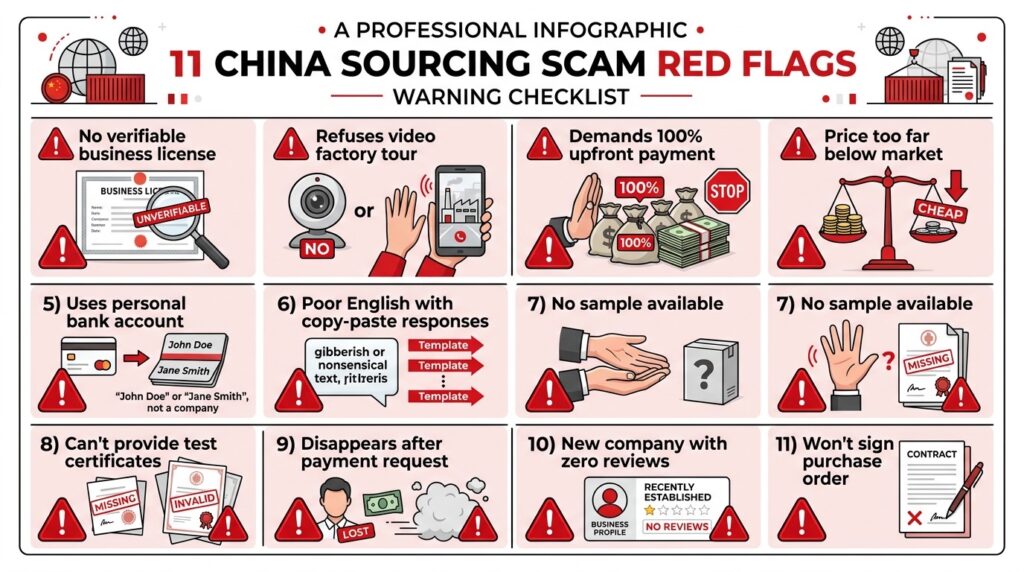
Diese Fälle betreffen unterschiedliche Produktkategorien, verschiedene Länder und unterschiedliche Beträge. Doch in jedem einzelnen Fall gab es mindestens eine Lücke im Kaufprozess des Käufers, die im Voraus erkennbar war:
Geschichte
Betrugsart
Vermeidbar durch
1. Phantom Factory
Identitätsbetrug
Überprüfung der Gewerbeanmeldung
2. Lockvogelangebot
Materialersatz
Prüfung vor dem Versand mit Materialübersicht
3. Weiterleitung zur Zahlung
Man-in-the-Middle
Telefonische Bestätigung bei Änderungen der Zahlungsdaten
4. Verschwundene Einzahlung
Scheingeschäftspartner
Kommunikation über die Plattform + Videoüberprüfung
5. Beispiel für einen Betrugsversuch
Betrug mit Vorauszahlungen
Bezahlen Sie den Restbetrag niemals ohne vorherige Überprüfung
6. Ersatz von Verpackungsmaterialien
Ausnutzung von Spezifikationslücken
Schriftliche Spezifikationen zu jedem wesentlichen Bestandteil
7. Fälschung von Zertifikaten
Urkundenfälschung
Direkte labortechnische Bestätigung von Untersuchungsberichten
None of these protections requires special expertise or expensive tools. Each one costs less than an hour to apply. The cost of not applying them is visible in the numbers above.
Diese Geschichten sind fiktive Zusammenfassungen, die auf dokumentierten Betrugsfällen in Importeurskreisen, Branchenberichten und Fallstudien von Beschaffungsfachleuten basieren. Identifizierende Details wurden geändert. Die Finanzzahlen sind ungefähre Angaben.
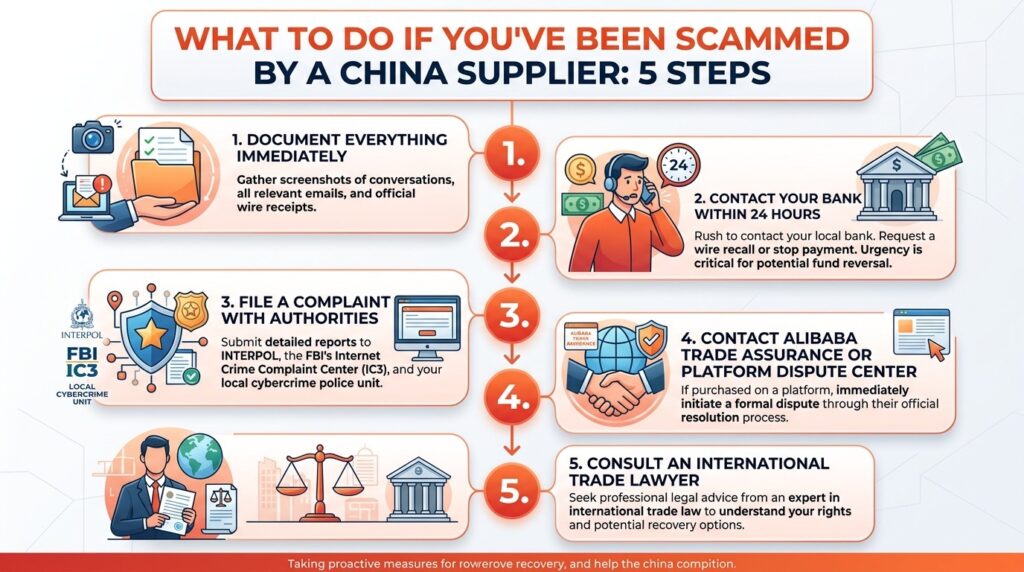
F: Kann man nach einem Betrugsfall bei der Beschaffung in China Geld zurückerhalten?#+
A: Recovery is possible but uncommon after 72 hours. Wire recalls initiated within 24–48 hours have the highest success rate — contact your bank immediately, provide all transaction details, and request an urgent wire recall. For amounts above $10,000, consult a lawyer familiar with international commercial fraud. Alibaba Trade Assurance provides meaningful recourse for transactions conducted within that system; transactions outside it have very limited platform protection.
F: Sind bestimmte Produktkategorien mit einem höheren Betrugsrisiko behaftet?#+
A: In den Bereichen Elektronik, Kinderprodukte sowie Gesundheit und Schönheit treten Zertifizierungsbetrug und Materialvertauschung am häufigsten auf, vor allem weil die Konformitätszertifizierung Druck ausübt, Abstriche zu machen. Bei generischen Konsumgütern (Verpackungen, Textilien, einfache Hardware) kommt es häufiger zu Identitätsbetrug und Betrugsmaschen mit „verschwindenden Pfandbeträgen“, die sich gegen Erstkäufer richten, die sich noch nicht angewöhnt haben, Produkte zu überprüfen.
F: Verhindert „Alibaba Trade Assurance“ all diese Szenarien?#+
A: „Trade Assurance“ bietet einen sinnvollen Schutz vor Betrug durch Zahlungsumleitung (Zahlungen gehen an Alibaba und nicht direkt an den Lieferanten) sowie vor Qualitätsstreitigkeiten (vorbehaltlich des Schlichtungsverfahrens). Es schützt Sie jedoch nicht vor „Bait-and-Switch“-Praktiken, bei denen Material ausgetauscht wird, das die Prüfung besteht, vor gefälschten Zertifikaten, die Ihre Qualitätskontrolle nicht erkannt hat, oder vor Abweichungen bei den Verpackungsspezifikationen, die auf schlecht formulierte Bestellungen zurückzuführen sind. Betrachten Sie es als eine Schutzebene, nicht als ein vollständiges System.
F: Kommen Betrugsfälle bei der Beschaffung aus China häufiger vor als bei der Beschaffung aus anderen Ländern?#+
A: China accounts for the largest volume of international sourcing, so it naturally accounts for the largest absolute number of fraud cases. The per-transaction fraud rate is not higher than other developing manufacturing regions. The difference is that China's sourcing ecosystem is sophisticated enough that fraudulent operators are skilled at mimicking legitimate business practices — which is why the verification steps described in these cases matter more, not less.
F: Wie kann ich überprüfen, ob ein Prüfbericht echt ist?#+
A: Contact the testing laboratory named on the report directly — use contact details from the laboratory's own website, not those provided by the supplier. Give them the certificate number, product name, and test date. They can confirm in writing whether they issued the report for that product. This takes one email and typically one business day.
F: Was ist die schnellste Maßnahme, die ich ergreifen kann, um das Betrugsrisiko zu senken?#+
A: Run the business license check first. It takes three minutes, costs nothing, and eliminates the largest category of first-contact fraud — the phantom factory. If the USCC code doesn't match the company you're talking to, the rest of the verification process is irrelevant. Start there every time.
SP
Verfasst von
Das SourcePilot-Team
Sourcing-Spezialisten für China, die KMU, Amazon-Verkäufer und Start-ups dabei unterstützen, geprüfte Fabriken zu finden, Preise auszuhandeln, die Qualität zu prüfen und Waren von China direkt bis vor die Haustür zu liefern. Haben Sie eine Frage zu diesem Thema? Fragen Sie unser Team.
Wir verwenden Cookies um Ihr Erlebnis auf unserer Website zu verbessern und die Besucherzahlen zu analysieren. Wenn Sie auf Akzeptieren, erklären Sie sich mit der Verwendung von Cookies gemäß den Angaben in unserer Datenschutzerklärung.