7 China Sourcing Scam Stories — And What Each Victim Learned
8 minuti di letturaA cura del team di SourcePilot
Seven real China sourcing fraud cases — each a different scam type, a different dollar amount, and a lesson experienced importers now apply to every order.
I numeri variano. Le categorie di prodotti cambiano. I paesi di provenienza degli acquirenti sono diversi in ogni caso. Ma la struttura delle storie di frodi nell’approvvigionamento dalla Cina è straordinariamente coerente: un fornitore che sembrava affidabile, un pagamento effettuato e poi un problema che si è rivelato irrisolvibile.
These are seven of those stories. They’re composites drawn from real reported cases — details changed to protect privacy, financial figures approximate. Each one involves a different type of fraud and a different gap in the buyer’s process. Each one ends with a lesson that costs nothing to apply going forward.
Story 1: The Phantom Factory — $28,000 Lost
L'ambientazione:
A UK-based online retailer found a ceramic cookware manufacturer through a Google search. The website was excellent — high-quality product photos, a detailed “About Us” page describing 12 years in the industry, testimonials. The email responses were prompt and professional.
Cosa è successo:
L'acquirente ha effettuato un ordine di 1.200 vasi in ceramica e ha versato un acconto del 30%, pari a 8.400 dollari. Tre settimane dopo, ha ricevuto un messaggio in cui si comunicava che la produzione era stata ritardata a causa della “manutenzione delle attrezzature”. Due settimane dopo, l'indirizzo e-mail ha smesso di rispondere. Il sito web è stato messo offline. Il numero di telefono rimandava a un cellulare cinese non funzionante.
A business license check — run after the fact — showed the 18-digit USCC code on the license image they’d been sent corresponded to a food distribution company in Henan province, not a cookware manufacturer in Guangdong.
Perdita totale: Deposito di 8.400 dollari (non rimborsabile).
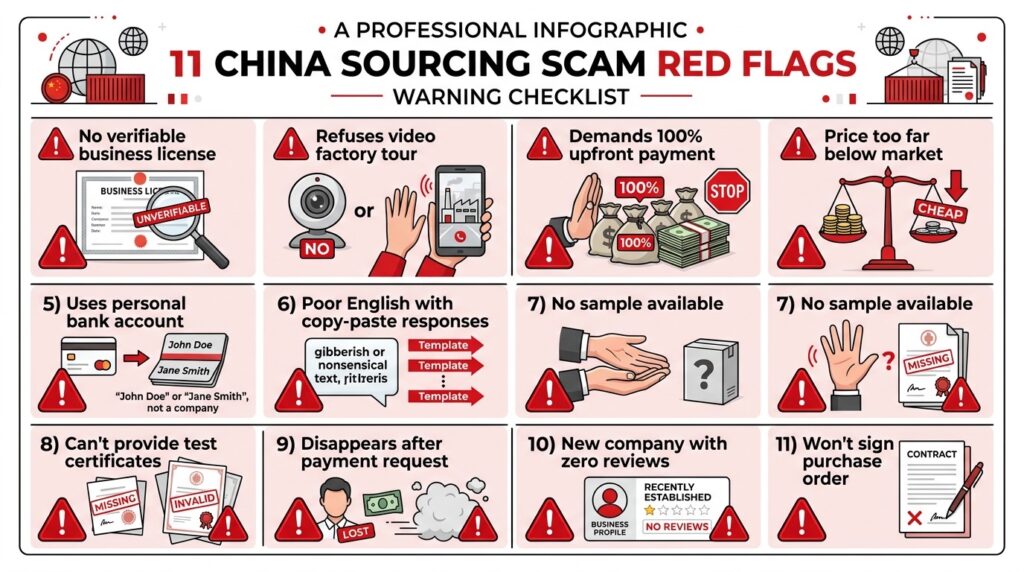
LA LEZIONE: Verify the business license before any payment. The 18-digit USCC code is publicly searchable at gsxt.samr.gov.cn in three minutes. A code that returns the wrong company type, the wrong province, or no result at all is a hard stop — not a reason to ask the supplier for clarification.
Story 2: The Quality Bait-and-Switch — $47,000 Absorbed
L'ambientazione:
A US Amazon seller sourced silicone baking mats from a Guangdong supplier they’d used once before for a small test order. The initial 200-unit sample order had been excellent — consistent thickness, proper food-grade certification documentation, clean printing.
Cosa è successo:
The follow-up 5,000-unit bulk order arrived 11 weeks later. Within the first week of Amazon FBA receiving, 23% of units were flagged for a quality defect: the logo printing was bleeding into the silicone surface under heat, creating a transfer that contaminated food surfaces. The defect was traced to a different silicone base compound used in the bulk run — a domestic-grade material substituted for the food-grade compound used in the sample.
Lo stabilimento ha riconosciuto la presenza di “alcune variazioni” e ha offerto uno sconto del 7% sul prossimo ordine. Non è stata effettuata alcuna ispezione pre-spedizione sulla produzione in serie.
Perdita totale: 10.810 dollari di scorte inutilizzabili (il 23% del valore dell'ordine pari a 47.000 dollari), più i costi di gestione dei resi su Amazon, più un ciclo di recensioni negative.
LA LEZIONE: A good sample doesn’t guarantee a good bulk order. Material substitution is the most common and hardest-to-detect quality fraud because it passes visual inspection. The fix is a pre-shipment inspection with a specific brief that includes material verification — not just cosmetic and functional checks. See our Guida all'ispezione pre-spedizione per sapere cosa inserire nel brief.
Story 3: The Payment Redirect — $78,000 Diverted
L'ambientazione:
Un importatore tedesco di mobili intratteneva da due anni rapporti commerciali con una fabbrica di Guangzhou produttrice di sedute imbottite. I pagamenti venivano sempre effettuati tramite bonifico bancario sullo stesso conto HSBC di Hong Kong.
Cosa è successo:
Three months into a new order cycle, the importer received an email from what appeared to be their regular supplier contact — same email address, same name, same signature — explaining that the company was restructuring their banking to a new account at a different Hong Kong bank. The email provided new account details and asked the buyer to use these for the forthcoming balance payment of $78,000.
L'importatore non ha chiamato per verificare. Il pagamento è stato effettuato. La vera fabbrica non l'ha mai ricevuto.
Un'analisi forense delle e-mail ha successivamente rivelato che l'account del fornitore era stato compromesso sei settimane prima. L'e-mail relativa al “reindirizzamento del pagamento” era stata inviata dall’indirizzo autentico, ma dall’autore dell’attacco, che aveva monitorato il traffico e-mail in attesa di intercettare un pagamento di importo elevato.
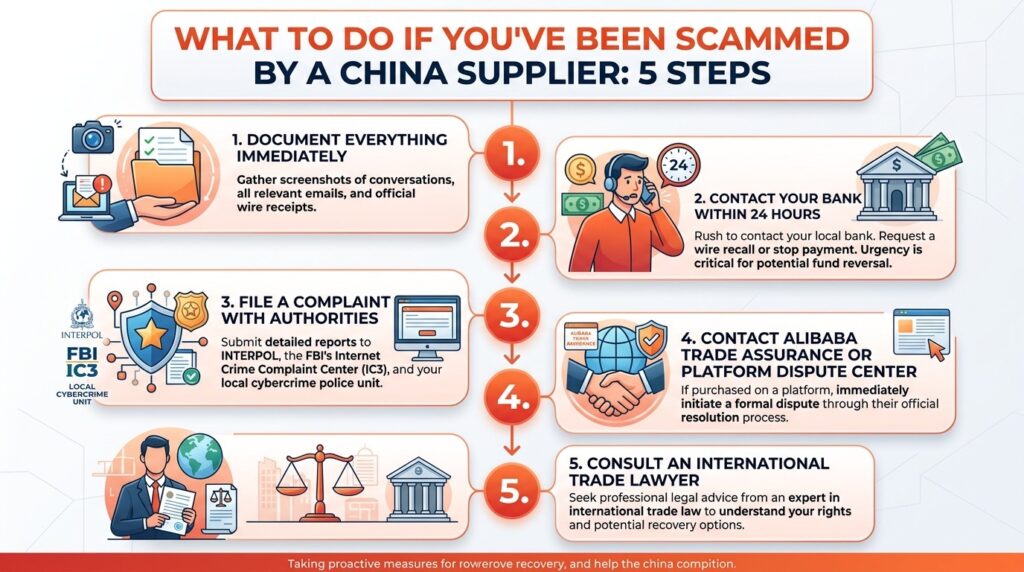
Perdita totale: $78,000 (partial recovery of $11,200 attempted via wire recall 96 hours after payment — largely too late).
LA LEZIONE: Any change to payment bank details must be confirmed by phone — calling the supplier’s verified, previously established contact number, not a number in the email requesting the change. This rule has no exceptions. Man-in-the-middle payment fraud is specifically designed to exploit long-established trust in email communication. The call takes 90 seconds.
Story 4: The Disappeared Deposit — $12,500 Gone
L'ambientazione:
Un marchio australiano di articoli per la casa ha trovato un produttore di mobili in rattan su Made-in-China.com. L'azienda era registrata sulla piattaforma da tre anni, aveva recensioni positive e proponeva prezzi competitivi per una collezione personalizzata di mobili da esterno.
Cosa è successo:
Dopo due settimane di trattative per l'approvazione dei campioni (i campioni erano stati inviati ed erano davvero di ottima qualità), l'acquirente ha effettuato un ordine di produzione per 400 unità e ha versato un acconto del 50%, pari a 12.500 dollari. La conferma della produzione è stata inviata due giorni dopo, con una data di completamento prevista a 45 giorni di distanza.
At day 40, the buyer sent a production progress inquiry. No response. At day 45, the buyer called the number on the business license. A different person answered — a private individual who said they’d never heard of the furniture company. The Made-in-China.com listing went offline within 48 hours of the buyer’s support ticket to the platform.
Perdita totale: $12,500 (full deposit, irrecoverable — Made-in-China’s dispute process found insufficient evidence of platform rule violations as the transaction had been conducted off-platform via WeChat).
LA LEZIONE: Conduct all business through the platform’s official messaging system, not WeChat or WhatsApp. Platform-based messaging creates a documented record that enables dispute resolution. Off-platform communication is private and gives you no case when the platform’s dispute team reviews what happened. Also: positive platform reviews and multi-year registration are necessary but not sufficient — combine them with business license verification and a video call.
Story 5: The Sample Scam — $3,200 and 14 Weeks
L'ambientazione:
A Canadian health and wellness brand was developing a custom supplement container — a specific shape, specific lid mechanism, BPA-free plastic. They found a plastics manufacturer in Zhejiang claiming OEM capabilities and requested a custom sample.
Cosa è successo:
The supplier quoted $800 for tooling fees and three custom samples. The buyer paid. Samples arrived at week six — well-made, matching the spec. The buyer placed a 3,000-unit production order and paid a 40% deposit.
At week 12, the supplier said production was “60% complete” and requested the 60% balance before shipping “to cover material costs.” The buyer — feeling the samples had proven quality — paid. At week 14, the supplier became unresponsive. No goods were ever shipped.
A reverse image search of the sample product photos later found identical images on five different supplier websites — the “custom sample” had been a stock product with the buyer’s label applied.
LA LEZIONE: Custom tooling should produce a verifiable paper trail — mold invoices, production photos, factory QC records. If a supplier can’t provide mid-production photos showing your specific product on the line, be skeptical of “60% complete” status updates. Never pay the balance before goods have been physically inspected and verified at the factory. Consider this a universal rule with no exceptions.
Story 6: The Packaging Substitution — $19,000 Absorbed
L'ambientazione:
Un marchio statunitense di e-commerce specializzato nella vendita di prodotti per la cura personale ha commissionato a un produttore di imballaggi di Shanghai la realizzazione di scatole da imballaggio personalizzate. Il campione approvato: una specifica carta kraft non patinata con una particolare finitura tattile, elemento fondamentale per il posizionamento premium del marchio.
Cosa è successo:
L'ordine di produzione (10.000 unità, 19.000 dollari) è arrivato nei tempi previsti. Una volta aperte le scatole, si è scoperto che erano state stampate su carta patinata standard, anziché sulla carta kraft specificata. La finitura superficiale era lucida anziché opaca. Le dimensioni erano corrette. La stampa era corretta. La carta no.
The factory’s position: “The artwork specifications didn’t specify paper type — we used a comparable alternative.” Review of the purchase order revealed no explicit paper specification had been included. The buyer had assumed the sample paper would be matched.
Perdita totale: 19.000 dollari in imballaggi che non potevano essere utilizzati per il lancio senza compromettere il posizionamento del marchio, oltre ai costi di ristampa.
LA LEZIONE: Approved samples must be accompanied by written specifications — paper type, weight, surface treatment, finish, dimension tolerances. “Make it like the sample” is not a specification. Anything that matters must be written down with measurable parameters. The factory will manufacture to what’s on paper; what’s in your head doesn’t count.
Story 7: The Certification Forgery — $120,000 and a Market Exit
L'ambientazione:
A UK electrical accessories importer sourced a range of smart home devices — switches, dimmers, smart plugs — from a Shenzhen electronics manufacturer. The supplier provided CE certification documents and test reports from what appeared to be an accredited testing laboratory.
Cosa è successo:
Eighteen months after market entry, a UK trading standards investigation prompted by a consumer complaint found that the CE marks on the products were self-declared rather than third-party certified, and that the test reports had been falsified — the laboratory named on the reports confirmed they had never tested the specific products. Several units had exhibited overheating under load testing.
L'importatore ha dovuto affrontare un richiamo del prodotto, sanzioni amministrative e l'esclusione definitiva dal settore degli accessori elettrici. Il fornitore, nel frattempo, si era già registrato nuovamente con una nuova denominazione sociale.
Perdita totale: Estimated £95,000+ in recall costs, fines, inventory write-off, and legal fees. Market reputation: permanently damaged in the category.
LA LEZIONE: For regulated products (electrical, children’s items, medical, food contact), never accept supplier-provided test reports at face value. Contact the named testing laboratory directly and ask them to confirm the certificate number and test date. Third-party certification by an accredited body (SGS, TÜV, Intertek, Bureau Veritas) means the certifier’s own reputation is attached to the document. Self-declared certificates mean nothing. This verification takes one email and one day.
Il filo conduttore che accomuna tutte e 7 le storie
Queste storie riguardano diverse categorie di prodotti, diversi paesi e importi in dollari diversi. Tuttavia, in ognuna di esse era presente almeno una lacuna nel processo di acquisto che era possibile individuare in anticipo:
Storia
Tipo di frode
Prevenibile con
1. Phantom Factory
Frode d'identità
Verifica della licenza commerciale
2. Pubblicità ingannevole
Sostituzione dei materiali
Ispezione pre-spedizione con scheda tecnica del materiale
3. Reindirizzamento del pagamento
Attacco "man-in-the-middle"
Conferma telefonica di eventuali modifiche ai dettagli di pagamento
4. Deposito scomparso
Fornitore fantasma
Comunicazione sulla piattaforma + verifica video
5. Esempio di truffa
Frode relativa al pagamento anticipato
Non pagare mai il saldo senza aver prima effettuato un controllo
6. Sostituzione dell'imballaggio
Sfruttamento delle lacune nelle specifiche
Specifiche scritte relative a ogni elemento materiale
7. Falsificazione di certificati
Falsità in documenti
Conferma diretta in laboratorio dei risultati delle analisi
None of these protections requires special expertise or expensive tools. Each one costs less than an hour to apply. The cost of not applying them is visible in the numbers above.
Queste storie sono il risultato di una sintesi di casi di frode documentati provenienti dalle comunità degli importatori, da rapporti di settore e da casi di studio di professionisti dell’approvvigionamento. I dettagli identificativi sono stati modificati. I dati finanziari sono approssimativi.
D: È possibile recuperare il denaro in caso di frode nell'approvvigionamento dalla Cina?#+
A: Recovery is possible but uncommon after 72 hours. Wire recalls initiated within 24–48 hours have the highest success rate — contact your bank immediately, provide all transaction details, and request an urgent wire recall. For amounts above $10,000, consult a lawyer familiar with international commercial fraud. Alibaba Trade Assurance provides meaningful recourse for transactions conducted within that system; transactions outside it have very limited platform protection.
D: Esistono categorie di prodotti che presentano un rischio maggiore di frode?#+
R: I settori dell’elettronica, dei prodotti per l’infanzia e della salute/bellezza registrano il più alto numero di casi di frodi relative alle certificazioni e di sostituzione dei materiali, principalmente perché le certificazioni di conformità creano una pressione a prendere scorciatoie. I beni di consumo generici (imballaggi, tessuti, articoli di ferramenta di base) sono invece più esposti a frodi relative all’identità e a truffe basate sulla scomparsa del deposito, che prendono di mira gli acquirenti alle prime armi che non hanno ancora sviluppato l’abitudine a verificare i prodotti.
D: Alibaba Trade Assurance previene tutte queste situazioni?#+
R: Trade Assurance offre una protezione significativa contro le frodi legate al reindirizzamento dei pagamenti (i pagamenti vengono versati ad Alibaba anziché direttamente al fornitore) e le controversie relative alla qualità (soggette a procedura di risoluzione). Non ti protegge, invece, dalla sostituzione del materiale con prodotti diversi da quelli promessi che superano l’ispezione, dalla falsificazione delle certificazioni che il tuo controllo qualità non ha individuato, né dalle discrepanze nelle specifiche di imballaggio derivanti da ordini di acquisto redatti in modo inadeguato. Consideralo come un ulteriore livello di protezione, non come un sistema completo.
D: Le frodi nell'approvvigionamento dalla Cina sono più comuni rispetto a quelle relative all'approvvigionamento da altri paesi?#+
A: China accounts for the largest volume of international sourcing, so it naturally accounts for the largest absolute number of fraud cases. The per-transaction fraud rate is not higher than other developing manufacturing regions. The difference is that China's sourcing ecosystem is sophisticated enough that fraudulent operators are skilled at mimicking legitimate business practices — which is why the verification steps described in these cases matter more, not less.
D: Come posso verificare se un rapporto di prova è autentico?#+
A: Contact the testing laboratory named on the report directly — use contact details from the laboratory's own website, not those provided by the supplier. Give them the certificate number, product name, and test date. They can confirm in writing whether they issued the report for that product. This takes one email and typically one business day.
D: Qual è la misura più rapida che posso adottare per ridurre il rischio di frode?#+
A: Run the business license check first. It takes three minutes, costs nothing, and eliminates the largest category of first-contact fraud — the phantom factory. If the USCC code doesn't match the company you're talking to, the rest of the verification process is irrelevant. Start there every time.
SP
Scritto da
Il team di SourcePilot
Specialisti nel sourcing dalla Cina che aiutano le PMI, i venditori su Amazon e le startup a trovare fabbriche verificate, negoziare i prezzi, controllare la qualità e spedire dalla Cina direttamente a domicilio. Hai qualche domanda su questo argomento? Chiedi al nostro team.
Utilizziamo i cookie per migliorare la tua esperienza sul nostro sito e analizzare il traffico. Cliccando su Accetta, acconsenti all'uso dei cookie da parte nostra, come descritto nella nostra Informativa sulla privacy.