Smartwatches, fitness bands, and other wearables combine three compliance challenges at once: wireless radio certification, lithium battery safety, and skin-contact material regulations — since these products are worn directly against skin for extended periods.
Certificazione radio e di connettività
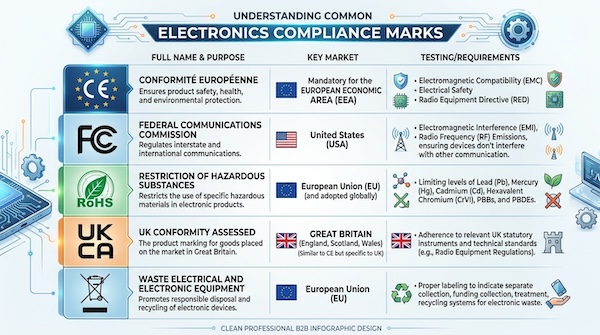
Any Bluetooth or Wi-Fi enabled wearable needs FCC certification for the US and CE/RED (Radio Equipment Directive) for the EU. Shenzhen wearable factories almost always use pre-certified Bluetooth modules, which simplifies your own certification since the radio component is already approved — you’re mainly certifying the finished device assembly.
Sicurezza relativa alle batterie e alla ricarica

Wearables use small lithium-polymer cells, which still require UN38.3 testing for shipping and, for the US market, UL 2054 or IEC 62133 battery safety certification. Wireless charging components add an additional layer — confirm Qi certification if you’re marketing wireless charging as a feature.
Conformità dei materiali a contatto con la pelle
Watch bands and device housings that touch skin for extended periods should be tested for nickel release (especially relevant in the EU under REACH) and general skin sensitization. This is frequently overlooked by importers focused only on electronics compliance, but it’s a real liability and return-rate issue — cheap metal buckles are a common source of skin irritation complaints.
Domande frequenti
È sufficiente la certificazione FCC o serve anche la certificazione CE per i dispositivi indossabili?
You need both if you’re selling in both markets — FCC covers the US, CE (specifically the RED directive) covers the EU. They test different things and neither substitutes for the other.
È necessaria una certificazione separata per la batteria se la cella stessa è già stata sottoposta ai test previsti dalla norma UN38.3?
Sì. La norma UN38.3 riguarda il trasporto in sicurezza; la norma UL 2054/IEC 62133 riguarda la sicurezza della batteria utilizzata nel prodotto finito. In genere sono richieste entrambe.
Quanto è diffusa l'allergia al nichel tra i dispositivi indossabili?
È un fenomeno talmente diffuso che il regolamento REACH dell’UE stabilisce un limite specifico di rilascio di nichel per qualsiasi prodotto che entri in contatto prolungato con la pelle. Vale la pena testare i componenti metallici anche se il vostro obiettivo principale in materia di conformità riguarda il settore dell’elettronica.