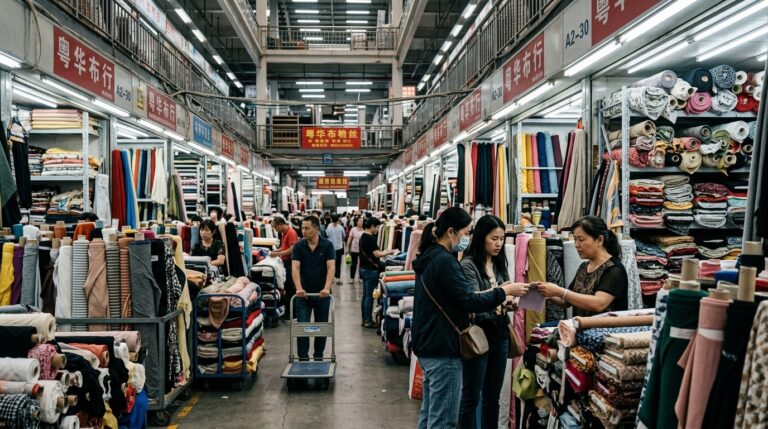
Clothing sourcing from China has a learning curve that catches most first-time buyers off guard. The challenges aren’t unique to China — they apply anywhere you’re sourcing garments — but China’s scale and the volume of new buyers entering the market means the mistakes show up repeatedly: sizing charts that don’t translate to your market, fabric substitutions that don’t emerge until bulk production, and label compliance gaps that create customs problems.
This guide covers the full process: where China’s garment manufacturing is concentrated, how to select a factory appropriate for your product, the specific risks in clothing sourcing that don’t apply to other product categories, and what to do about each of them.
China’s Garment Manufacturing Clusters
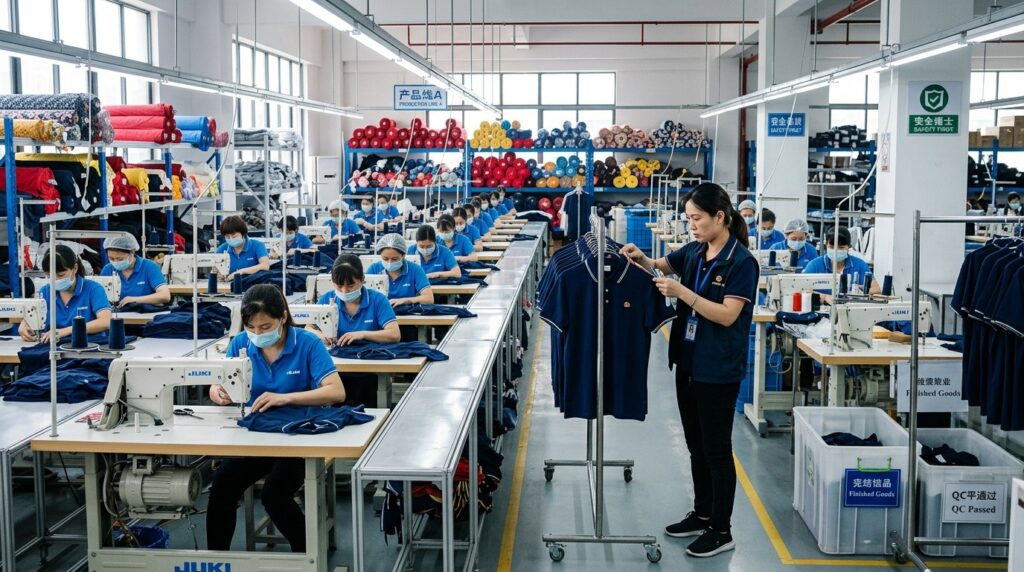
Garment manufacturing in China is geographically concentrated. The cluster you need depends on what you’re making.
| Region | Specialization | Notable For |
|---|---|---|
| Guangzhou (Guangdong) | Fast fashion, women’s wear, street fashion | High turnover, design-forward, many small-batch factories |
| Hangzhou / Shaoxing (Zhejiang) | Silk, high-end fabrics, premium garments | China’s traditional silk production center |
| Changshu / Suzhou (Jiangsu) | Outerwear, down products, functional clothing | Heavy winter garments, technical fabrics |
| Qingdao (Shandong) | Denim, workwear, casual wear | Strong on fabric manufacturing, export experience |
| Ningbo (Zhejiang) | Men’s suits, formal wear, export-focused manufacturers | Long history of high-quality tailored goods |
| Keqiao (Zhejiang) | Fabric wholesale | China Textile City — largest fabric market in the world |
Practical implication: If you’re sourcing basic fashion knitwear, Guangzhou manufacturers with Alibaba presence will serve you. If you’re developing a technical outdoor jacket, you need Jiangsu factories with functional fabric expertise. If you’re sourcing high-end silk, Hangzhou is the relevant starting point. Sourcing the wrong factory type for your product category adds quality and production risk before the first sample is cut.
Step 1: Define Your Product Before Finding a Factory
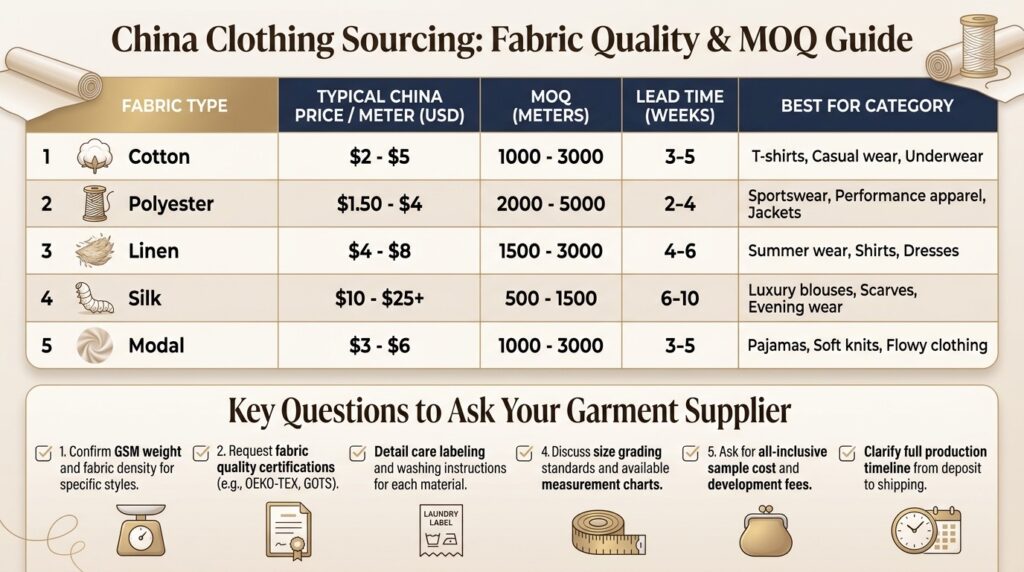
The most common clothing sourcing mistake is approaching factories before having a complete product definition. Unlike generic commodity products, garments require specification on multiple variables before meaningful factory communication is possible:
Your tech pack (technical package) should define:
– Silhouette and construction (with reference images or technical drawings)
– Fabric composition (e.g., “95% Pima cotton, 5% elastane, 180gsm jersey”)
– Color specification (Pantone number — not “navy” or “forest green”)
– Sizing system (US, UK, EU, or custom) and size run (XS–3XL)
– Grading rules (how dimensions change between sizes)
– All trims (buttons, zippers, labels, drawcords) — material, size, color
– Label requirements (country of origin, fiber content, care instructions per target market)
– Quality standards (stitch count per inch, seam allowance, allowable defect rate)
A factory cannot give you an accurate quote without this information. Quotes received without a tech pack are essentially meaningless — the factory is estimating based on assumptions, and those assumptions rarely match your actual requirements.
Step 2: Understand Sizing — The Most Common Hidden Problem
Chinese sizing standards (GB/T 1335) use body measurements that don’t map directly to US, EU, or UK sizing conventions. A garment labeled “L” by a Chinese factory may correspond to a US Medium in chest circumference.
The risk: If you order based on Chinese size labels and sell in a Western market without conversion, you will have returns — potentially a lot of them.
The solution has two parts:
Part 1 — Provide your own grading chart. Give the factory your actual target measurements in centimeters for each size in your run. Don’t rely on the factory’s “standard” sizing. Your tech pack’s measurement sheet should specify chest width, body length, sleeve length, and all other critical dimensions for each size, with tolerances (typically ±1–1.5cm).
Part 2 — Fit review on pre-production samples. Before approving production, have samples graded to your full size run (or at minimum, small and large endpoints) physically worn and fit-tested. Fit testing on a form (fit model) catches problems that flat measurement alone misses.
Step 3: Fabric — The Most Common Quality Betrayal
Fabric substitution is the most damaging quality issue in garment sourcing — and the hardest to catch without testing.
How it happens: You specify “polyester fleece, 280gsm.” The factory’s regular fabric supplier raises prices or runs out of stock. A substitute supplier offers a 260gsm fleece at lower cost. The factory uses it — the fabric looks similar, the weight difference isn’t visible to the eye, and unless you weigh the fabric, you won’t know until your customers notice that the product is thinner than expected.
Prevention:
– Specify fabric weight, composition, and weave type in your tech pack and purchase order
– Request fabric lab test reports (GSM test, fiber content test by spectrometer) from your inspector
– Retain a cutting from your approved pre-production sample as a physical reference for the inspection company
– Include fabric cut-sample verification as a specific line item in your pre-shipment inspection brief
Lab fabric testing adds approximately $50–150 per sample per test — a fraction of the cost of a production run of garments that don’t match specification.
Step 4: Label Compliance — A Customs and Legal Issue
Labeling requirements for imported clothing vary by destination market and are legally mandated, not optional. Selling non-compliant garments can result in goods being held at customs, fined, or recalled from retail.
US Label Requirements (FTC Regulations)
- Fiber content (exact percentages, regulated fiber names — e.g., “cotton” not “soft cotton”)
- Country of origin (“Made in China”)
- Care instructions (symbols per ASTM D5489 or written instructions)
- Manufacturer/dealer identity (RN number or company name)
EU Label Requirements (EU Textile Regulation 1007/2011)
- Fiber content in all EU official languages of the destination country (or universally with ISO codes)
- Country of origin (optional in EU but increasingly required by retailers)
- Care instructions using ISO 3758 symbols
UK (Post-Brexit) Requirements
- Same fiber content and care instruction requirements as EU
- UK-specific address for responsible person on label (no longer EU-only acceptable)
Practical approach: Provide the factory with the exact label content in the format you need. Don’t ask the factory to generate labels from a description — supply the artwork, the specific text, and confirm via sample review that the label matches exactly before production.
Step 5: The Sample Development Process
Clothing samples go through multiple rounds before production approval:
Round 1 — Proto sample (prototype):
The factory’s first attempt at your design, using available fabrics (not necessarily your specified materials). Goal: confirm construction and silhouette interpretation. Not for evaluation of final quality.
Round 2 — Fit sample:
Made to your specified fabric or closest available substitute. Used for fit testing on your target body (fit model or mannequin). Dimensions measured against your tech pack. Issues noted and corrections specified.
Round 3 — Pre-production sample (PPS) / Golden sample:
Made with confirmed production materials from the actual production fabric lot. This sample must match your full specifications. When approved in writing, it becomes the production standard against which all QC is measured.
Timeline: A typical proto-through-PPS cycle takes 4–8 weeks with a cooperative factory. Rush timelines are possible but add cost.
Cost: Sample costs range from $20–200+ per piece depending on complexity. Most factories charge for samples (unlike some commodity product suppliers). For complex designs, factor sample development costs into your product launch budget.
Common Pitfalls Specific to Clothing Sourcing
Colorfastness failures: A color that looks correct in the sample may bleed or fade after washing. Request wash test (colorfastness to washing, ISO 105-C06) results before approving production — particularly for vibrant or dark colors that are high-risk for bleeding.
Shrinkage: Many factories do not pre-wash fabric before cutting. Garments may shrink 3–8% after consumer washing. Include shrinkage allowance in your tech pack dimensions, and specify pre-washing requirements if your product positioning requires it.
Pilling: Low-quality fleece, acrylic, and polyester blends pill quickly with wear. Request pilling test results (Martindale or ICI Pilling Box method) if durability is relevant to your brand positioning.
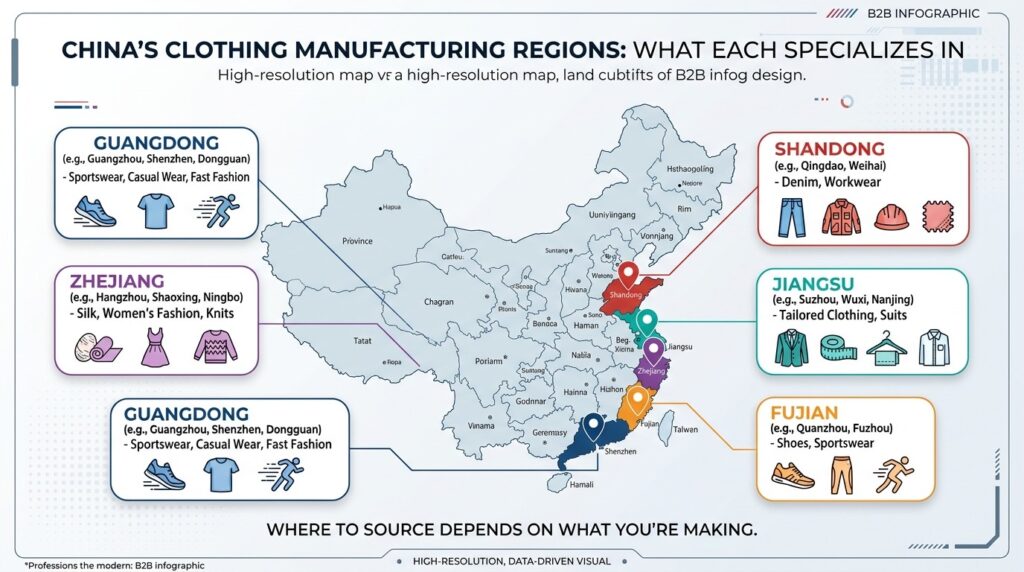
Minimum order quantity reality: Chinese garment factories typically have MOQs of 100–500 pieces per style per colorway, with some large factories requiring 1,000+. Small designers testing new styles can often work with smaller Guangzhou cut-and-sew operations (30–100 pcs per style) at higher per-unit cost.
If you need help selecting a Chinese garment factory, reviewing tech packs, or managing production quality for a clothing line, our sourcing team works across all major garment manufacturing regions.
Related reading → China Quality Control: The Complete 2026 Guide for Importers
Related reading → Pre-Shipment Inspection in China: What Gets Checked