The economics of Shopify sourcing from China are different from Amazon FBA in ways that matter for every sourcing decision you make.
On Amazon, the listing environment is competitive and commoditized. Price, reviews, and search rank determine visibility. Your product competes directly with hundreds of alternatives, often including the factory that makes it selling under their own brand.
On Shopify, you own the customer relationship. If someone visits your store, they’re already interested in your brand. The conversion question is about experience, trust, and brand fit — not just price vs. competitor price. That shifts where sourcing quality matters most: not lowest unit cost, but packaging, brand presentation, product consistency, and customer experience on unboxing.
This guide covers sourcing for Shopify specifically — what’s different, what to optimize for, and how to build a supply chain that supports brand-driven DTC growth.
The Shopify Sourcing Model: What You’re Actually Building
Before supplier selection, be clear on your model:
Private Label: You source products from Chinese factories, brand them with your own identity, and sell under your own brand name. The factory makes the product; you own the customer relationship and the brand.
Custom OEM: You work with Chinese factories to develop a product that’s meaningfully different from what the factory already makes — different formulation, different design, different functionality. Higher cost and longer development timeline, but higher defensibility.
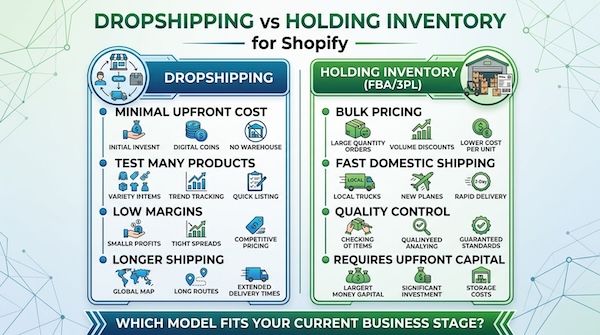
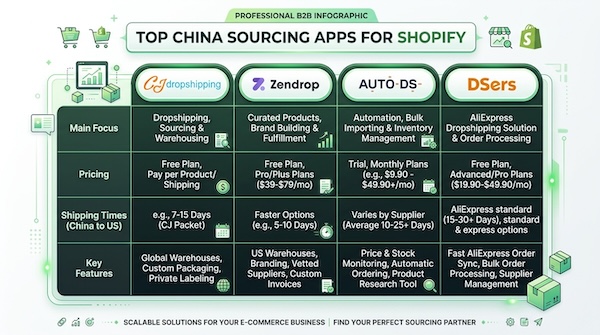
Dropshipping (from Chinese suppliers): You list products on your Shopify store without holding inventory; when an order comes in, a third-party supplier ships directly to your customer. Low upfront cost, but very limited control over product quality, shipping speed, and brand experience.
The honest assessment of each model:
– Dropshipping works for testing product-market fit but fails as a sustainable brand model. Shipping times (15–30 days from China), packaging you can’t control, and product quality you can’t verify consistently undermine the brand experience that Shopify is built to support.
– Private label with inventory is the model that scales. You have quality control, you have branded packaging, and you have the margins to invest in customer acquisition.
– Custom OEM is the premium tier — justified once you have validated demand and the budget to invest in product development.
What Chinese Suppliers Can and Can’t Do for Shopify Brands
What They Do Well
Branded packaging at scale: Chinese packaging manufacturers can produce custom-printed mailer boxes, tissue paper, thank-you cards, ribbon, and product boxes to your exact specification at prices that make premium packaging economics work for DTC brands. A branded mailer box that costs $0.35–0.60/unit from a Guangdong packaging supplier would cost $1.20–2.00+ from a comparable Western supplier.
Product customization: Most Chinese factories offer standard OEM services — your logo on their existing product line, your color choices, your packaging spec. True ODM (meaningful product differentiation) requires more investment but is available from factories with engineering capability.
Consistent production quality: At the right factory tier for your product, Chinese manufacturing quality is highly consistent — often more consistent than artisan or small-batch production because it’s managed by documented QC processes.
Where They Create Challenges for Shopify
Long lead times vs. fast trend cycles: If your Shopify store is trend-driven (seasonal, fast fashion, reactive to social media trends), China’s 45–90 day production cycle is a mismatch. For evergreen products with predictable reorder cycles, this isn’t an issue.
Minimum order quantities vs. inventory risk: Factory MOQs of 200–1,000 units require upfront inventory commitment before you’ve validated demand. This is the primary financial risk for early-stage Shopify brands.
Shipping complexity for DTC fulfillment: You need to get goods from China into your fulfillment infrastructure — either a 3PL warehouse in your home market or FBA if you’re cross-channel. This adds time and cost that direct-to-consumer brands need to factor into their landed cost.
Step-by-Step: Setting Up China Sourcing for Your Shopify Store
Step 1: Define Your Product Specification Before Supplier Outreach
Every supplier conversation starts better with a clear brief. For Shopify sourcing, your specification should include:
- Core product specification (dimensions, materials, colors, features)
- Brand packaging specification (box style, print finish, inserts, tissue paper)
- Labeling requirements (country of origin, care instructions if applicable)
- Quality standards you require
- Target landed cost — work backward from your retail price to determine what your COGS budget is
Without this, supplier quotes are not comparable, and factory relationships start with misaligned expectations.
Step 2: Choose the Right Supplier Type
For established product categories with good off-the-shelf quality:
Find an Alibaba-listed factory or trading company with relevant experience. Look for suppliers who’ve worked with DTC brands before — they understand branded packaging requirements, can coordinate with your designer, and know what “unboxing experience” means.
For products requiring meaningful customization:
Either a factory with OEM/ODM capability (confirmed by reviewing their existing OEM clients’ product portfolios) or a China sourcing agent who can find the right factory for your brief.
For a multi-SKU store:
Consider a sourcing agent who can coordinate multiple factories under one roof — consolidated shipping, single point of contact, and consistent quality oversight across different product categories.
Step 3: Packaging — Where Shopify Brands Win or Lose
For DTC brands, packaging is the first physical brand touchpoint. It’s worth investing in.
What to specify to your Chinese packaging supplier:
– Box style (mailer box, rigid box, folding carton)
– Material and weight (350gsm vs. 450gsm board makes a tactile difference)
– Print finish (matte lamination, soft-touch coating, spot UV)
– Custom inserts (foam inserts for product protection, printed card inserts for brand storytelling)
– Tissue paper and ribbon if used
Packaging suppliers vs. product suppliers: Your product factory and your packaging supplier may be different companies. Coordinating them is part of the sourcing process — or something a sourcing agent handles on your behalf.
Cost reality: Custom branded mailer box (medium size, matte finish, 500-unit run): $0.45–0.80/unit. At 2,000+ units: $0.30–0.50/unit. Tissue paper (branded): $0.08–0.15/sheet. Printed thank-you card: $0.05–0.12/card. Full branded unboxing setup adds $0.50–1.20/unit to your COGS — often worth it for the brand impact.
Step 4: First Order Strategy — Validate Before You Scale
For Shopify brands, the validation question is different from Amazon: you’re not just validating product demand, you’re validating that your target customer responds to this brand, product, and price combination.
Recommended first order approach:
– Order minimum viable quantities (250–500 units) for your first product validation
– Get your full branded packaging on the first order — don’t test with plain packaging and add branding later; the brand experience is part of what you’re testing
– Run a pre-shipment inspection on every first order — see our inspection guide for what to cover
– Plan your reorder threshold before the first order arrives — you need to place the reorder before you run out, which means understanding your lead time and sales velocity
Step 5: Fulfillment from China to Your Customers
Option A — Direct from factory to your 3PL:
Your Chinese factory ships to your warehouse or 3PL fulfillment center. You control fulfillment and customer experience. Best for brands with consistent demand and established fulfillment partners.
Option B — Cross-dock via a China prep service:
Some China-based services receive your goods, apply any final touches (stickers, inserts, additional packaging), and ship either to your 3PL or directly to customers via international express (DHL/FedEx). Useful for brands not yet ready to manage bulk import.
Option C — Bonded warehouse with cross-border e-commerce:
Some brands use Chinese bonded warehouse infrastructure to ship directly to international customers with simplified customs treatment. This has grown significantly since 2020 — Chinese logistics companies offer this as a service for DTC brands wanting to sell to Chinese consumers from outside, or vice versa.
The Economics: Making China Sourcing Work for DTC Margins
A healthy DTC margin structure on a Shopify store typically looks like:
| Cost Element | % of Selling Price |
|---|---|
| COGS (product + packaging) | 20–30% |
| Shipping + fulfillment | 10–15% |
| Customer acquisition | 20–35% |
| Platform/payment fees | 3–5% |
| Gross Margin | 25–40% |
For this math to work with China sourcing, your China landed cost (product + packaging + freight + duties) needs to be in the 20–30% range. That means your total landed cost per unit should be approximately 1/4 to 1/3 of your retail price.
If your retail price is $45 and you’re paying $18/unit landed, your COGS is 40% — that’s tight for a DTC brand with meaningful customer acquisition costs. If you’re paying $10/unit landed, you have room.
This is why product and price selection is the primary strategic decision — not just finding the cheapest supplier within a category.
Building a Shopify brand with China-sourced products? Our sourcing team works with DTC brands on supplier selection, branded packaging, quality control, and ongoing supply chain management.
Related reading → Amazon FBA Sourcing from China: The Complete 2026 Roadmap
Related reading → How to Get Product Samples from Chinese Manufacturers