For decades, many businesses relied heavily on China for manufacturing.
The formula was simple:
Find suppliers in China, scale production, and reduce costs.
For many companies, this strategy worked extremely well.
But recent years changed how businesses think about sourcing.
Supply chain disruptions, rising labor costs, tariffs, and geopolitical uncertainty have pushed companies to ask a new question:
“Should we depend on only one country for manufacturing?”
This shift has made the China + 1 strategy increasingly popular.
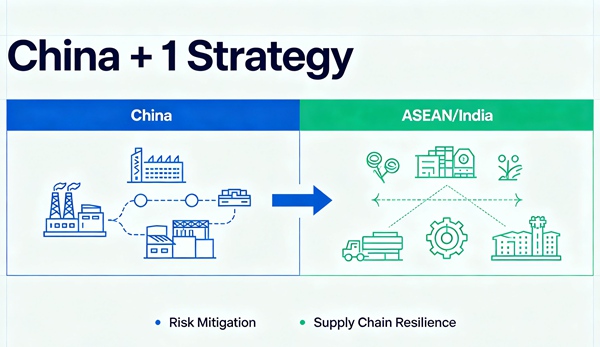
Instead of leaving China completely, businesses diversify production by adding at least one additional sourcing country.
But is this strategy right for every company?
Not necessarily.
What Is the China + 1 Strategy?
The China + 1 strategy refers to a sourcing approach where businesses continue manufacturing in China while adding another country to reduce dependency.
Instead of moving production entirely, companies diversify risk.
For example:
A business may:
- Source electronics from China
- Manufacture packaging in Vietnam
- Produce selected product lines in India
The idea is simple:
Avoid relying too heavily on one manufacturing location.
For many businesses, this improves supply chain flexibility.
If you’re evaluating China sourcing overall, read: China Sourcing in 2026: Is Manufacturing in China Still Worth It?
Why Businesses Are Diversifying Manufacturing
Several factors are driving manufacturing diversification.
Supply Chain Risk
Recent disruptions exposed vulnerabilities.
Factory shutdowns, shipping delays, and material shortages reminded businesses that concentrated sourcing carries risk.
Rising Manufacturing Costs
China is no longer always the lowest-cost option.
Labor and operating costs have increased in some sectors.
For labor-intensive products, alternatives may offer pricing advantages.
Tariffs and Trade Policies
Import tariffs can significantly affect profitability.
Some businesses diversify sourcing to reduce exposure.
Geographic Flexibility
Different regions support different business needs.
For example:
Manufacturing closer to customers may reduce lead time.
Investor and Customer Expectations
Some companies diversify sourcing for strategic resilience.
Especially larger brands.
Benefits of the China + 1 Strategy
Manufacturing diversification offers several advantages.
Reduced Supply Chain Risk
Depending on one country creates vulnerability.
Multiple sourcing locations improve flexibility.
Greater Cost Flexibility
Different countries may offer better pricing depending on:
- Labor intensity
- Product category
- Shipping destination
Better Capacity Management
Additional suppliers can support scaling.
Especially during high-demand periods.
Improved Negotiation Leverage
Multiple sourcing options may improve supplier flexibility.
Read: How to Negotiate Better Pricing With Suppliers Without Hurting Relationships
Stronger Business Continuity
Unexpected disruptions become easier to manage.
Diversification increases resilience.
Challenges of Manufacturing Diversification
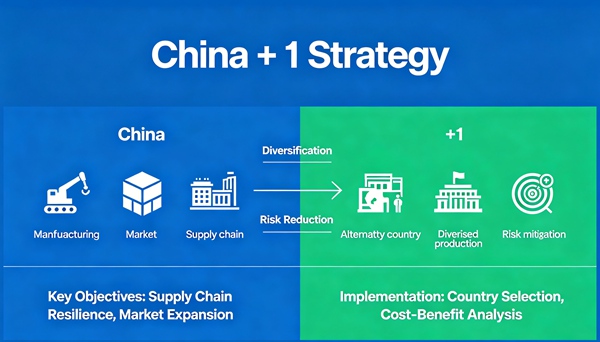
China + 1 is not always simple.
Businesses often underestimate complexity.
More Supplier Management
More countries often mean:
- More communication
- More logistics
- More coordination
Managing multiple suppliers takes time.
Quality Consistency Challenges
Different factories may produce products differently.
Strong quality standards matter.
Read: Quality Inspection in Manufacturing
Higher Operational Complexity
Managing customs, timelines, and documentation across countries increases workload.
Limited Supplier Ecosystems
Some countries still lack China’s manufacturing depth.
This matters for:
- Complex products
- Multi-component products
- Fast scaling
Which Countries Are Popular Alternatives?
Businesses exploring China + 1 often evaluate several markets.
Vietnam
Popular for:
- Consumer goods
- Furniture
- Apparel
Often competitive for labor-intensive products.
India
Growing manufacturing capabilities.
Strong in selected industries.
Mexico
Often attractive for North American businesses due to geographic proximity.
Thailand and Malaysia
Useful for certain manufacturing sectors.
Especially electronics.
There is no universal “best” alternative.
The right fit depends on product requirements.
When China Still Makes Sense
Despite diversification trends, China remains highly competitive.
China often still works best when businesses need:
Complex Manufacturing
Strong supplier ecosystems matter.
Fast Scalability
China handles large production efficiently.
Supplier Variety
Multiple supplier options improve flexibility.
OEM and Custom Manufacturing
Customization capabilities remain strong.
Read: OEM vs ODM Manufacturing
Leaving China entirely is not always necessary.
For many businesses:
China + 1 works better than China replacement.
Is China + 1 Right for Your Business?
The answer depends on business goals.
China + 1 may make sense if:
✔ Supply chain resilience matters
✔ Tariffs significantly affect cost
✔ You want geographic diversification
✔ Production risk feels too concentrated
But staying focused may make more sense if:
✔ Your supply chain already works well
✔ Product complexity is high
✔ China supplier ecosystems are essential
Diversification without strategy can increase cost.
Careful evaluation matters.
Final Thoughts
The China + 1 strategy is growing for good reason.
Businesses want more flexibility and resilience.
But diversification should be strategic.
Not emotional.
China still offers enormous manufacturing advantages.
For many companies, the smartest approach is not:
China or no China.
Instead:
China plus smarter diversification.
The best sourcing strategy depends on product complexity, risk tolerance, and long-term business goals.
Need Help Evaluating Global Manufacturing Options?
At SourcePilot Global, we help businesses:
✓ Evaluate sourcing strategies
✓ Find reliable global suppliers
✓ Diversify manufacturing responsibly
✓ Verify suppliers before production
✓ Reduce procurement risks
Looking for sourcing support? Contact our team to discuss your project.