The $34,000 Lesson One Importer Learned the Hard Way
In early 2023, a California-based furniture retailer placed a $140,000 order with a Guangdong factory. The factory quoted CIF Los Angeles — the buyer nodded, signed, and wired the deposit.
Three months later, a 40-foot container arrived at the Port of Los Angeles with 23 pieces visibly damaged. The buyer filed a claim. Then the real problem surfaced: the cargo insurance in the CIF quote was a bare-minimum policy arranged by the Chinese supplier through a domestic insurer with a $500 per-item cap. The buyer’s actual loss was $34,000. They recovered $4,200.
The root cause wasn’t the factory. It wasn’t even the shipping company. It was a two-word trade term the buyer never fully understood.
Incoterms — short for International Commercial Terms — are published by the International Chamber of Commerce (ICC) and revised periodically (the current version is Incoterms® 2020). They define who pays for shipping, who handles customs, and — critically — exactly where risk transfers from the seller to the buyer. Get them wrong and a single shipment can erase months of margin.
This guide explains the 7 Incoterms that matter most for China importers, gives you real numbers on what each one costs, and walks you through exactly which term to choose based on your situation.
Why Incoterms Matter More Than Most Buyers Realize
Most purchasing guides spend two paragraphs on Incoterms before moving on. That’s a problem, because the wrong term can:
- Leave you uninsured while cargo is on the ocean
- Make you responsible for Chinese export customs when you have no local presence
- Hand your supplier control over your freight costs and forwarder selection
- Create tax and VAT complications in your home country
There are 11 official Incoterms 2020 rules. Of those, 7 are commonly used in China trade. The remaining 4 (FAS, CPT, CIP, DPU) appear occasionally but rarely come up in standard factory-to-port freight negotiations. This guide focuses on the 7 you’ll actually encounter.
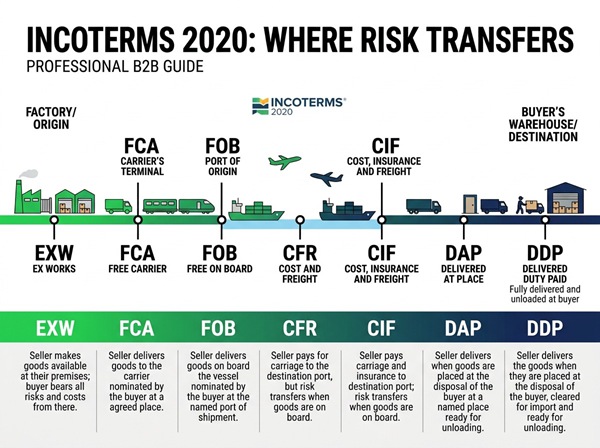
The 7 Key Incoterms for China Importers — Explained Simply
EXW — Ex Works
Risk transfers: At the factory gate (or named premises)
Who arranges inland freight to port: Buyer
Who handles Chinese export customs: Buyer
Who pays ocean freight: Buyer
Who insures the cargo: Buyer (entirely)
EXW is the maximum-responsibility option for the buyer. The seller’s job ends the moment goods are ready at their facility. You arrange every leg from the factory floor to your warehouse door — inland trucking, export documentation, port handling, ocean freight, import customs, final delivery.
The catch most buyers miss: Under EXW, you’re technically responsible for Chinese export clearance. If you don’t have a licensed customs broker or freight forwarder in China, you’ll need one. Many factories will “help” arrange this for a fee, but that puts you in a legally gray area where the factory is acting as your agent without a formal agreement.
Real cost impact: A shipment from a factory in Dongguan to the Port of Shenzhen for a 20′ container typically adds $180–$350 in local trucking on top of the EXW factory price. Add export documentation handling (often $80–$150 through a forwarder), and you’re looking at $260–$500 before the cargo even reaches the vessel.
Best for: Experienced importers who have an established China-based freight forwarder and want full control over carrier selection and routing.
Avoid if: You’re new to importing, you don’t have a China forwarder relationship, or your order is small enough that the complexity isn’t worth the marginal cost savings.
FCA — Free Carrier
Risk transfers: When goods are handed to the buyer’s nominated carrier at the named place
Who handles Chinese export customs: Seller
Who pays ocean freight: Buyer
Who insures the cargo: Buyer
FCA is the ICC’s recommended alternative to EXW for buyers who want the seller to handle export customs but still want control over the main carriage. In Incoterms 2020, FCA was updated specifically to accommodate Letter of Credit (L/C) requirements — a key change for buyers who use documentary credit.
Why FCA often beats EXW in practice: With FCA, the seller clears export customs. That’s significant. Export declarations in China require a licensed customs registrant, and handling this yourself as a foreign buyer adds friction. FCA removes that friction while still letting you choose your own freight forwarder and negotiate ocean freight rates directly.
Best for: Buyers using an L/C, buyers who want seller-handled export customs but still want to control ocean freight, air freight shipments.
FOB — Free On Board
Risk transfers: When goods are loaded on board the vessel at the named port of shipment
Who handles Chinese export customs: Seller
Who pays ocean freight: Buyer
Who insures the cargo: Buyer (once goods are on board)
FOB is the most commonly used Incoterm in China sourcing — and also the most frequently misunderstood. Under FOB, the seller handles everything up to and including loading the goods onto the ship at the named Chinese port. From that point, the buyer bears all risk.
The classic FOB misunderstanding: Many buyers (and some factories) think “FOB” means the seller is responsible until the cargo crosses the ship’s rail at the destination port. That’s the old pre-2010 interpretation. Under Incoterms 2010 and 2020, risk transfers once goods are loaded on board at the origin port.
What FOB actually costs you: You’ll negotiate ocean freight directly with your forwarder. As of mid-2025, FCL (full container load) rates from major Chinese ports (Shanghai, Shenzhen, Ningbo) to the US West Coast have ranged from $1,800–$3,200 per 20′ container depending on market conditions. LCL (less-than-container-load) rates run approximately $60–$120 per CBM.
Best for: Most importers ordering FCL shipments from China. FOB gives you seller-handled export clearance while keeping freight and insurance under your control. This is the baseline term to negotiate from.
Note: FOB is technically only appropriate for sea or inland waterway transport. For air or multimodal shipments, FCA is the technically correct alternative, though many freight invoices still say “FOB” colloquially.
CFR — Cost and Freight
Risk transfers: When goods are loaded on board the vessel at the named port of shipment
Who handles Chinese export customs: Seller
Who pays ocean freight: Seller (to named destination port)
Who insures the cargo: Buyer (risk transfers at origin, even though seller pays freight)
CFR creates one of the most counterintuitive situations in international trade: the seller pays for ocean freight, but the buyer bears the risk during that ocean leg. The cargo is sailing on a vessel the seller selected, paid for, and has a relationship with — but if anything happens en route, it’s your problem.
This means you need to arrange your own marine cargo insurance separately, even though the seller is handling freight logistics.
Best for: Situations where the supplier has strong carrier relationships and can negotiate better freight rates than you can. Less common in China trade than FOB or CIF.
CIF — Cost, Insurance, and Freight
Risk transfers: When goods are loaded on board the vessel at the named port of shipment
Who handles Chinese export customs: Seller
Who pays ocean freight: Seller (to named destination port)
Who arranges cargo insurance: Seller
Coverage requirement: Minimum only — 110% of invoice value under Institute Cargo Clauses (C)
CIF is where many importers get burned, exactly like the furniture retailer in our opening story. The seller arranges cargo insurance, which sounds convenient. But the ICC’s minimum requirement for CIF insurance is Institute Cargo Clauses (C) — the most basic, most restricted coverage available. It covers catastrophic total losses (sinking, fire, major collision) but excludes theft, pilferage, water damage from rain, and most partial losses.
The insurance gap: Most professional cargo insurance policies use Institute Cargo Clauses (A), which is “all-risks” coverage. The premium difference between (A) and (C) on a $100,000 shipment is typically $150–$400 — but the coverage difference is enormous. Under CIF, your supplier chooses (C) to minimize their cost. You have no control over the policy, the insurer, or the claims process.
The second CIF trap: Because the seller is arranging and paying for freight, they’ll typically choose their preferred carrier and routing. You may not know until the cargo is already at sea.
Best for: Small or low-value trial orders where simplicity outweighs the insurance and freight control issues. If you’re ordering $5,000 of samples, CIF is fine. If you’re ordering $200,000 of electronics, it’s not.
If your supplier insists on CIF: Specify in your contract that the insurance must be Institute Cargo Clauses (A), not (C), and that the insurer must be a company you can actually file a claim with in your home country.
DAP — Delivered at Place
Risk transfers: At the named destination, when goods are ready for unloading by the buyer
Who handles Chinese export customs: Seller
Who pays ocean freight: Seller
Who handles import customs: Buyer
Who pays import duties and taxes: Buyer
DAP means the seller delivers right to your door (or named warehouse), but you handle import customs and pay all duties and taxes on arrival. This is a meaningful step up from FOB or CIF in terms of seller responsibility.
The import duty timing issue: Under DAP, your goods are sitting on a truck outside your warehouse while you race to clear customs. In practice, this means having your import broker ready and your ISF (Importer Security Filing in the US) already submitted before the vessel arrives. Delays at customs under DAP are at the buyer’s risk and cost.
Best for: Buyers who have a good import broker but don’t want to manage international freight. Increasingly common with DTC (direct-to-consumer) brands ordering from Chinese factories that have established their own freight operations.
DDP — Delivered Duty Paid
Risk transfers: At the named destination, when goods are ready for unloading by the buyer
Who handles Chinese export customs: Seller
Who pays ocean freight: Seller
Who handles import customs: Seller
Who pays import duties and taxes: Seller
Who pays VAT/GST: Seller
DDP is the maximum-responsibility option for the seller. Every cost and every risk stays with the supplier until the goods arrive at your door, duties paid. It sounds ideal, especially for new importers who don’t want to deal with customs.
Why DDP is riskier than it looks:
Customs compliance is your legal responsibility regardless. In most countries, the importer of record (that’s you, legally) bears responsibility for accurate customs declarations. If the seller mis-declares the goods or undervalues them to reduce duties, you can face fines and seizure — even though you didn’t arrange the customs filing. You have no visibility into how the seller is clearing your goods.
DDP often means customs fraud. Some Chinese suppliers who offer DDP use informal channels — “gray customs clearance” — to avoid duties and taxes. This is illegal. Goods cleared this way can be seized without compensation, and you can be held liable.
You lose price transparency. The seller is rolling all costs (freight, insurance, customs, duties) into a single price. You can’t audit or negotiate any of them. Margins get hidden.
Import VAT complications. In the EU and UK, DDP creates a VAT accounting mess for buyers who need to reclaim input VAT. Many EU buyers specifically exclude VAT from DDP terms using “DDP VAT unpaid.”
Best for: Absolute beginners on very small, low-risk orders. Or buyers in countries where import customs is genuinely complex and where the supplier has a proven, legal customs agent.
Not recommended for: Regular large-scale importing, any country with significant import duties, or any situation where you need audit-trail documentation for compliance.
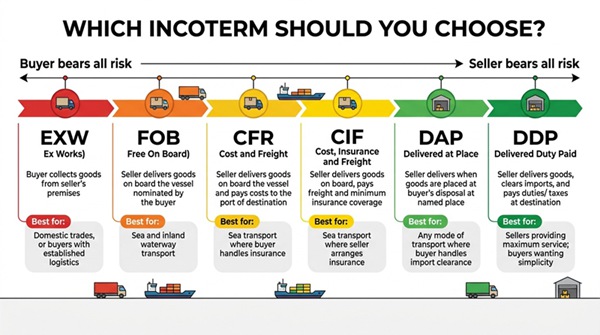
How to Choose the Right Incoterm: A Decision Framework
This isn’t complicated once you know what questions to ask:
Step 1: How experienced are you with China importing?
– First order, no forwarder relationship → Start with CIF for simplicity, but specify ICC (A) insurance in writing
– 1–3 years, have a forwarder → Use FOB. Standard, transparent, you control freight
– 3+ years, established operations → FOB or FCA depending on shipment mode
Step 2: What’s your shipment size and value?
– Under $10,000 or sample orders → CIF or DDP acceptable
– $10,000–$100,000 → FOB strongly recommended
– Over $100,000 → FOB minimum; consider FCA if using L/C
Step 3: What mode of transport?
– Ocean FCL or LCL → FOB is the standard choice
– Air freight → FCA (technically correct; FOB doesn’t apply to air)
– Express courier (DHL, FedEx) → DAP or DDP as specified by courier terms
Step 4: Do you have a China-based freight forwarder?
– Yes → FOB or FCA give you maximum control
– No → CIF removes the freight-selection burden, but at the cost of insurance control
Step 5: Are you using a Letter of Credit?
– Yes → FCA (updated in Incoterms 2020 to support on-board B/L requirements under L/C)
– No → FOB works fine
For most importers ordering FCL ocean freight with an order value above $30,000: FOB is your answer. It gives you export customs handled by the seller, full control over freight and insurance, and transparent cost visibility. Learn to use it well and you’ll use it for most of your career.
The Incoterms Clause Checklist: Get This Right in Your Contract
Specifying the Incoterm alone isn’t enough. Your purchase order or sales contract should include:
- The full term and version: “FOB Shanghai, Incoterms® 2020” — not just “FOB”
- Named place or port: Exact port or location (e.g., “FOB Port of Shenzhen, Incoterms® 2020”)
- Insurance specification (for CIF): “Insurance to be placed under Institute Cargo Clauses (A), with [named insurer], policy to be provided to buyer prior to vessel departure”
- Carrier nomination (for FOB): Specify your freight forwarder and confirm the supplier will book with them, not a factory-preferred carrier
- Customs agent (for EXW): Name your licensed China customs broker
For a full template of purchase order contract clauses, our China sourcing agent guide includes a downloadable PO checklist that covers Incoterm specifications alongside payment terms and quality requirements.
Common Mistakes China Importers Make with Incoterms
Mistake 1: Accepting “CIF” without specifying insurance clauses
As covered above, ICC (C) coverage is near-useless for most cargo types. Always specify ICC (A) in writing.
Mistake 2: Using EXW without a China forwarder
You need a licensed entity in China to handle export declarations. Without one, you’re either operating illegally or relying on the seller to act as your undocumented agent.
Mistake 3: Not specifying the port or place
“FOB China” is not a valid Incoterm. “FOB Port of Ningbo, Incoterms® 2020” is. The named place matters for insurance claims, dispute resolution, and cost allocation.
Mistake 4: Confusing the freight payment point with the risk transfer point
Under CFR and CIF, the seller pays freight but risk transfers at origin. Many buyers assume they’re covered during the ocean leg because the seller “arranged” the shipment. They’re not.
Mistake 5: Accepting DDP without understanding customs compliance implications
If your goods are being cleared through gray channels, you’re the one facing penalties — not the factory.
If you’re planning your first import from China, our guide on how to import from China covers the full process including forwarder selection, customs bonds, and duty calculation — the practical context you need before these Incoterm choices become real.
Pre-Shipment Inspection and Incoterms
One area where Incoterm selection directly affects inspection logistics is pre-shipment quality control. Under EXW and FCA, you (as the buyer) arrange inspection before the seller hands goods to the carrier — which is logistically straightforward since the goods are still at the factory. Under FOB and CIF, goods are typically inspected before loading at the Chinese port.
The key point: regardless of your Incoterm, inspection should happen before risk transfers to you. For FOB, that means completing your pre-shipment inspection in China before goods are loaded onto the vessel. After that point, the cargo is your risk — and any defects discovered at the destination port are much harder (and more expensive) to remediate.
FOB vs. CIF: A Side-by-Side Breakdown
| Factor | FOB | CIF |
|---|---|---|
| Export customs | Seller | Seller |
| Ocean freight control | Buyer | Seller |
| Freight rate visibility | Full | Hidden in price |
| Insurance control | Buyer | Seller |
| Insurance coverage | Buyer specifies | ICC (C) minimum only |
| Risk transfer point | On board at origin port | On board at origin port |
| Best for | Most importers $30k+ | Small/sample orders |
| Supplier gaming risk | Low | Higher (freight markups) |
The risk transfer point is identical for FOB and CIF. The difference is who pays for freight and insurance — and therefore who controls both.
Ready to Source from China Without the Guesswork?
Getting your Incoterms right is one piece of the puzzle — but there are dozens of other variables that determine whether a China sourcing project succeeds or fails. Supplier verification, quality control, payment terms, logistics timing — each one carries risk if handled without experience.
If you’d like professional support navigating a sourcing project, our team works with importers across the full procurement cycle, from supplier identification through final delivery. Contact us to discuss your specific needs.
Last updated: August 2025. Incoterms® is a registered trademark of the International Chamber of Commerce. All terms referenced are from Incoterms® 2020.